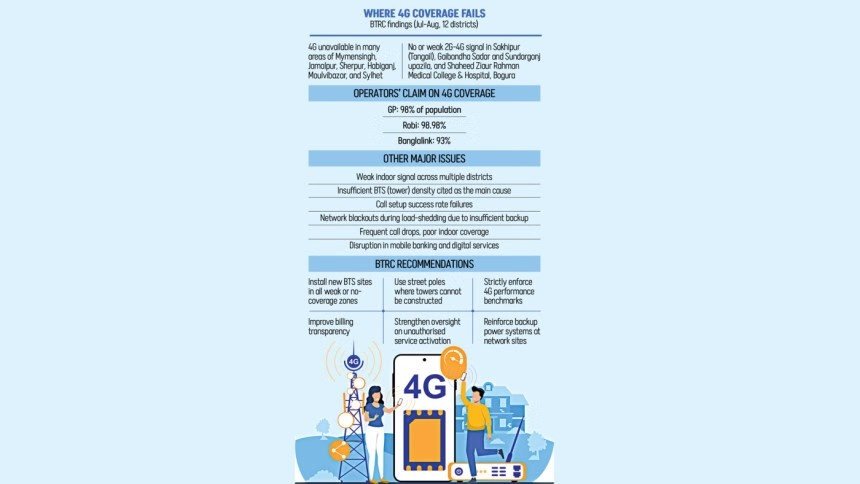








A fresh BTRC inspection has revealed a significant mismatch between mobile operators’ claims of near-universal 4G population coverage and the actual experience of users across Bangladesh. Despite public reports of 93–99 percent 4G reach, inspectors found widespread dead zones, weak signals, poor indoor coverage, and service disruptions in both rural and urban locations.
Four inspection teams visited multiple districts—including Tangail, Bogura, Gaibandha, Habiganj, Moulvibazar, Sylhet, Cumilla, Noakhali, Chattogram, Mymensingh, Jamalpur, and Sherpur—using advanced tools to measure real service quality. They discovered that 4G networks were unavailable in many areas, with several locations also suffering from weak 2G signals, frequent call drops, blurred video calls, and complete outages during load-shedding.
The BTRC report says operators failed to meet regulatory benchmarks in several districts, violating service guidelines and previous rollout directives. Challenges such as limited Base Transceiver Stations (BTS), hilly terrain, tower siting difficulties, and costly low-band spectrum have further affected coverage and quality.
The inspection also flagged unauthorised balance deductions due to faulty Pay-As-You-Go processes and issues with e-SIM services. To improve service reliability, BTRC recommended more BTS deployments, stricter enforcement of 4G rollout obligations, closer oversight of billing, and a joint monitoring cell between operators and regulators.
Operators defended their performance—Robi stating that obligations were met based on technical validation, while Banglalink noted that more low-band spectrum and easier tower approvals are needed to ensure consistent coverage nationwide.
Bangladesh regulator finds major gaps between operators’ 4G coverage claims and real-world network performance