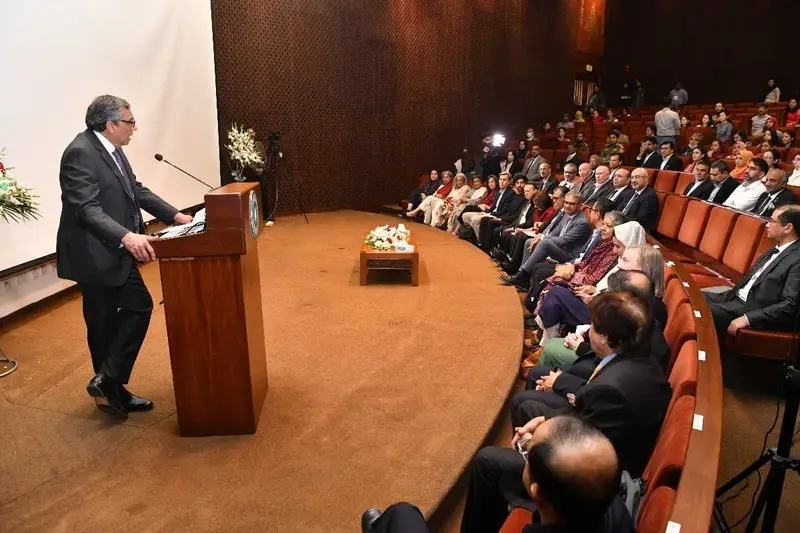









Karachi, November 28, 2025 —The Aga Khan University’s (AKU) Institute for Global Health and Development (IGHD)brought together Pakistan’s leading architects, planners, public health experts,development specialists, and government representatives to address one of the country’smost pressing national challenges: how to redesign homes, neighbourhoods, and publicsystems to withstand intensifying climate pressures in both urban and rural settings.The dialogue unfolded at IGHD’s Annual Conference on Climate Change and the BuiltEnvironment, hosted in partnership with Sustainable Development Solutions Network(SDSN) Pakistan, under the leadership of Professor Zulfiqar A. Bhutta, Founding Director ofIGHD. This year’s theme, “Climate Change and the Built Environment: Promoting Resilience& Adaptation in Low-Income Settings,” set the stage for a day focused on evidence,solutions and innovative approaches.Underscoring the gravity of the issues being addressed at the conference, His Highness theAga Khan, in a statement read at the event, emphasized that, “Climate change is one of thegreatest threat multipliers of our era. Its impacts intensify disease, malnutrition,displacement, learning loss, and poverty. These burdens fall disproportionately uponwomen, children, older adults, and marginalized communities. Addressing them is notoptional; it is imperative for equity, stability, and sustainable development.” His Highnessfurther stressed that, “Progress in addressing climate change will depend on partnership,”and welcomed many of collaborators attending from across Pakistan, Europe, NorthAmerica, and Southeast Asia.The inaugural session welcomed Chief Guest His Excellency Tariq Khan, HighCommissioner of Canada to Pakistan, followed by a Special Message from HonourableMinister Professor Ahsan Iqbal, Federal Minister for Planning, Development and SpecialInitiatives, Government of Pakistan, who joined the conference virtually.“Canada is helping countries like Pakistan confront climate-driven vulnerabilities,” said HisExcellency Tariq Khan. “The ideas shared at this conference can help shape a moresustainable future for millions of people.”Delivering a special message via Zoom, Honourable Minister Professor Ahsan Iqbalhighlighted the national urgency for climate adaptation. “Pakistan’s future will depend onhow boldly we reimagine our cities, homes, and public institutions in the face of climatechange. Building resilience is not optional — it is a national development priority.
Conferences like this help translate research into policies that enable safer, more inclusive,and climate-adaptive environments for all Pakistanis.”The conference’s opening day featured keynote presentations by Professor Sajida HaiderVandal (THAAP), Christopher Burman and Joseph Augustine (UCL), and Dr Zahra Hussain(Laajverd), showcasing climate-smart architecture, indigenous design approaches, andcommunity-led adaptation innovations.“Pakistan’s future will depend on how boldly we reimagine our cities, homes, and publicinstitutions in the face of climate change,” said Chief Guest Professor Ahsan Iqbal,underscoring the national urgency for climate action. “Building resilience is not optional —it is a national development priority. Conferences like this help translate research intopolicies that enable safer, more inclusive, and climate-adaptive environments for allPakistanis.”Addressing the audience, Dr Sulaiman Shahabuddin, President of AKU, reaffirmed theUniversity’s commitment to advancing climate resilience, saying, “Climate change isreshaping every aspect of life in Pakistan. Our responsibility as a university is to help thecountry design smarter, safer, more resilient environments. AKU is committed to generatingevidence, solutions, and partnerships that support climate adaptation at scale.”The inaugural session concluded with reflections outlining a pathway for the remainder ofthe conference, which will explore rural adaptation models, climate-resilient healthsystems, indigenous solutions, community-led innovations, and a high-level nationalpolicy panel
Pakistan’s Leaders Unite to Reimagine Climate-Resilient Cities and Communities atIGHD Annual Conference 2025