








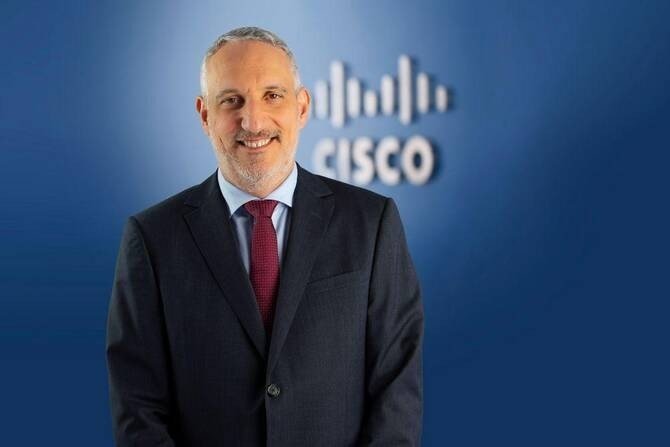
Cisco is deepening its role in supporting Saudi Arabia’s transition toward an AI-driven, cloud-first future by investing in local infrastructure, AI-ready data centers, and long-term skills development. According to Fady Younes, Managing Director for Cybersecurity at Cisco across the Middle East, Africa, Türkiye, Romania, and CIS, Saudi Arabia is adopting artificial intelligence faster than the global average, creating both significant opportunities and new security risks.
Younes noted that while AI adoption is accelerating efficiency and innovation, it also expands attack surfaces and introduces challenges such as shadow AI, identity-based threats, and fragmented security environments. As a result, Cisco is emphasizing the need to embed security into AI and digital initiatives from the earliest stages.
A central pillar of Cisco’s strategy is localized infrastructure. The company has established fully operational data centers in Saudi Arabia to deliver cloud-based security services and Webex, with plans underway to launch a dedicated Meraki cloud region. Local deployment supports data sovereignty, strengthens regulatory compliance, and reduces latency, enabling faster AI-driven threat detection and response.
Cisco is also partnering with AMD and HUMAIN, a Public Investment Fund-backed company, on a joint initiative launching in 2026 to develop up to 1 gigawatt of AI capacity by 2030. The project combines advanced data centers with Cisco and AMD technologies to deliver cost-efficient, scalable AI infrastructure aligned with the Kingdom’s long-term ambitions.
To meet growing demand for AI workloads, Cisco is modernizing traditional data center environments into unified, high-performance platforms. These include Secure AI Factory architectures with scalable AI PODs, private and hybrid cloud models, GPU-optimized compute powered by low-latency Silicon One networking, and unified management through platforms such as Intersight and Nexus Dashboard. Strategic partnerships with companies like NVIDIA further support large-scale AI deployment.
On cybersecurity, Younes said AI now underpins how threats are detected, analyzed, and contained. Cisco applies AI across its security stack to correlate signals across networks, endpoints, identities, and cloud workloads, automating responses at machine speed. Platforms such as Cisco AI Defense protect AI models and applications, while identity-focused security tools safeguard authentication and access across hybrid environments through zero-trust architectures.
Beyond infrastructure and security, Cisco is investing heavily in talent development. More than 480,000 learners in Saudi Arabia have already been trained through the Cisco Networking Academy, with women representing 36 percent of participants. The company has also committed to providing free digital upskilling to 500,000 learners over the next five years in AI, cybersecurity, data science, and programming.
Cisco is expanding its focus on AI-security literacy and research through partnerships with universities and institutions, including the launch of a new AI Institute with King Abdullah University of Science and Technology. The institute will focus on applied research in AI-native communications, edge infrastructure for Industry 5.0, and AI applications in critical sectors such as water, energy, food, and healthcare.
Looking ahead, Younes said Saudi organizations will increasingly need to secure AI systems themselves, not just data, as attackers use AI to scale cyber operations. Integrated, zero-trust, AI-aware security architectures and a skilled local workforce will be essential to sustaining innovation at scale.