








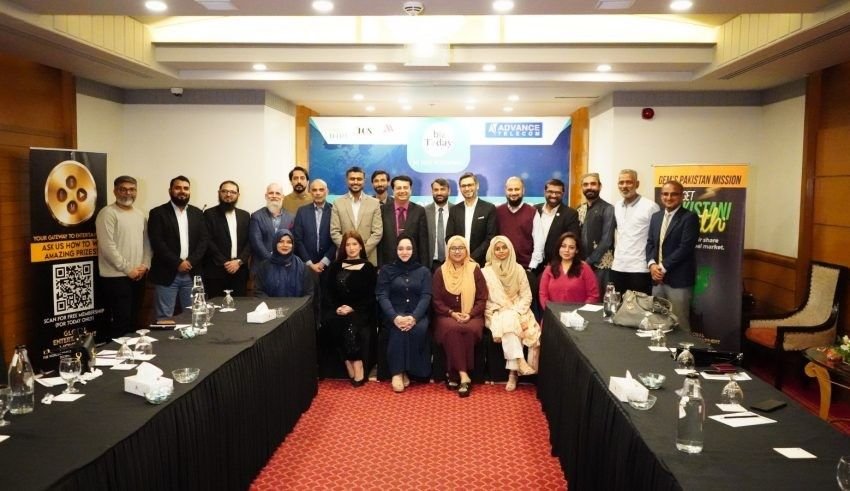
Pakistan’s telecom sector and its role in shaping the country’s digital and investment future took center stage at Telecom Roundtable 2025, held on December 23 at the Karachi Marriott Hotel. Organized by Biz Today International and hosted by the TCN Executive Forum powered by Advance Telecom, the event brought together senior industry leaders to discuss “Shaping the Future of Pakistan’s Telecom Ecosystem.”
Moderated by Dr. Imran Batada, Director ICT at the Institute of Business Management (IoBM), the discussion focused on connectivity stability, regulatory coherence, and the growing dependence of national sectors on resilient digital infrastructure.
The panel featured Jamal Ali Khan, Chief Growth Officer at eocean; Mohsin Kamal, Former Director South at Jazz; and Khurram Saif, Group CTO at Dr. Ziauddin Group. Drawing on experience across telecom, enterprise services, and digital transformation, the speakers emphasized that reliable connectivity is now a foundational requirement for national development rather than a competitive advantage.
Using healthcare as an analogy, panelists noted that digital solutions lose credibility if they only work for a limited segment of users. The same applies to connectivity, particularly as education systems increasingly rely on Learning Management Systems, online assessments, and digital examinations. International examination frameworks were cited as benchmarks where uninterrupted connectivity is essential to trust and transparency.
Regulatory complexity emerged as a central concern. Panelists highlighted how overlapping authorities, inconsistent policies, and procedural uncertainty continue to deter long-term investment. Recent developments such as Telenor’s exit from Pakistan were described as a moment for reflection, underscoring the need for regulatory clarity and balanced oversight to preserve competition while enabling consolidation where appropriate.
Despite these challenges, the discussion reflected optimism about Pakistan’s growth potential, particularly in broadband expansion, fiber deployment, and enterprise digital services. Speakers stressed that with the right policy environment, telecom can serve as a backbone for digital governance, financial inclusion, and broader economic growth.
Emerging technologies, including satellite-based internet services, were viewed as complementary rather than disruptive. Panelists advocated a collaborative model where satellite, fiber, and wireless networks work together to extend coverage to remote and underserved regions.
On 5G, the consensus was clear: progress should be measured not just by speed, but by service quality, affordability, stability, and ecosystem readiness.
The panel also highlighted a shift in workforce dynamics, noting that Pakistan’s youth are increasingly drawn toward freelancing, startups, and digital entrepreneurship. This trend was seen as a significant opportunity to grow digital exports and strengthen foreign exchange inflows.
Institutions such as NADRA were cited as strategic assets that can enable digital identity-based services, fintech innovation, and API-driven governance, provided existing infrastructure is leveraged effectively.
Concluding the session, speakers agreed that Pakistan’s telecom future depends on closer collaboration between regulators, operators, academia, and the private sector. A unified, long-term digital vision, they said, is essential to convert connectivity into sustainable economic value and global competitivenes