






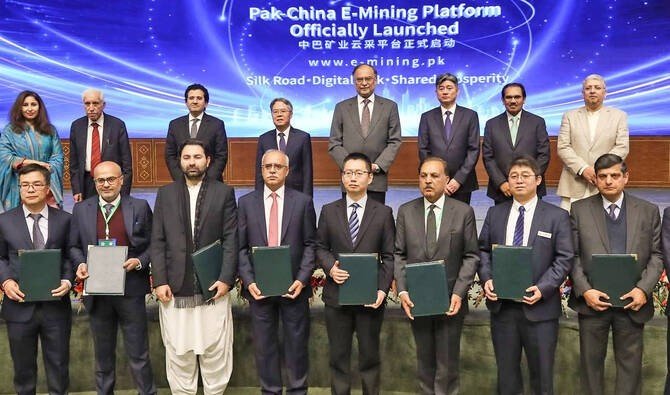
Pakistan and China have launched a joint digital “Pak–China e-mining platform” and signed multiple cooperation memorandums to deepen collaboration in the minerals sector, as Islamabad moves to attract foreign investment and integrate into global critical-minerals supply chains.
The announcement was made at the Pak–China Mineral Cooperation Forum in Islamabad, where officials emphasized a shift from raw mineral extraction toward value-added mining, processing, and export-oriented development. Chinese companies explored opportunities across Pakistan’s mineral value chain amid easing regulatory and coordination bottlenecks.
Pakistan holds substantial reserves of copper, gold, coal, and other critical minerals, though development has long been constrained by regulatory uncertainty, infrastructure gaps, and limited downstream capacity. The government views mining as a key driver of long-term growth and foreign exchange earnings, particularly as global demand rises due to the energy transition.
A central focus of the strategy is the Reko Diq copper-and-gold project in Balochistan, one of the world’s largest undeveloped copper deposits, which authorities see as a test case for restoring investor confidence and attracting large-scale capital.
According to Pakistan’s information ministry, the new digital e-mining platform is designed to improve transparency, information sharing, project connectivity, and cooperation between Pakistani institutions and Chinese enterprises. Several MoUs were signed, including frameworks for digital cross-border industrial trade and joint mineral development involving PMDC, POWERCHINA International, and Pak China Investment Company.
The forum attracted more than 70 Chinese companies, over 100 Pakistani firms, and around 800 participants, highlighting growing investor interest as regulatory frameworks improve. Chinese Ambassador Jiang Zaidong reaffirmed Beijing’s interest in expanding mining investment, technology transfer, workforce training, and sustainable practices, citing long-running projects such as Saindak as models of cooperation.