









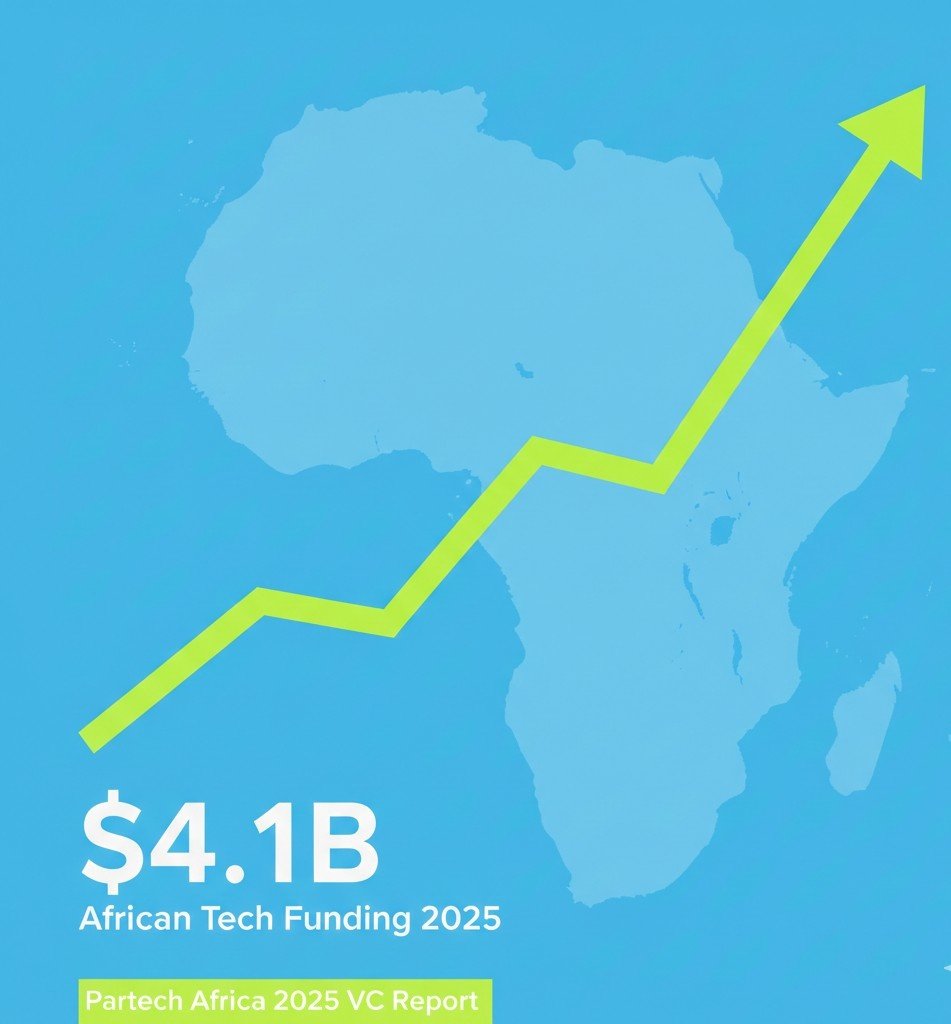
After two challenging years, African tech funding has regained momentum. According to Partech Africa’s 2025 Africa Tech VC Report, startups across the continent raised $4.1 billion in 2025, marking a 25% increase from $3.25 billion in 2024 and the strongest performance since 2022.
But beneath the headline figure lies a deeper structural shift.
Debt, Not Euphoria, Is Driving the Surge
Equity funding grew modestly by 8% year-on-year to $2.4 billion across 462 deals, with deal count largely flat. The real acceleration came from debt financing.
African startups secured a record $1.64 billion in debt funding in 2025, a 63% increase year-on-year. Debt accounted for 41% of total capital deployed, up from just 17% in 2019. This signals maturity rather than exuberance. Startups are increasingly leveraging structured capital to scale revenue-generating operations, particularly in fintech and asset-heavy models.
The funding rebound is not a return to the speculative boom of 2021. It reflects a more disciplined ecosystem.
Capital Remains Concentrated in Four Markets
Kenya, South Africa, Egypt and Nigeria collectively attracted 72% of total funding and 68% of all deals in 2025.
Kenya led with $1.04 billion in funding, up 72% year-on-year, largely driven by debt-heavy megadeals. Four large transactions alone accounted for approximately 60% of its total capital raised.
South Africa topped the continent in equity funding at $643 million, growing 41% year-on-year. Importantly, its performance was broad-based rather than driven by a single outlier deal.
Egypt maintained deal density with 100 transactions and rising ticket sizes, reinforcing its role as one of Africa’s most active venture markets.
Nigeria recorded a 21% decline in equity funding and a 19% drop in deal count, reflecting normalization after the megadeal surge of 2021 rather than systemic contraction.
Fintech Still Leads, But the Ecosystem Is Diversifying
Fintech remained the largest sector with $1.49 billion across 150 deals, though its share of total equity funding dropped from 60% to 32%. This indicates diversification rather than decline.
Cleantech nearly doubled to $1.18 billion, while Enterprise software, E-commerce and Healthtech each crossed $200 million in annual equity funding for the first time since the 2021-2022 peak. Growth in these sectors during a normalized market suggests improving fundamentals and stronger investor conviction.
The Quiet Risk: A Shrinking Seed Pipeline
Seed deal count fell 1% year-on-year to 311 rounds and is down 38% from its 2022 peak. Seed capital declined to $462 million. Conversion rates to Series A remain low, raising concerns about the future growth pipeline.
Fewer early-stage startups today could translate into reduced late-stage deal flow by 2027 and 2028.
AI Is Embedded, Not Branded
Artificial intelligence is present across fintech, healthtech, logistics and enterprise startups, yet rarely categorized separately in funding data. AI in Africa is being integrated into sectoral models rather than funded as a standalone hype category.
The Bottom Line
African tech funding in 2025 represents measured recovery. Equity markets are stabilizing. Debt financing has become structural. Sector diversification is underway. Yet the early-stage ecosystem remains fragile.
The rebound is real. The next chapter depends on rebuilding the seed pipeline that will power Africa’s next generation of growth-stage champions.