








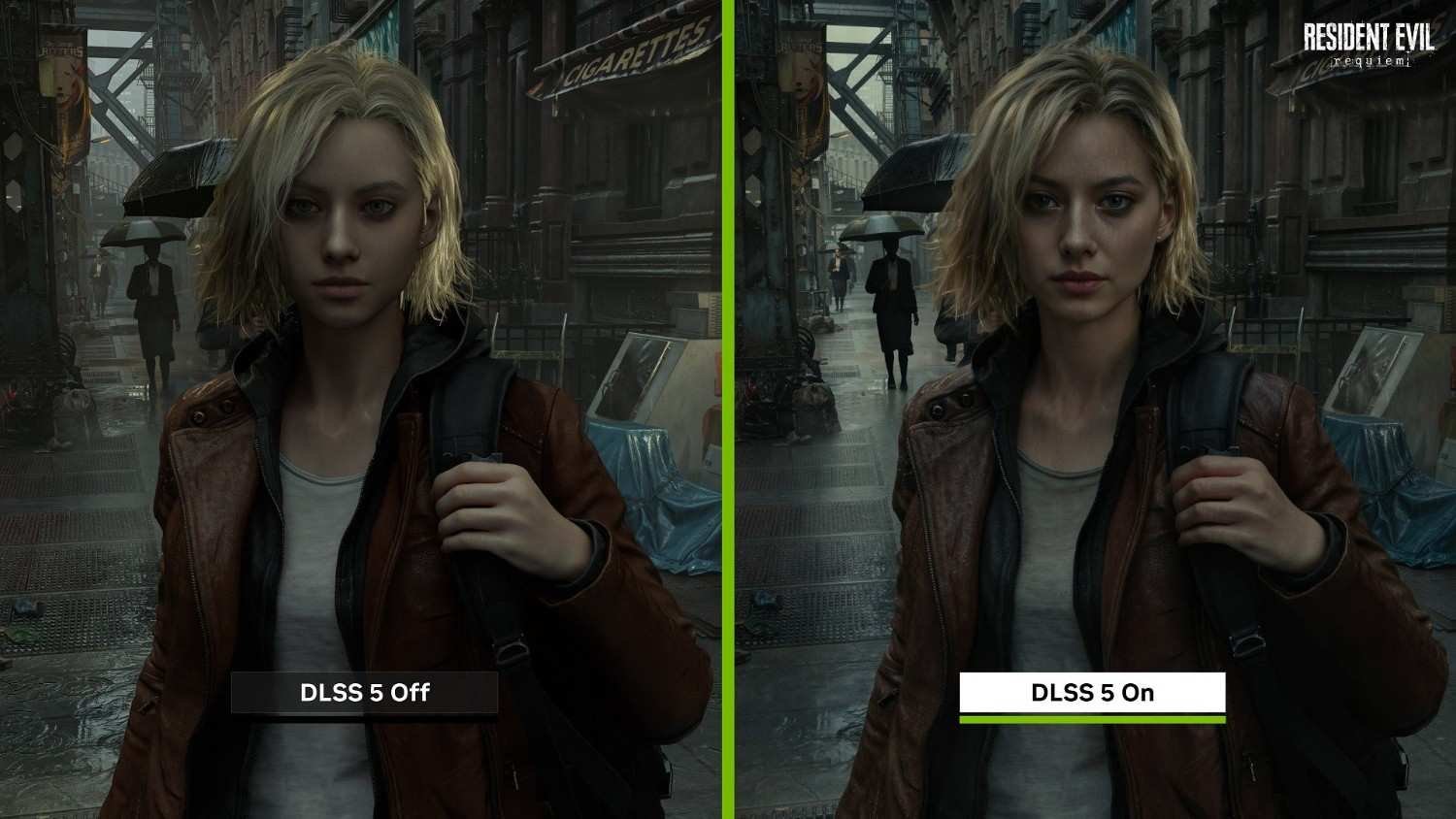
NVIDIA has announced DLSS 5 at its GTC conference, introducing what the company describes as one of the most significant advances in computer graphics since the debut of real-time ray tracing in 2018. The new technology, scheduled to arrive in fall 2026, brings a real-time neural rendering model designed to dramatically improve visual realism in video games.
DLSS 5 introduces AI-driven neural rendering capable of infusing scenes with photorealistic lighting and materials. By bridging the gap between traditional rendering techniques and real-world visual fidelity, the technology enables game developers to create highly immersive environments that approach the quality previously seen mainly in Hollywood visual effects.
First launched in 2018, NVIDIA’s Deep Learning Super Sampling (DLSS) technology initially focused on boosting game performance by upscaling resolution. Over time, it evolved to generate entirely new frames using AI, helping deliver smoother gameplay without requiring additional rendering power. DLSS has since been integrated into more than 750 games, becoming one of the most widely adopted technologies in modern PC gaming. Earlier this year at CES, NVIDIA introduced DLSS 4.5, which uses artificial intelligence to generate the vast majority of pixels seen on screen.
With DLSS 5, the technology moves beyond performance enhancement toward improving visual fidelity. The system takes a game’s colour and motion vectors from each frame as input and applies an AI model that enhances scenes with photoreal lighting and materials. These enhancements remain anchored to the original 3D content and maintain visual consistency from frame to frame. The technology operates in real time at resolutions of up to 4K while maintaining smooth, interactive gameplay.
DLSS 5 will be supported by major game publishers and development studios including Bethesda, CAPCOM, Hotta Studio, NetEase, NCSOFT, S-GAME, Tencent, Ubisoft and Warner Bros. Games. Several upcoming titles are expected to incorporate the technology, including AION 2, Assassin’s Creed Shadows, Black State, CINDER CITY, Delta Force, Hogwarts Legacy, Justice, NARAKA: BLADEPOINT, NTE: Neverness to Everness, Phantom Blade Zero, Resident Evil Requiem, Sea of Remnants, Starfield, The Elder Scrolls IV: Oblivion Remastered and Where Winds Meet.
NVIDIA founder and CEO Jensen Huang said the company is once again redefining computer graphics technology. He described DLSS 5 as a major milestone that blends handcrafted rendering techniques with generative AI to deliver significant improvements in realism while preserving artistic control for game developers.
Todd Howard, studio head and executive producer at Bethesda Game Studios, said DLSS 5 brought a new level of visual life to Starfield when the studio tested the technology. He noted the long-standing collaboration between Bethesda and NVIDIA in pushing graphical innovation.
Jun Takeuchi, executive producer and executive corporate officer at CAPCOM, said the technology supports the company’s ambition to create cinematic and believable gaming experiences where lighting, textures and shadows contribute to a more immersive atmosphere.
Charlie Guillemot, co-CEO of Vantage Studios, added that DLSS 5 significantly improves immersion by enhancing how lighting, materials and characters are rendered, enabling developers to build more realistic game worlds.
The new technology is expected to play a key role in shaping the next generation of computer graphics, combining AI-driven rendering techniques with traditional graphics pipelines to deliver highly detailed, photorealistic interactive experiences.