








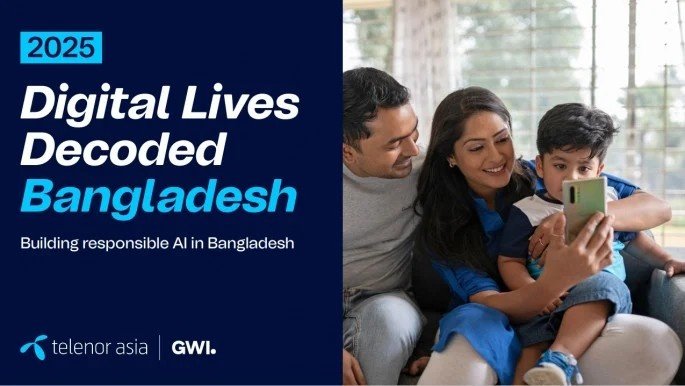
Mobile technology is rapidly accelerating artificial intelligence adoption in Bangladesh, with 96 percent of internet users now using AI regularly, up from 88 percent in 2024, according to Telenor Asia’s latest report, Digital Lives Decoded 2025: Building Trust in Bangladesh’s AI Future. The fourth edition of the study is based on a survey of 1,000 internet users across the country and highlights how AI is becoming deeply embedded in everyday life, while also stressing the importance of responsible, ethical, and secure adoption.
Mobile phones have become central to Bangladesh’s digital transformation, enabling online learning, financial services, information access, and daily task management. Over the past year, mobile usage grew most strongly in remote work, which increased by 39 percent, and budgeting and expense tracking, which rose by 36 percent. Currently, mobile technology supports online learning for 62 percent of users, remote work for 54 percent, and financial management for 50 percent.
Nearly six in ten respondents now use AI on a daily basis, primarily for content creation, personalised advice, and practical assistance in everyday tasks. Trust in AI-generated educational content and chatbots remains high, reinforcing widespread optimism about AI’s role in education and Bangladesh’s broader economic future. Millennials are leading adoption in areas such as smart home applications, health tracking, and voice assistants, reflecting the growing normalisation of everyday AI usage.
AI adoption in the workplace also saw a major increase, rising from 44 percent in 2024 to 62 percent in 2025. However, only half of surveyed employees say their organisations have a formal AI strategy in place. While writing and content creation are the most common professional use cases, only 28 percent currently use AI for automating routine or administrative tasks, pointing to substantial untapped potential.
Despite their high usage, younger generations also express the strongest concerns about over-reliance on AI, job security, and privacy. This dual mindset of optimism and caution highlights growing demand for innovation that is supported by strong safeguards.
Commenting on the findings, Jon Omund Revhaug, Head of Telenor Asia, said that mobile phones are transforming daily life and enabling smarter, more connected communities. He added that telecom operators now carry a unique responsibility to build secure digital infrastructure that underpins trustworthy AI. He stressed that while optimism around AI’s potential is strong, digital inclusion, connectivity, and digital skills remain critical to ensuring no one is left behind in the country’s AI-driven future.