









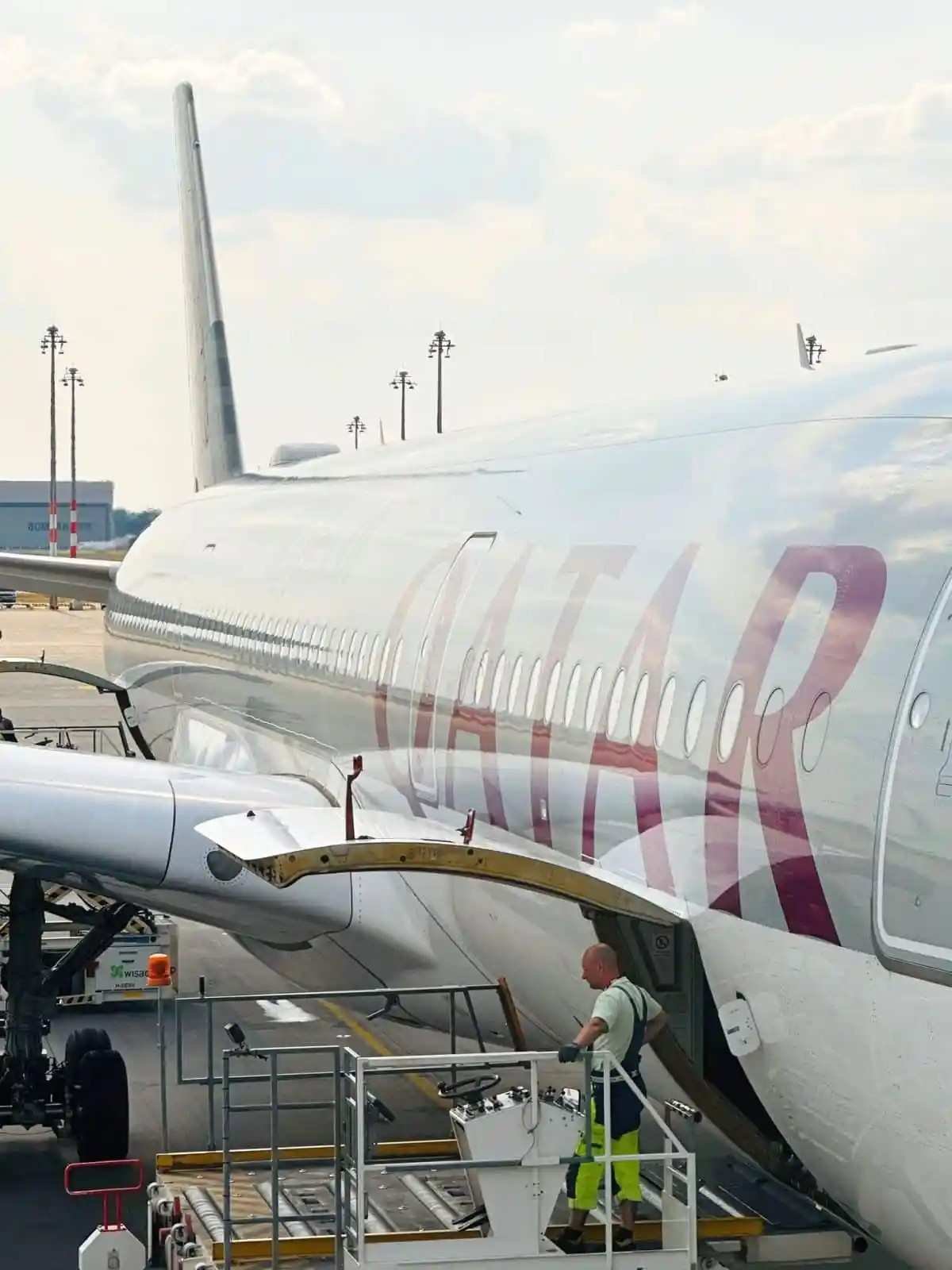
Global air travel has entered a new phase of digital transformation as Qatar Airways announced the completion of one of the most ambitious connectivity upgrades in aviation history. In January 2026, the airline confirmed that its entire Airbus A350 fleet is now equipped with Starlink satellite technology, following a record installation period of just eight months.
In parallel, Qatar Airways achieved a global milestone by becoming the first airline certified to install Starlink on the Boeing 787-8. Three aircraft are already in active service, bringing the airline’s connected widebody fleet to nearly 120 aircraft. This represents more than 58 percent of its long-haul inventory.
Since the program began in October 2024, over 11 million passengers have used the service. The airline now offers free high-speed internet across much of its fleet, with speeds reaching up to 500 Mbps, surpassing the performance of many terrestrial broadband connections.
Strategic alliance with SpaceX and operational milestones
The partnership with Starlink, a business unit of SpaceX, marks a structural shift in in-flight connectivity. Unlike traditional satellite systems characterized by high latency and limited bandwidth, Starlink’s low Earth orbit (LEO) architecture enables near real-time communication.
This allows passengers on long-haul and ultra-long-haul routes to use data-intensive applications such as 4K streaming, online gaming, and high-resolution video conferencing without interruption.
The speed of deployment is unprecedented. Installation programs for the Boeing 777 and Airbus A350 were completed within 14 months. Qatar Airways’ early adoption on the A350 reflects its pioneering role as the aircraft’s launch customer. Certification on the Boeing 787-8 closes a critical gap and reinforces the airline’s ambition to operate the world’s largest Starlink-equipped widebody fleet.
Transforming operations through real-time data
Beyond passenger experience, the technology is reshaping airline operations. Continuous broadband connectivity allows flight updates, duty rosters, and operational changes to be transmitted instantly to crew devices, even over oceans and remote regions.
In medical situations, cabin crew can now connect with ground-based medical teams via real-time video, enabling faster and more accurate decision-making. Engineers can monitor onboard systems during flight, allowing maintenance teams to prepare repairs before landing, reducing turnaround time and improving punctuality.
Market leadership in connected aviation
In 2025, around 21 million passengers worldwide accessed Starlink in-flight connectivity. Nearly half of them flew with Qatar Airways, highlighting the airline’s scale of deployment.
The service is offered free, gate-to-gate, subject to local regulations. It spans six continents and is particularly valued on ultra-long-haul routes to North America and Australia, where flight times often exceed 15 hours.
Technical foundation
Starlink’s antennas must track fast-moving LEO satellites while aircraft travel at cruising speeds near 900 km/h. The system operates at an altitude of roughly 550 kilometers, compared to 35,000 kilometers for geostationary satellites.
This proximity reduces latency from over 600 milliseconds to below 50 milliseconds, enabling real-time productivity, streaming, and communication.
Competitive positioning in MENA
Qatar Airways is the first carrier in the Middle East and North Africa to deploy this technology at scale. While competitors remain in pilot phases or offer paid, bandwidth-limited services, Qatar Airways has adopted a fully integrated, free high-speed model.
The airline plans to continue equipping the remainder of its fleet, effectively transforming aircraft into connected digital environments. The strategy aims to make in-flight work and entertainment indistinguishable from ground-based experiences, reinforcing Qatar Airways’ position as a global aviation leader.