








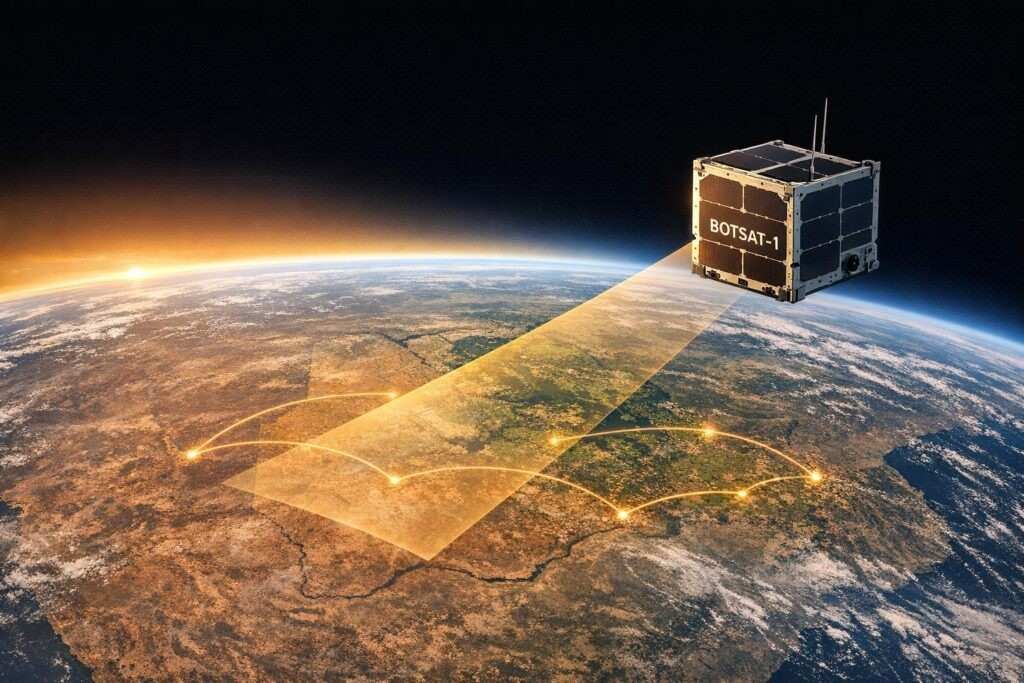
Botswana made history on March 15, 2025, with the launch of its first satellite, BOTSAT-1, aboard a SpaceX Falcon 9 rocket. The milestone places Botswana among 16 African nations with active space capabilities and marks a decisive step toward strengthening national development, security, and technological sovereignty.
Developed over four years by engineers at Botswana International University of Science and Technology (BIUST) in partnership with EnduroSat and Dragonfly Aerospace, the $2.19 million mission is designed to serve agriculture, environmental monitoring, disaster response, and border security. BOTSAT-1 is a 3U software-defined CubeSat equipped with the Mantis Hyperspectral Imager, capable of capturing detailed spectral data across visible and near-infrared bands.
Orbiting in a sun-synchronous path at 500–600 km, the satellite passes over Botswana six times daily, delivering imagery at 12–32 meter resolution across a 32-kilometer swath. Data is transmitted directly to a dedicated ground station at BIUST in Palapye, enabling real-time use by policymakers, researchers, and emergency services.
Beyond environmental insights, BOTSAT-1 strengthens national security by supporting border monitoring, detecting illegal mining, and tracking wildlife trafficking. Its hyperspectral capability can identify disturbed terrain and unique material signatures, making it a powerful tool against resource theft and smuggling.
The satellite also plays a strategic role in Botswana’s digital ambitions. While BOTSAT-1 does not provide internet connectivity itself, its data helps identify underserved regions and guide infrastructure planning. This groundwork supports the upcoming BOTSAT-2 mission, which aims to directly enhance rural connectivity and close the digital divide.
Equally significant is the human capital impact. Botswana engineers trained in Bulgaria during assembly, integration, and testing, and BIUST now hosts a clean-room facility for future satellite builds. The program has already launched new academic tracks in space engineering and positioned Botswana to assemble future satellites domestically.
With Africa’s space economy projected to reach $22 billion by 2026, Botswana is entering a rapidly expanding sector. The country now joins 11 African nations operating Earth-observation satellites and contributes to a continental fleet of more than 65 spacecraft.
BOTSAT-1 signals more than technological progress. It reflects a strategic shift toward economic diversification, data sovereignty, and long-term resilience—establishing Botswana as an emerging space nation with regional influence and global relevance.