









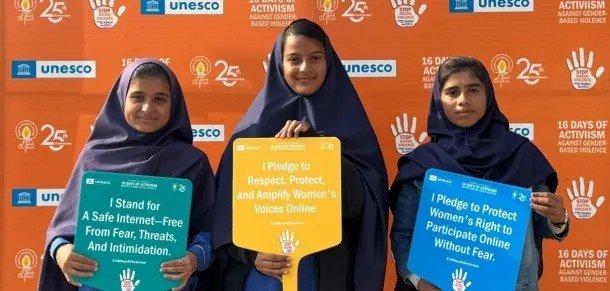
The fight for gender equality in 2025 has expanded into a new and complex battlefield: the digital world. For UNESCO’s Islamabad office, commemorating the 16 Days of Activism against Gender-Based Violence became a multi-platform mission to transform “unseen” online threats into visible action. By combining high-level advocacy, artistic expression, and youth empowerment, UNESCO Pakistan moved beyond awareness to build a practical “survival framework” for the next generation.
The campaign launched at the Pakistan National Council of Arts in Islamabad, chaired by Federal Minister for Human Rights Senator Azam Nazeer Tarar, where the message was unequivocal: digital violence is a global crisis demanding local legislative action. The event highlighted that nearly half of the world’s women lack legal protection from online abuse.
To humanise the issue, UNESCO joined ten UN agencies for the “Seen & Unseen” art exhibition. Guided by Honorary Advisor Prof. Salima Hashmi, Pakistani artists transformed canvases into powerful narratives of surveillance, harassment, and resilience, bridging the gap between data and lived experience.
Recognising that technology is often used to silence women’s voices, UNESCO partnered with Media Matters for Democracy through the UNESCO-IPDC-supported project “Towards Internet Universality: Promoting Meaningful Gender Inclusion.” Grounded in UNESCO’s ROAM-X principles and aligned with the Pakistan Telecommunication Authority’s Digital Gender Inclusion Strategy, the initiative exposed real examples of technology-facilitated gender-based violence.
By spotlighting harmful comments on women’s public and private profiles, the campaign revealed how hostile digital spaces have become, while also guiding users toward practical pathways for digital safety and literacy. The message was clear: online abuse is not invisible, and silence is no longer an option.


