







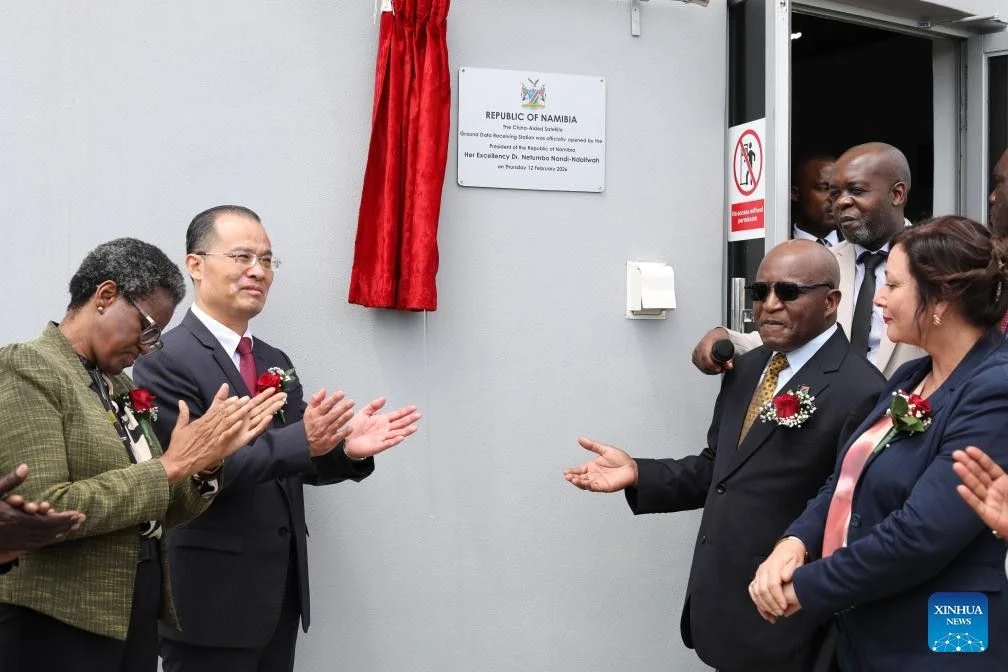
Namibia has officially received a China-aided Satellite Ground Data Receiving Station, marking a significant step forward in the country’s space science capabilities, disaster management readiness, and innovation-led development agenda.
The facility, located at the Telecom Earth Station outside Windhoek, enables Namibia to directly receive and process remote-sensing data from satellites, including the China-Brazil Earth Resources Satellite (CBERS-4). The new capability is expected to strengthen data-driven decision-making across sectors such as environmental monitoring, agriculture, border management, and infrastructure planning.
Speaking at the handover ceremony on behalf of President Netumbo Nandi-Ndaitwah, Prime Minister Elijah Ngurare expressed appreciation for China’s support, describing the project as a milestone that strengthens bilateral relations while positioning Namibia among a select group of African countries capable of receiving real-time satellite data independently.
Namibia’s Minister of Education, Innovation, Youth, Sports, Arts and Culture, Sanet Steenkamp, said the facility aligns with the country’s National Space Science and Technology Policy of 2021 and represents a strategic national asset. She noted that access to high-resolution satellite imagery will enhance environmental protection efforts, improve border and maritime monitoring, and enable faster responses to natural disasters such as floods and wildfires without reliance on external data-sharing timelines.
The project also includes a capacity-building component, with 14 Namibians trained to operate and manage the facility, supporting the development of local technical expertise and long-term operational independence.
Chinese Ambassador to Namibia Zhao Weiping said the station represents China’s first high-technology development assistance project in Namibia and reflects ongoing cooperation aimed at advancing scientific and technological development across Africa. He added that the facility will be fully owned and operated by Namibia, with continued technical collaboration planned as part of a second development phase.