






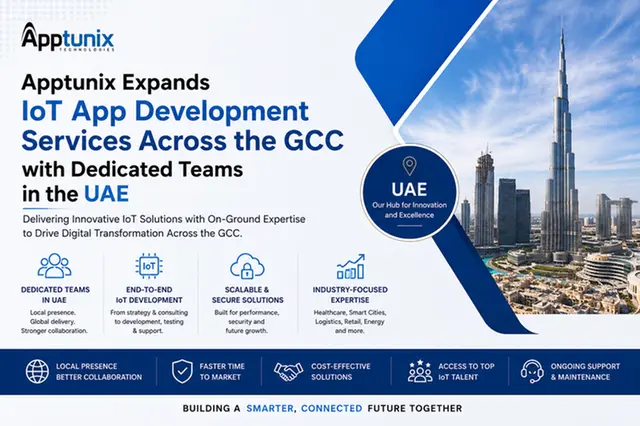
Technology solutions provider Apptunix has expanded its Internet of Things (IoT) application development services across the Gulf Cooperation Council (GCC), establishing dedicated teams in the UAE to support growing demand for connected technology solutions across the region.
The expansion reflects the accelerating adoption of IoT technologies across industries as businesses and governments increasingly deploy connected devices, sensors, and intelligent systems to improve operational efficiency, automate processes, and generate real-time insights.
By strengthening its regional presence, Apptunix aims to support organizations seeking to develop and deploy IoT-enabled applications across sectors including logistics, healthcare, manufacturing, retail, energy, smart cities, and transportation. The move aligns with broader digital transformation initiatives underway across GCC markets, where connected technologies are becoming key enablers of innovation and economic modernization.
IoT has emerged as one of the foundational technologies underpinning smart infrastructure and digital economy development. Connected devices collect and transmit data that can be analyzed to improve decision-making, optimize resource utilization, monitor assets, and automate operations. As organizations generate larger volumes of operational data, IoT platforms are becoming increasingly important components of enterprise technology strategies.
The UAE continues to serve as a regional hub for technology deployment and innovation, attracting companies seeking to support digital transformation projects across the Gulf. Establishing dedicated teams within the country enables technology providers to work more closely with customers while responding to growing demand for localized expertise and implementation support.
The expansion comes amid rising investment in smart city initiatives, industrial automation, and digital infrastructure across the GCC. Governments and enterprises are deploying connected technologies to support sustainability objectives, improve service delivery, and enhance operational resilience. These initiatives are creating opportunities for companies specializing in IoT development, systems integration, and digital platform implementation.
IoT adoption is also being accelerated by complementary technologies such as 5G, artificial intelligence, cloud computing, and edge computing. Together, these technologies enable organizations to collect, process, and act on data in real time, unlocking new use cases ranging from predictive maintenance and intelligent logistics to connected healthcare and smart energy management.
For enterprises, IoT applications increasingly represent strategic investments rather than experimental technology projects. Organizations are seeking measurable outcomes related to productivity, cost optimization, customer experience improvements, and operational visibility.
The GCC has emerged as one of the most active regions for smart infrastructure deployment, with projects spanning intelligent transportation systems, connected utilities, industrial digitalization, and smart building management. This growing ecosystem is creating sustained demand for specialized technology expertise capable of designing and managing complex IoT environments.
As digital transformation initiatives continue to expand, the role of IoT is expected to become increasingly central to both public-sector modernization and private-sector innovation strategies.
Editor’s Note
Apptunix’s regional expansion highlights an important reality of digital transformation: the next wave of innovation will be driven by connected systems rather than standalone applications.
For many years, digital transformation focused primarily on software platforms, mobile applications, and cloud services. Today, organizations are increasingly seeking to connect physical assets, operational processes, and digital platforms through IoT ecosystems that generate real-time intelligence and enable automation at scale.
The GCC is particularly well positioned to benefit from this trend. Governments across the region have invested heavily in digital infrastructure, including fiber networks, 5G deployments, cloud platforms, and smart city initiatives. IoT technologies act as a bridge between these digital assets and the physical environments they are designed to improve.
The expansion is also significant because it reflects growing enterprise demand for practical IoT implementations. Early IoT initiatives often focused on proof-of-concept projects. Increasingly, organizations are deploying connected technologies to solve operational challenges, improve efficiency, and support strategic business objectives.
The role of the UAE as a regional technology hub is another important factor. The country has become a focal point for companies seeking to serve Gulf markets, supported by strong digital infrastructure, business-friendly policies, and a growing ecosystem of technology providers and innovation initiatives.
From a digital infrastructure perspective, IoT represents one of the largest future drivers of data generation. Billions of connected devices are expected to produce vast amounts of information that will require processing, storage, cybersecurity protection, and AI-driven analysis. This creates opportunities across the broader technology value chain, from connectivity providers and cloud operators to software developers and data analytics companies.
The broader implication is that IoT is transitioning from a niche technology segment into a core layer of digital infrastructure. Organizations that successfully integrate connected systems into their operations will be better positioned to improve productivity, enhance decision-making, and capture value from the growing convergence of physical and digital environments.