








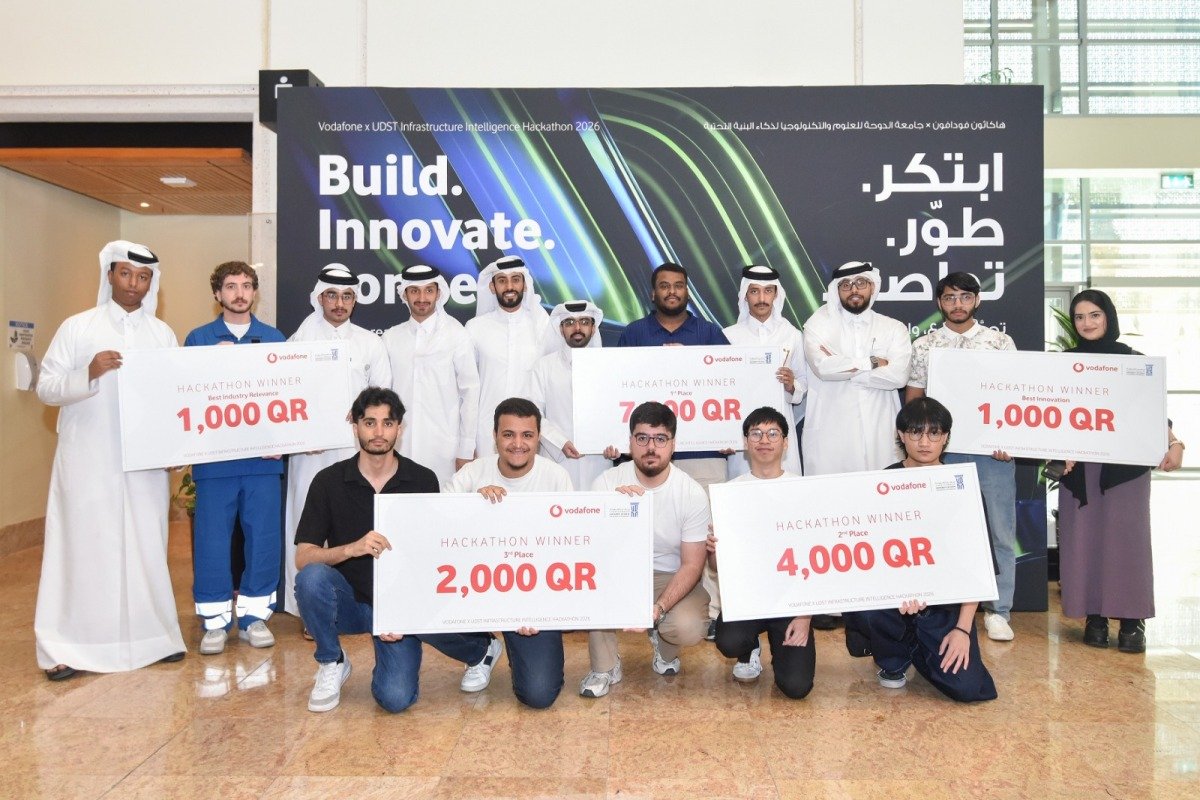
Vodafone Qatar and the University of Doha for Science and Technology (UDST) have honored the winners of the Infrastructure Intelligence Hackathon, an initiative designed to encourage innovation in artificial intelligence, data analytics, and smart infrastructure technologies.
The competition brought together students, innovators, and technology enthusiasts to develop solutions that address infrastructure challenges through the application of emerging technologies. The initiative reflects growing efforts across Qatar to strengthen digital skills development while fostering innovation in areas critical to future economic growth.
The hackathon focused on leveraging artificial intelligence and advanced analytics to improve infrastructure planning, monitoring, and management. Participants were challenged to create practical solutions capable of enhancing operational efficiency, optimizing resource utilization, and supporting smarter decision-making across infrastructure environments.
The event aligns with Qatar’s broader digital transformation ambitions, which place significant emphasis on developing local technology talent and accelerating the adoption of advanced technologies across public and private sectors. As governments and enterprises increasingly rely on data-driven systems, demand for professionals with expertise in AI, digital infrastructure, and analytics continues to grow.
For Vodafone Qatar, the initiative reflects the expanding role of telecommunications operators in supporting innovation ecosystems and digital skills development. Beyond providing connectivity, telecom companies are increasingly investing in technology education, startup engagement, and innovation programmes that contribute to broader digital economy objectives.
The partnership with UDST highlights the growing importance of collaboration between industry and academia. Universities are playing an increasingly active role in preparing students for technology-driven careers by providing practical exposure to real-world challenges and emerging digital technologies.
Infrastructure intelligence has become a key focus area for organizations worldwide. The convergence of artificial intelligence, Internet of Things (IoT) technologies, cloud computing, and advanced analytics is enabling more proactive management of infrastructure assets. These capabilities can support predictive maintenance, operational optimization, energy efficiency, and improved service delivery.
Hackathons have become valuable mechanisms for identifying talent and generating innovative ideas. By creating environments where participants can experiment with emerging technologies and tackle practical challenges, such programmes help bridge the gap between academic learning and industry requirements.
The initiative also supports Qatar’s wider efforts to build a knowledge-based economy. Developing local expertise in AI and digital technologies is increasingly viewed as essential to supporting long-term competitiveness and reducing dependence on imported technological capabilities.
As investment in smart infrastructure and digital transformation accelerates across the Gulf region, initiatives that encourage technology innovation and workforce development are expected to play an increasingly important role in shaping future talent pipelines.
Editor’s Note
The Infrastructure Intelligence Hackathon illustrates an important shift in how countries are approaching digital transformation: technology infrastructure is only as effective as the talent capable of building and managing it.
Governments across the Gulf are investing heavily in artificial intelligence, smart cities, digital infrastructure, and cloud platforms. While these investments create the foundation for future growth, long-term success ultimately depends on developing a workforce capable of designing, operating, and innovating within these environments.
Hackathons are becoming an increasingly valuable tool in this process because they expose participants to practical challenges rather than purely theoretical learning. They create opportunities for students and young professionals to apply emerging technologies to real-world problems while gaining experience that is directly relevant to future employment opportunities.
The focus on infrastructure intelligence is particularly noteworthy. Infrastructure is undergoing a profound transformation as sensors, AI systems, and analytics platforms enable assets to become more connected and data-driven. Roads, utilities, telecommunications networks, and public facilities are increasingly generating information that can be used to improve efficiency and performance.
For Qatar, the initiative aligns with broader efforts to build local capabilities in advanced technologies. Developing domestic expertise in AI and digital infrastructure reduces reliance on external talent while supporting innovation ecosystems that can contribute to economic diversification.
The involvement of Vodafone Qatar also reflects the changing role of telecommunications operators. Increasingly, telecom companies are acting as digital ecosystem enablers, supporting education, innovation, entrepreneurship, and skills development alongside their traditional connectivity businesses.
From a digital economy perspective, talent development has become one of the most strategic investments countries can make. AI, cloud computing, cybersecurity, and data analytics are creating demand for skills that are in short supply globally. Nations that successfully cultivate these capabilities will be better positioned to capture value from future technological growth.
The broader implication is that infrastructure intelligence is not solely about technology deployment. It is about building the human capital required to transform data into insights, automate operations, and create innovative solutions. Initiatives such as this hackathon help ensure that the next generation of technology professionals is prepared to lead that transformation.