







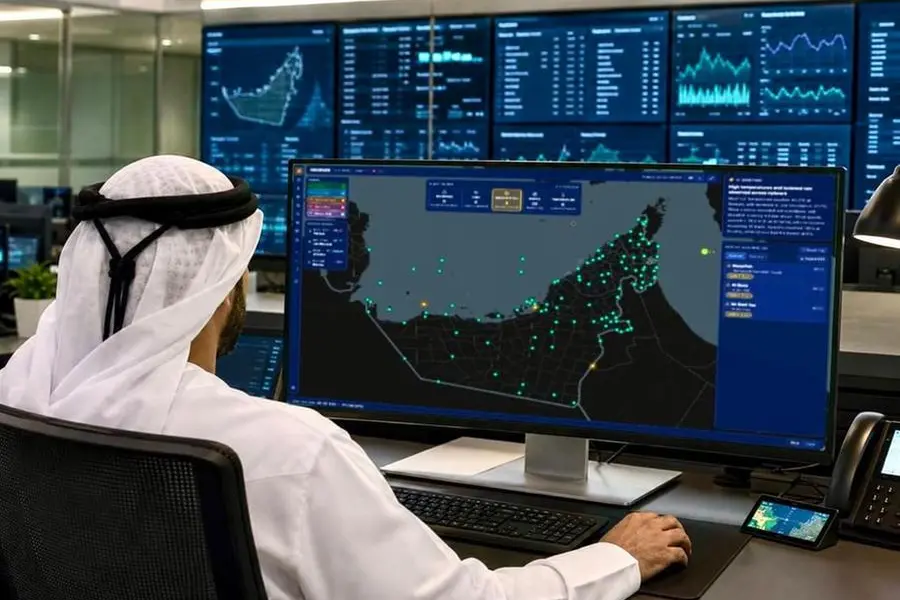
The UAE’s National Center of Meteorology (NCM) has launched the country’s first agentic AI assistants for the meteorological sector, marking a significant step in applying autonomous artificial intelligence to weather forecasting, climate analysis and public weather services.
The initiative introduces AI agents capable of performing complex, multi-step tasks to support meteorologists, automate routine workflows and enhance the delivery of weather intelligence. The deployment aligns with the UAE’s broader strategy of integrating advanced AI across critical government services while strengthening national resilience through data-driven decision-making.
The launch positions the meteorological sector among the latest public services to benefit from the growing adoption of agentic AI, which is rapidly emerging as the next evolution of enterprise and government artificial intelligence.
Agentic AI Transforms Meteorological Operations
Unlike conventional AI assistants that primarily answer questions or generate content, agentic AI systems are designed to plan, reason and execute complex workflows with limited human intervention.
Within meteorology, these capabilities can support the analysis of vast datasets from satellites, weather radars, sensors and forecasting models, enabling faster processing and more efficient operational workflows.
AI agents can also assist meteorologists by automating repetitive tasks, generating reports, monitoring weather events and providing decision support during severe weather situations.
Industry experts view agentic AI as a major advancement in operational intelligence across data-intensive sectors.
AI Enhances Weather Forecasting and Climate Intelligence
Modern weather forecasting depends on processing enormous volumes of real-time environmental data.
Artificial intelligence is increasingly helping meteorological agencies improve forecasting accuracy by identifying complex weather patterns, accelerating model analysis and supporting earlier detection of extreme weather events.
As climate variability increases, AI-powered forecasting tools are becoming increasingly valuable for disaster preparedness, aviation, agriculture, maritime operations and emergency response.
The introduction of autonomous AI assistants further strengthens the ability of meteorological organizations to respond quickly to changing environmental conditions.
Supporting the UAE’s National AI Strategy
The initiative aligns with the UAE’s long-term vision of embedding artificial intelligence across government operations and public services.
The country continues to invest heavily in AI infrastructure, cloud computing, digital government and advanced analytics, positioning itself as a global leader in practical AI deployment.
Applying agentic AI within meteorology demonstrates how autonomous intelligence can improve public sector efficiency while supporting national resilience and critical infrastructure.
The project also reinforces the UAE’s growing role as a regional pioneer in government AI adoption.
Government AI Moves Beyond Automation
Public sector organizations are increasingly evolving from basic digital automation toward intelligent systems capable of assisting with planning, analysis and operational decision-making.
Agentic AI enables government agencies to manage complex information flows more efficiently while freeing specialists to focus on higher-value analytical work.
Meteorology represents one of many sectors where AI can enhance operational effectiveness through intelligent data processing and workflow orchestration.
As AI technologies mature, similar deployments are expected across transportation, healthcare, environmental management and public safety.
Why This Matters
Agentic AI represents the next phase of artificial intelligence, enabling organizations to automate complex workflows rather than isolated tasks. Applying these capabilities to meteorology can improve forecasting efficiency, operational responsiveness and public weather services.
For the UAE, the launch of the country’s first agentic AI assistants for meteorology reinforces its leadership in government AI adoption and digital innovation. For the wider public sector, it demonstrates how autonomous AI can strengthen critical services by improving data analysis, decision support and operational resilience.
Editor’s Note
Artificial intelligence is entering a new era in which autonomous agents are becoming operational partners rather than simple productivity tools. Meteorology is particularly well suited to this evolution because of its reliance on massive real-time datasets and time-sensitive decision-making. The UAE’s deployment of agentic AI assistants by the National Center of Meteorology illustrates how governments are beginning to apply advanced AI in mission-critical environments. As autonomous AI capabilities mature, they are likely to become an integral part of public sector operations, supporting faster decisions, more efficient workflows and more resilient national services.