








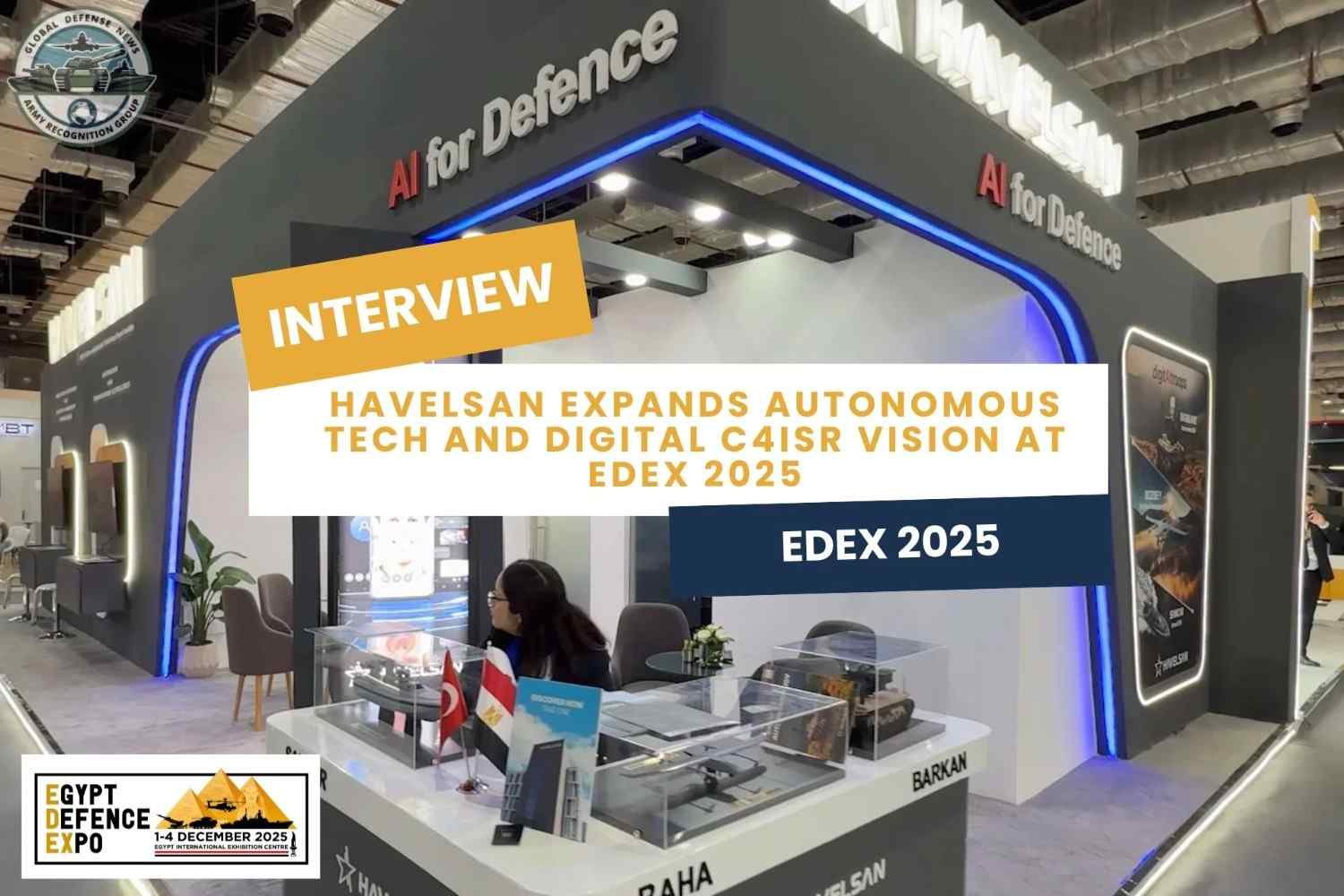
Turkish defense technology company Havelsan used the Egypt Defence Expo (EDEX) 2025 in Cairo to outline an expanded long-term cooperation plan with Egypt—one that links its advanced C4ISR systems, MATRA maritime-surveillance technologies, and autonomous BARKAN and BAHA platforms with deep industrial partnerships and local production.
Building on groundwork laid since 2023, Havelsan is adapting its architectures to Egypt’s complex Mediterranean and Red Sea operating environment while positioning the country as a regional production and integration hub for African markets. Partnerships with entities such as Kader Factory and the Arab Organization for Industrialization include technology transfer, joint manufacturing, and the gradual establishment of full local production chains for unmanned systems.
A priority area is the transformation of traditional C4ISR structures into flexible, multi-layered command networks able to integrate manned naval assets, coastal sensors, and unmanned platforms into a unified operational picture. This real-time coherence strengthens maritime situational awareness—critical for Egypt’s heavily trafficked waterways and strategic sea routes.
Havelsan’s MATRA solutions, presented in broad terms at EDEX, consolidate radar feeds, AIS data, electro-optical inputs, and meteorological information into cohesive maritime-traffic and surveillance systems. These platforms support missions ranging from counter-smuggling operations to irregular-migration monitoring and port-area incident response.
To reinforce operational readiness, Havelsan is also integrating advanced simulation environments—VR, XR, and digital-twin training—that replicate complex mission scenarios. These tools help militaries prepare personnel more efficiently while reducing reliance on physical assets.
Autonomous systems remain a central pillar of cooperation. In Egypt, a locally produced unmanned ground vehicle derived from Havelsan’s BARKAN platform is already in manufacturing, while the BAHA UAV complements a common communication framework shared across Havelsan’s unmanned family. Together, these systems form a distributed sensor network capable of persistent surveillance and border-security operations across large and challenging terrain.
Havelsan emphasized that the goal is not merely to export systems but to build technological sovereignty in partner countries. With its autonomous-control architecture already deployed in nine nations—from Indonesia to Chile—the company sees Egypt as a strategic launchpad for an African footprint.
The deeper defense-industrial collaboration, paired with rapid modernization of maritime and land-surveillance tools, could enhance strategic autonomy for African states and reshape defense-technology balances across the region. As border pressures and maritime-security challenges intensify, modular and integrated autonomous solutions are expected to play an increasingly decisive role in North Africa and beyond.