









E-commerce has fundamentally reshaped Bangladesh’s retail ecosystem, altering how consumers shop and how businesses compete. What began as a convenience-driven alternative has evolved into a powerful force demanding transparency, accountability, and higher customer service standards—pressures that are now reshaping brick-and-mortar retail as well.
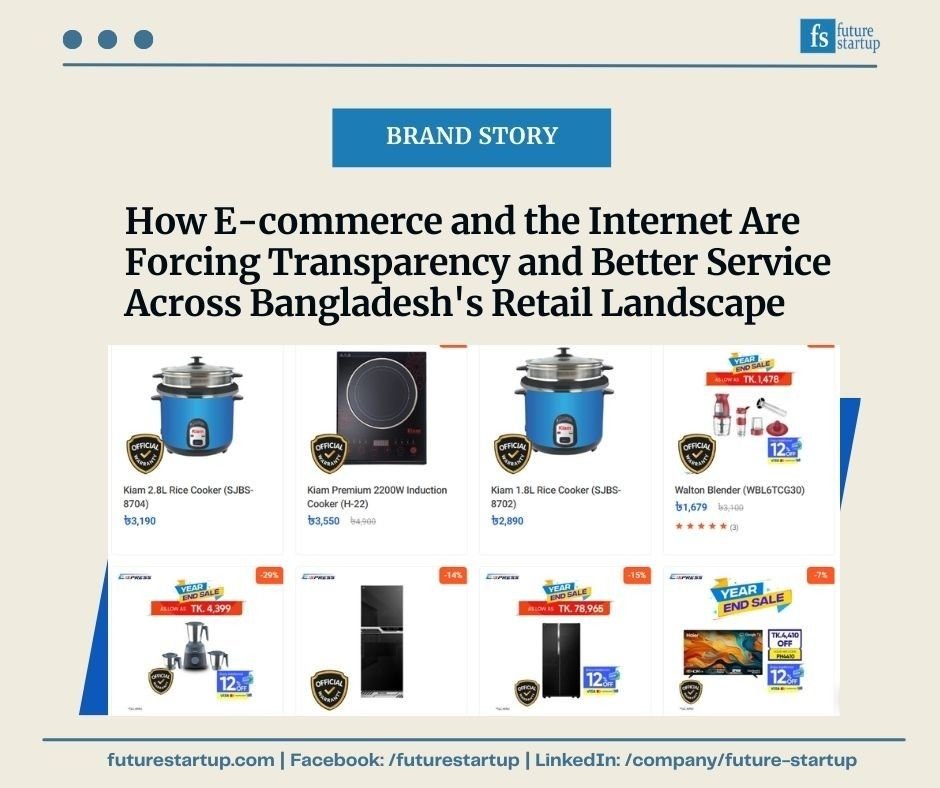
The mechanics of online commerce have made transparency unavoidable. Customers can compare prices instantly, verify product specifications, read peer reviews, and publicly voice complaints on social media. This environment leaves little room for opaque pricing or vague product information. Retailers must compete not only on price, but on clarity and trust.
While Bangladesh’s e-commerce sector faced a credibility crisis in 2021 due to scams, fake products, and delivery failures, platforms that failed to meet customer expectations were unable to survive. The structure of online commerce naturally rewards businesses that prioritize authentic products, clear communication, and reliable service, while penalizing those that do not.
At the heart of this shift is the collapse of information asymmetry. Traditional retail once gave sellers a knowledge advantage, with limited price comparison and unclear specifications. E-commerce dismantled this model entirely, placing information—and power—directly in the hands of consumers.
Customer service has emerged as a defining competitive factor. Online retailers cannot rely on location or convenience alone. When products and prices are comparable, service quality becomes the differentiator. In a market where trust remains fragile and cash-on-delivery dominates, responsive support and reliability are critical to winning customer confidence.
Pickaboo’s rise illustrates this shift. By focusing on authentic products, fast delivery, and highly responsive customer service, the company built trust without depending heavily on discounting. Its success highlights how transparency and service can create sustainable competitive advantages.
These expectations are now spilling into offline retail. Consumers increasingly check online prices while shopping in physical stores, eroding traditional retailers’ negotiating power. Clear pricing, return policies, and responsive after-sales support—once uncommon—are becoming baseline expectations across the sector.
Despite persistent challenges such as fraud, misleading marketing, and inconsistent regulatory enforcement, the trajectory is clear. E-commerce has permanently raised the bar for retail in Bangladesh. The future of the sector will be shaped not by who offers the lowest prices, but by who serves customers with the greatest transparency, reliability, and care.