









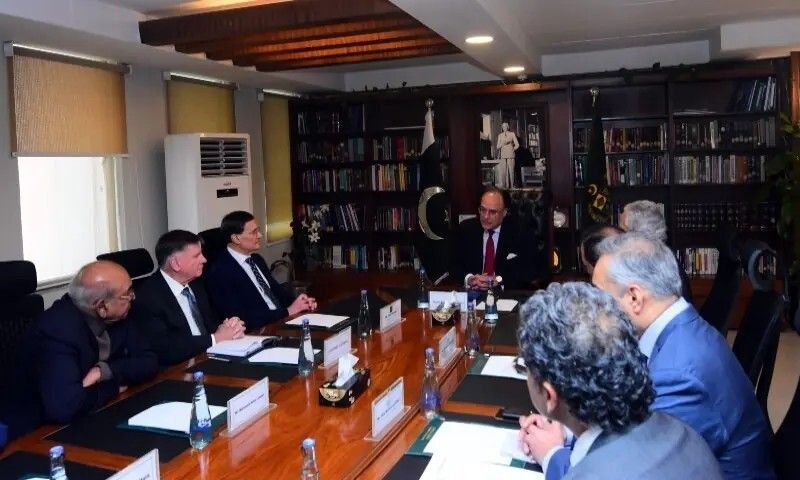
Federal Minister for Finance and Revenue Muhammad Aurangzeb has said Pakistan is at an early but critical stage in shaping its digital asset ecosystem, as the country moves toward a structured and responsible regulatory framework.
The remarks were made during a meeting with a visiting delegation from Icoin Technology Inc., a Silicon Valley-based blockchain infrastructure company, led by Chief Executive Officer Chet Silvestri.
According to a press release from the finance ministry, Aurangzeb welcomed knowledge-sharing and responsible investment aligned with national priorities, noting that Pakistan is laying the groundwork for a well-regulated digital asset environment.
The minister briefed the delegation on ongoing efforts to develop a “structured and responsible” framework for digital assets, including progress toward establishing a Pakistan Crypto Council and the Pakistan Virtual Assets Regulatory Authority (PVARA).
He highlighted Pakistan’s growing participation in global digital asset activity, as reflected in international analytics, and underscored the government’s resolve to channel this momentum into a regulated ecosystem that safeguards users while encouraging innovation and investment.
Aurangzeb stressed that regulation is essential to balance opportunity with risk, particularly as digital asset usage continues to rise among Pakistani citizens. He said the evolving policy framework aims to provide clarity to market participants, align with international best practices, and ensure coordination among regulators, including the State Bank of Pakistan, to enable orderly market development and institutional participation.
Silvestri shared insights from the United States and Canada, drawing on Icoin Technology’s experience working with banks, exchanges, and large consumer platforms. He explained how regulatory clarity in mature markets has enabled traditional financial institutions to engage with digital assets using existing infrastructure rather than rebuilding core banking systems.
He also outlined the role of wallet-based middleware and switching technologies that allow banks to connect securely with exchanges, manage liquidity, enhance compliance, and offer digital asset services through familiar banking applications.
The delegation highlighted the transformational potential of blockchain technology and stablecoins in modernising financial infrastructure by enabling faster, lower-cost, and more transparent transactions while maintaining regulatory oversight. Reference was made to recent legislative developments in the United States aimed at bringing coherence to digital asset regulation, particularly around stablecoins and banking integration.
They noted that young and tech-savvy populations are already engaging with digital assets across markets, and that regulated participation through banks helps retain this activity within the formal financial system.
Aurangzeb advised that, given the evolving regulatory landscape, initial engagement with interested banks and relevant institutions would be a constructive next step, alongside continued dialogue with regulators, including the State Bank of Pakistan.
Discussions also covered Icoin Technology’s global engagements and partnerships enabling large consumer bases to access digital asset services, as well as the company’s interest in exploring opportunities in Pakistan with local partners. The delegation sought guidance on regulatory pathways, licensing requirements, and engagement mechanisms with banks and authorities.
Both sides agreed to maintain engagement, explore areas of cooperation, and continue exchanges to support Pakistan’s efforts to build a transparent, inclusive, and well-regulated digital asset market.