









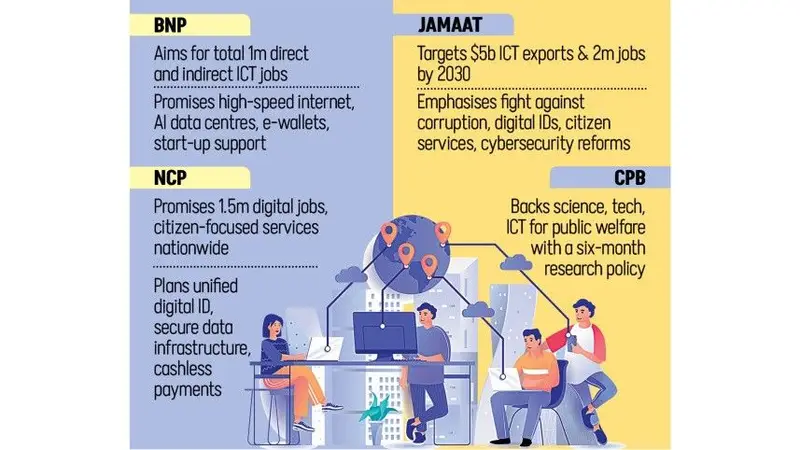
Digital transformation and telecommunications have emerged as central themes in Bangladesh’s political discourse ahead of the upcoming general election, as major parties outline ambitious plans to expand ICT infrastructure, create jobs, and strengthen digital governance. However, persistent challenges including rural connectivity gaps, power reliability issues, and skills shortages continue to raise questions about the feasibility of these promises.
Bangladesh’s ICT and telecom sector has experienced rapid growth in recent years, driven by rising mobile adoption and increasing internet penetration. Despite this progress, service quality remains inconsistent, particularly in rural areas where broadband reliability is uneven and power outages frequently disrupt network performance. Structural challenges such as licensing complexity and limited digital public infrastructure efficiency continue to constrain sector development.
Several political parties have positioned ICT as a core economic driver. The Bangladesh Nationalist Party (BNP) has proposed large-scale job creation initiatives targeting cybersecurity, AI, data services, semiconductors, and Industry 4.0, alongside infrastructure commitments such as nationwide high-speed connectivity and near-constant network reliability through a proposed Connectivity Masterplan. Plans also include introducing global payment platforms, building AI-driven data center infrastructure, and expanding startup funding mechanisms. Analysts note, however, that current workforce capacity remains significantly below projected targets.
Jamaat-e-Islami has emphasized governance reform and anti-corruption measures through ICT adoption, including unified digital identity systems, improved cybersecurity frameworks, and reforms aimed at increasing transparency and competition in the telecom sector. While export and employment targets are ambitious, observers have highlighted ongoing concerns around talent development, global competitiveness, and institutional coordination.
The National Citizen Party (NCP) has proposed a citizen-centric digital model, focusing on nationwide digital service delivery, unified identity systems, digital hubs across districts, and expanded digital economy employment through remote work and data services. Meanwhile, the Communist Party of Bangladesh (CPB) has emphasized ethical technology adoption, public-interest-driven ICT development, and stronger links between research, education, and industry.