








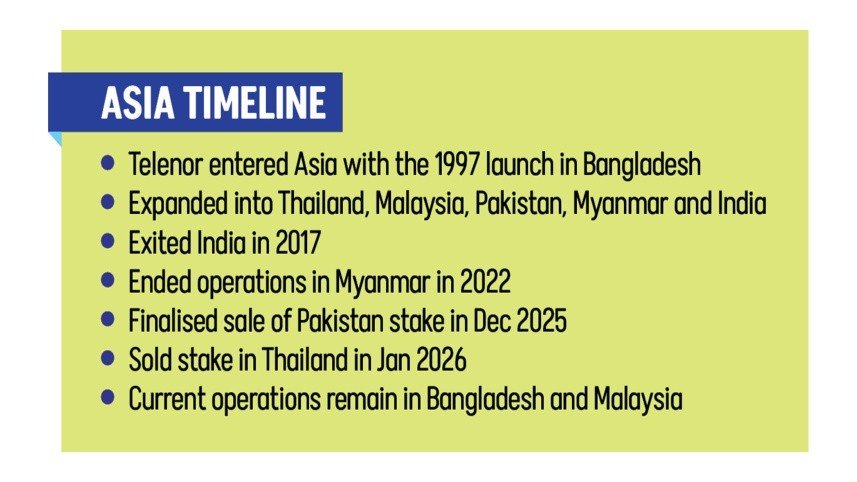
Telenor’s exit from Pakistan and its agreement to sell its stake in Thailand mark a decisive contraction of the Norwegian telecom group’s Asian presence. With these moves, the company has exited most of its regional markets, leaving only Bangladesh and Malaysia as its remaining major footholds in Asia.
Last week, Telenor signalled that even these remaining assets could be part of future transactions. Reuters quoted Group CFO Torbjørn Wist as saying that the company’s Asian assets, including Grameenphone in Bangladesh, “could also become subject to deals.” He added that operations would continue “business as usual” unless opportunities arise.
Telenor Asia head Jon Omund Revhaug echoed the same stance for Bangladesh, stating that the group remains fully focused and committed “until such time that any opportunities present themselves.” This marks the first time senior Telenor executives have publicly acknowledged that Grameenphone could be included in a future deal.
As recently as April 2024, the company projected a far firmer commitment. Then CEO Sigve Brekke told The Daily Star that Telenor was “very committed” to Bangladesh, even as it restructured operations in Thailand and Malaysia through local mergers that reduced its operational exposure.
Telenor’s Asian journey began with the launch of Grameenphone in 1997, which became the cornerstone of its regional expansion into Thailand, Malaysia, Pakistan, Myanmar, and India. Since then, the group has exited India in 2017 and Myanmar in 2022 following the military coup and regulatory shifts.
Today, Telenor remains in only two Asian markets. In Malaysia, it holds a 33.1 percent minority stake in CelcomDigi Berhad following a 2022 merger. In Bangladesh, its position is far stronger. Through Grameenphone, Telenor owns 55.8 percent of the market leader, which serves 45.46 percent of subscribers, generates nearly half of industry revenue, accounts for 88 percent of sector profits, and is the country’s most valuable listed company.
“Telenor has been a growth partner in Bangladesh for 28 years,” Revhaug said. “We remain committed to bringing global expertise to support the country’s connectivity and digital development goals.”
He added that sustaining long-term investment requires regulatory predictability, objective frameworks, fair dispute resolution, and evidence-based policymaking. “Such rigour builds trust, ensures technical feasibility, and produces balanced outcomes that reward competition and innovation rather than narrow interests,” he said.
Industry sentiment remains divided. Some executives describe Bangladesh as Telenor’s “golden goose” in Asia, citing Grameenphone’s profitability and Telenor’s controlling stake. Others point to a strategic pivot toward the Nordic region and slowing growth in Bangladesh’s telecom market.
While Grameenphone remains profitable, revenue has stagnated and declined slightly across 2024 and the first three quarters of 2025. One senior executive suggested that a major shift could occur within two to three years, adding that if Telenor ultimately makes a decisive move on Bangladesh, “it will not come as a surprise.”