








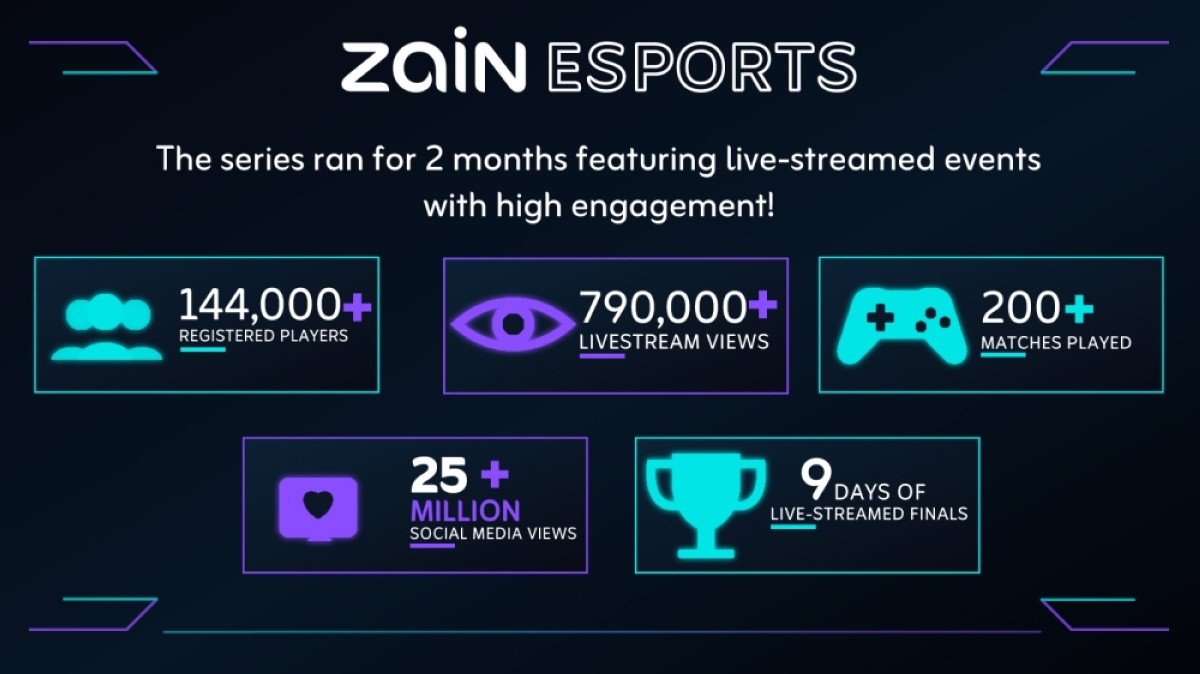
Zain Esports has launched what it describes as the largest PUBG Mobile championship in the Middle East and North Africa, bringing together players from seven countries in a regional tournament that underscores the rapid growth of competitive gaming and digital entertainment across the region.
The championship spans multiple Zain markets, creating a regional platform for esports talent while highlighting the increasing role of telecommunications operators in supporting gaming ecosystems, digital communities, and youth-focused technology engagement.
Esports has emerged as one of the fastest-growing segments of the global digital economy, attracting millions of players and spectators through competitive gaming tournaments, streaming platforms, and online communities. The MENA region has become an increasingly important market for the industry, supported by high smartphone penetration, widespread mobile broadband adoption, and a young, digitally engaged population.
The tournament centers on PUBG Mobile, one of the world’s most popular mobile esports titles. Mobile gaming has become particularly influential across emerging markets, where smartphones often serve as the primary platform for digital entertainment. As a result, mobile esports is experiencing significant growth across the Middle East, Africa, and South Asia.
For Zain, the initiative reflects a broader strategy of engaging customers through digital lifestyle services that extend beyond traditional telecommunications offerings. Operators increasingly view gaming as an important growth segment due to its impact on data consumption, customer engagement, and digital ecosystem development.
The championship also demonstrates the growing sophistication of the region’s esports landscape. Competitive gaming has evolved from a niche activity into a structured industry supported by sponsors, tournament organizers, technology providers, content creators, and professional players. Regional tournaments help strengthen this ecosystem by creating pathways for talent development and audience growth.
Governments across the Gulf have increasingly recognized esports as both an economic opportunity and a component of broader digital economy strategies. Investments in gaming infrastructure, esports events, digital skills development, and technology innovation are contributing to the sector’s expansion.
The rise of esports is also driving demand for high-performance digital infrastructure. Competitive gaming requires reliable low-latency connectivity, cloud services, content delivery networks, and advanced mobile networks capable of supporting real-time interactions. This creates opportunities for telecommunications providers to play a central role in ecosystem development.
The regional nature of the championship highlights the growing interconnectedness of MENA’s digital entertainment markets. Cross-border competitions are helping build larger audiences, create regional gaming communities, and attract greater commercial investment into the esports sector.
As gaming continues to evolve into a mainstream form of entertainment and competition, regional tournaments are expected to play an increasingly important role in developing talent, attracting sponsorships, and strengthening digital engagement across the MENA region.
Editor’s Note
The Zain Esports championship illustrates how gaming is becoming a significant pillar of the digital economy rather than simply a form of entertainment.
Globally, gaming now rivals or exceeds many traditional media sectors in terms of audience engagement and economic activity. Esports, in particular, has created entirely new ecosystems involving professional players, content creators, tournament operators, sponsors, streaming platforms, and technology providers.
For the MENA region, the growth of mobile esports is especially important. Mobile-first markets often experience faster gaming adoption because smartphones provide a more accessible entry point than dedicated gaming hardware. This has enabled millions of users to participate in gaming communities and competitive events across the region.
The involvement of telecommunications operators such as Zain reflects the industry’s strategic significance. Gaming generates substantial data traffic, drives demand for high-quality connectivity, and creates opportunities for operators to offer value-added digital services. As a result, gaming is increasingly viewed as a core component of digital engagement strategies.
The championship also highlights the emergence of esports as a platform for regional integration. By connecting players across multiple countries, tournaments help build shared digital communities while creating opportunities for talent development and cross-border collaboration.
From a digital infrastructure perspective, esports serves as a powerful driver of network innovation. Competitive gaming demands low latency, stable connections, and reliable performance, encouraging continued investment in advanced telecommunications infrastructure.
The broader implication is that gaming is evolving into a strategic growth industry with economic, technological, and cultural significance. Beyond entertainment, esports contributes to digital skills development, content creation, entrepreneurship, and technology adoption.
As regional governments continue investing in digital economy initiatives and youth engagement programmes, gaming and esports are likely to become increasingly important components of broader innovation and economic diversification strategies. The success of large-scale regional tournaments suggests that the MENA gaming ecosystem is entering a new phase of maturity and commercial opportunity.