






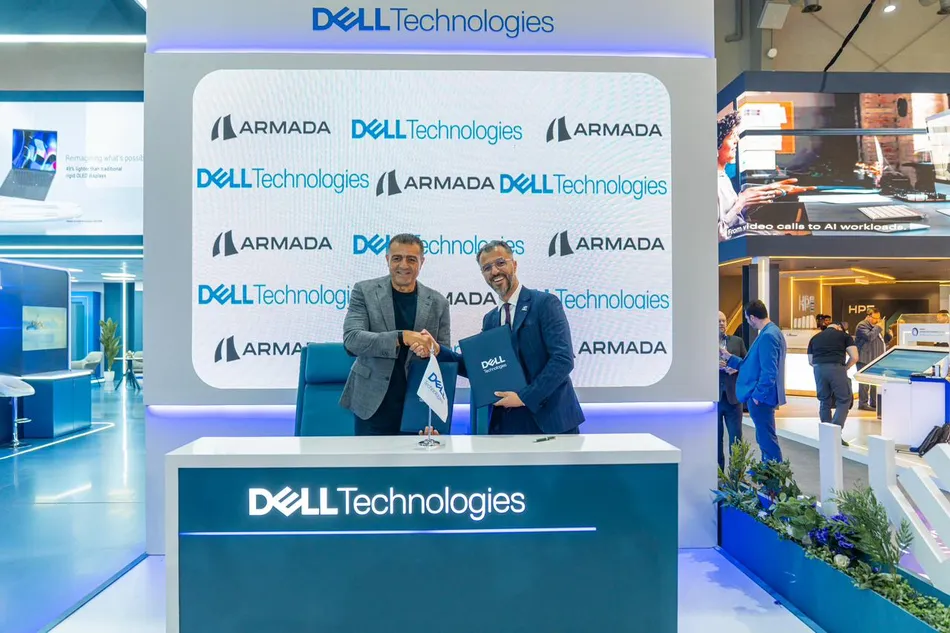
Dell Technologies and Armada have signed a Memorandum of Understanding to explore the delivery of containerised mobile and edge data centre infrastructure across Saudi Arabia, targeting AI and computing requirements in sectors including energy, telecommunications, manufacturing and public infrastructure.
The agreement, signed during LEAP 2026 in Riyadh, establishes a framework for combining Dell’s enterprise hardware and infrastructure stack with Armada’s specialised containerised data centre technology.
The companies are targeting projects that require compute and storage capacity to be deployed rapidly and closer to where data is generated, particularly in remote or resource-constrained environments.
Containerised infrastructure targets rapid deployment
Under the MoU, Dell infrastructure is envisaged to be integrated into Armada’s mobile and containerised data centre solutions.
Unlike conventional data centres that depend on permanent facilities, containerised systems can package computing, storage and supporting infrastructure into modular units that can be deployed closer to operational sites.
The approach is intended to provide organisations with greater flexibility when local computing capacity is required but constructing or connecting to conventional data centre infrastructure may not be practical.
Dell and Armada said the combination would provide high-performance infrastructure for customers across Saudi Arabia.
The companies have not disclosed planned capacity, investment commitments, deployment locations or a timetable for the first projects.
Edge AI among targeted applications
Supporting Edge AI is one of the main objectives of the collaboration.
Moving compute closer to industrial equipment, operational facilities and other sources of data can allow information to be processed locally rather than depending entirely on distant centralised infrastructure.
This can be particularly relevant for applications requiring rapid processing or operating in locations where network connectivity to central cloud infrastructure may be constrained.
The companies said the architecture could support real-time Edge AI applications while strengthening data sovereignty and operational continuity.
Armada is positioning the infrastructure for use at field operations, remote assets and other critical enterprise environments.
Energy and telecom sectors among priority markets
Dell and Armada plan to target organisations across energy, telecommunications, manufacturing and public infrastructure.
These sectors can involve geographically distributed operations where computing requirements extend beyond conventional offices and central data centres.
The companies also plan to use Dell’s authorised regional channel partner network to expand access to enterprise customers across the Kingdom.
Mohamed Talaat, Vice President for Saudi Arabia, Egypt, North Africa and Levant at Dell Technologies, said the collaboration is intended to expand resilient mobile edge infrastructure in Saudi Arabia.
“By pairing Dell’s high-performance hardware stack with Armada’s containerized data center design, we are empowering enterprises to deploy Edge AI with speed, scale and reliability in alignment with Saudi Vision 2030,” Talaat said.
Armada targets mission-critical edge infrastructure
Armada said the partnership could strengthen its ability to deliver AI and edge infrastructure for organisations with demanding operational requirements.
Rabee El Mohammadi, Vice President of Sales and Partnerships for MEA at Armada, said combining the company’s edge platform with Dell technology would enable computing resources to be deployed directly to field operations, remote assets and critical enterprise environments.
The partnership fits into a wider shift toward distributed computing architectures as organisations seek to process growing volumes of data closer to where it originates.
Why this matters
Saudi Arabia’s rapid expansion of AI and data centre infrastructure is largely associated with large centralised facilities, but not every AI workload is best served from a hyperscale campus.
Industrial operations, telecom infrastructure, energy facilities and remote assets can require computing resources much closer to the point where data is generated. Containerised edge data centres offer one way to deploy that capacity without waiting for conventional facilities to be constructed.
The Dell and Armada agreement therefore addresses a different layer of Saudi Arabia’s emerging AI infrastructure market, bringing compute and storage closer to operational environments while potentially supporting requirements around latency, resilience and data sovereignty.
Editor’s note
The MoU should currently be viewed as a framework for potential deployments rather than a confirmed Saudi data centre rollout.
No customers, sites, capacity figures, investment commitments or deployment schedules have been announced. The strategic proposition is nevertheless relevant because Saudi Arabia’s growing AI ambitions will require more than large centralised computing campuses.
The key test will be whether Dell and Armada convert the agreement into operational deployments, particularly in energy, industrial and telecom environments where edge computing can solve practical latency, connectivity and resilience challenges. Concrete projects would provide a clearer indication of how significant containerised infrastructure could become within the Kingdom’s broader AI compute ecosystem.