








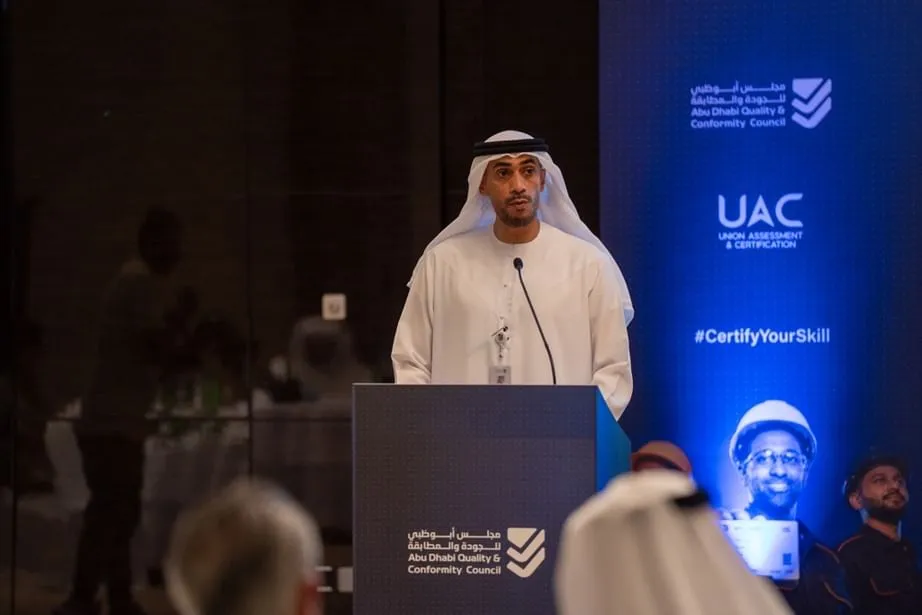
The Abu Dhabi Quality and Conformity Council has launched what it describes as the Gulf region’s first Digital Skills Card, introducing a blockchain-verifiable system for recording and validating professional skills and qualifications.
Developed in partnership with Union Assessment and Quality Accreditation, the initiative is designed to give employers, regulators and other stakeholders a secure way to verify accredited workforce credentials while supporting professional mobility across institutions and borders.
Each Digital Skills Card is linked to a certification issued through personnel conformity programmes accredited by QCC and delivered by UAC.
Credentials verified through ADI Chain
The card allows professional certifications to be verified digitally using a QR code.
When scanned, the code enables employers, regulators and other authorised stakeholders to confirm the validity and authenticity of the underlying certification through ADI Chain, the regulation-compliant blockchain infrastructure operated by ADI Foundation.
The approach is intended to reduce reliance on paper-based or manually checked credentials and provide a more tamper-resistant method for validating professional qualifications.
QCC said the initiative supports broader digitalisation efforts around trusted data, transparency and connected regulatory systems.
Initial rollout focuses on accredited personnel certifications
At launch, the Digital Skills Card is tied to certifications awarded through personnel conformity programmes accredited by QCC and delivered by UAC.
The launch event brought together government representatives, regulators, industry stakeholders and certified professionals, including some of the first individuals to receive the new credentials.
Badr Khamis Al Shumaili, Executive Director of the Conformity and Standards Services Sector at QCC, said digitalisation is increasingly becoming a foundation for trusted and transparent systems rather than simply a tool for making procedures faster.
He said the Digital Skills Card provides a secure and reliable method for verifying professional skills and credentials while strengthening confidence among regulators, employers and professionals.
UAC plans wider credential coverage
UAC said the long-term ambition is to expand the Digital Skills Card beyond the current certification base.
Shahbaz Muhammad Khan, Director and CEO of UAC, said verified skills should be able to travel with professionals and retain their value across institutions and borders.
The organisation plans to extend the system over time to cover a broader range of certifications, qualifications and professional achievements.
No timetable was disclosed for that expansion, and the partners did not specify which additional credential categories will be added first.
Digital credentials could support workforce mobility
The initiative also has implications for labour mobility and skills recognition.
Digitally verifiable credentials can potentially simplify the process of confirming whether a worker holds a valid qualification, particularly in sectors where employers and regulators need to verify technical or safety-related competencies.
That can be especially relevant in labour markets with significant cross-border movement, where paper certificates or fragmented databases can make verification slower and more difficult.
By linking accredited qualifications to a blockchain-based verification layer, QCC and UAC are attempting to create a more portable credential that can be checked independently rather than relying only on documents presented by the individual.
QCC targets broader adoption across Abu Dhabi
QCC said it will continue working with government bodies, regulators, employers and industry stakeholders to expand digital credential solutions.
The council’s broader mandate covers standardisation, conformity assessment, testing, inspection and accreditation across Abu Dhabi.
UAC focuses on workforce skills assessment and accreditation for industrial sectors, with programmes aligned to regulatory requirements and labour market needs.
The Digital Skills Card therefore sits at the intersection of workforce certification, digital identity and regulatory technology.
Why this matters
Professional credential verification is often treated as an administrative process, but it can directly affect hiring, regulatory compliance and workforce mobility.
A verifiable digital credential can reduce the risk of fraudulent certificates, make validation faster and provide employers with greater confidence that qualifications remain authentic and current.
The use of blockchain is relevant here because the technology is being applied to a specific verification problem rather than as a standalone feature. Its value will depend on whether the system remains easy for employers and regulators to use and whether more certification bodies and credential types are added over time.
Editor’s note
The most important question is not whether the credential is stored or verified using blockchain, but whether the Digital Skills Card becomes broadly accepted across hiring and regulatory workflows.
If adoption expands beyond the initial QCC-accredited certifications, the system could become part of a wider digital trust layer for workforce qualifications in Abu Dhabi and potentially across the GCC.
The next milestones to watch are the number of certifications added, employer uptake, cross-border recognition and whether the platform integrates with larger digital identity, labour and professional licensing systems.