
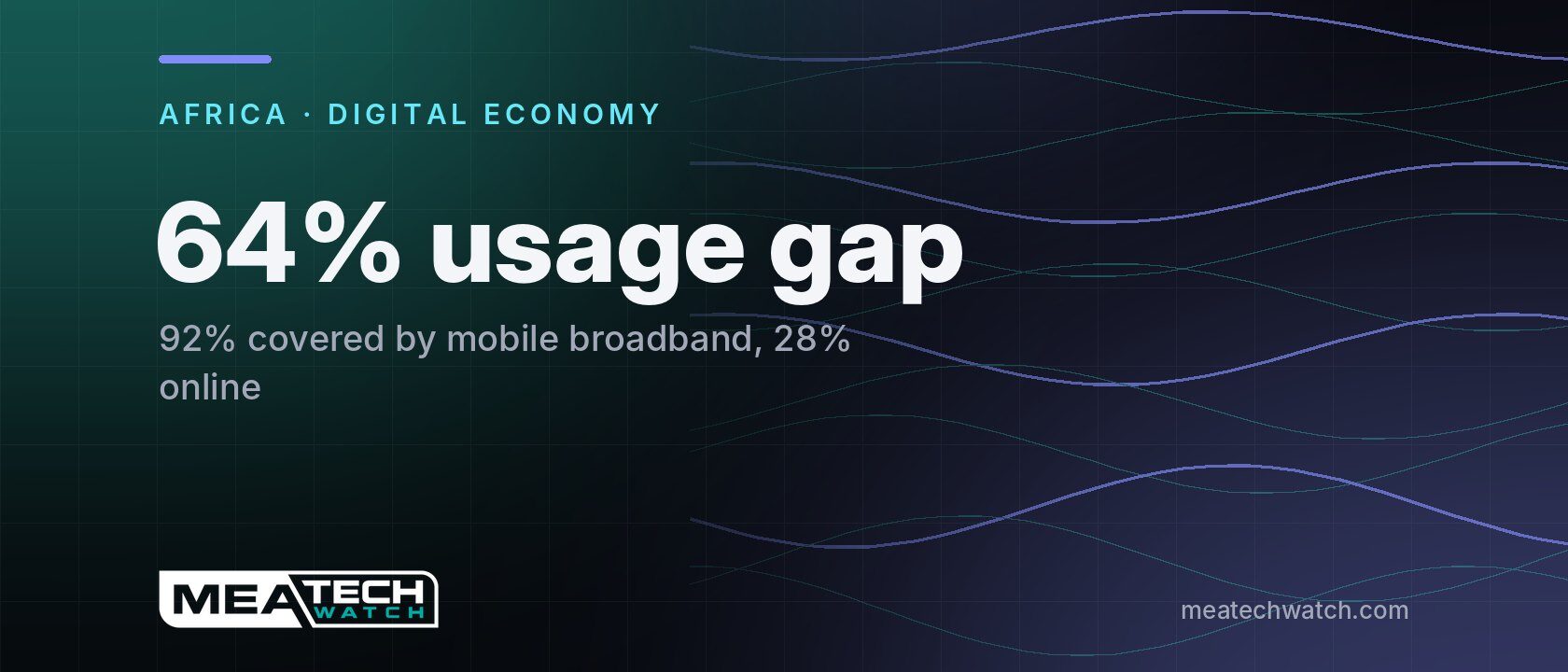
Mobile broadband now covers 92% of Africa’s population but only 28% of people use mobile internet on their own devices, a 64% usage gap, according to the GSMA‘s Digital Africa Index 2026, published on 18 November.
The gap matters more than coverage for most African markets now: the networks are largely built, but people are not using them. The index points to device costs, weak digital skills and a lack of local content and services as the main reasons, and to handset taxes as a lever governments still control.
What the Digital Africa Index 2026 found
The GSMA said in its statement that the usage gap in Africa is the largest of any region. The full report draws on data from 54 countries.
The index scores countries on two main measures out of 100: the Digital Nations and Society Index (DNSI), which tracks digital development and adoption, and the Digital Policy and Regulatory Index (DPRI), which tracks government policy and regulation.
Ten countries now combine stronger digital development with more supportive policy, the GSMA said, compared with three in 2024. Egypt, Ghana, Nigeria, Rwanda, Senegal, Seychelles and Tunisia joined Kenya, Mauritius and South Africa in that group.
- South Africa had the highest DNSI score, at 69 out of 100, followed by Kenya at 65.
- Egypt and Ghana made the largest DPRI gains since 2024. TechAfrica News, reporting the release, said the gains came from reforms in cybersecurity, spectrum management, consumer protection and digital inclusion.
- Only nine of the 54 countries charge neither sector-specific taxes nor import duties on mobile handsets, down from 10 in 2024.
Angela Wamola, head of Africa at the GSMA, said in the statement: “Africa has made real progress in expanding mobile broadband coverage.” She added: “The challenge now is ensuring that more people can actually use it.”
How South Africa’s phone tax cut moved sales
The report uses South Africa as its main example of a tax change with a measurable effect. South Africa removed its 9% excise duty on smartphones priced under R2,500 in April 2025.
Monthly sales of entry-level smartphones then rose by about 80%, from roughly 250,000 units in March 2025 to roughly 460,000 in February 2026, according to GSMA analysis. The GSMA urged other governments to remove duties on entry-level smartphones.
What the GSMA says governments should do with digital services
This year’s edition also looks at digital public services. It says putting a service online does not mean people will use it, and lists five areas where delivery falls short: access, public value, trust and accountability, inclusion, and coordination between agencies.
The GSMA set out five priorities in response: affordable and reliable connectivity as the base for digital services, a focus on whether people complete services and get value from them, stronger trust and accountability, inclusion built into service design, and secure links between government systems.
Context: a gap that has barely moved
The first Digital Africa Index, published in October 2024, said about two-thirds of Africa’s population did not use mobile internet. The 2026 figures show coverage close to universal and the share of non-users still in the same range.
Policy, rather than usage, is where the index records change. The top group has more than tripled in two years, and it now spans North Africa (Egypt, Tunisia), West Africa (Ghana, Nigeria, Senegal), East Africa (Kenya, Rwanda) and the islands (Mauritius, Seychelles), alongside South Africa.
Ecofin Agency, which also reported the findings, noted that the GSMA’s recommendations put more weight on whether people use digital public services than on how many services are put online.
Frequently asked questions
What is Africa’s mobile internet usage gap in 2026?
64%, according to the GSMA’s Digital Africa Index 2026: mobile broadband covers 92% of Africans, but only 28% use mobile internet on their own devices.
Which African countries are in the GSMA’s top group?
Ten: Egypt, Ghana, Kenya, Mauritius, Nigeria, Rwanda, Senegal, Seychelles, South Africa and Tunisia. In 2024 there were three.
Which country scored highest on digital development?
South Africa, with a DNSI score of 69 out of 100, followed by Kenya at 65.