
Saudi Arabia’s workforce is undergoing a profound transformation as artificial intelligence and financial literacy converge under Vision 2030, reshaping how people work, lead, and create value. Experts argue that the Kingdom’s true competitive edge lies not just in advanced technologies, but in people who can confidently navigate both digital systems and financial decision-making.
Shereen Tawfiq, co-founder and CEO of financial education firm Balinca, views financial literacy as a foundational economic capability rather than a soft skill. Through gamified simulations, Balinca trains individuals and organizations to understand financial logic, risk, and strategic trade-offs in real time. Tawfiq believes this immersive approach builds intuitive financial judgment that traditional classroom methods often fail to deliver.
She highlights the untapped potential of Saudi women as entrepreneurs and investors, noting that if even 10–15 percent of women-led SMEs scale into growth ventures over the next five years, they could contribute between $50 billion and $70 billion to GDP through job creation, innovation, and capital formation. Tawfiq, who helped shape early frameworks for Saudi Arabia’s venture capital ecosystem, describes the Kingdom’s rapid investment transformation as a case study in national ambition.
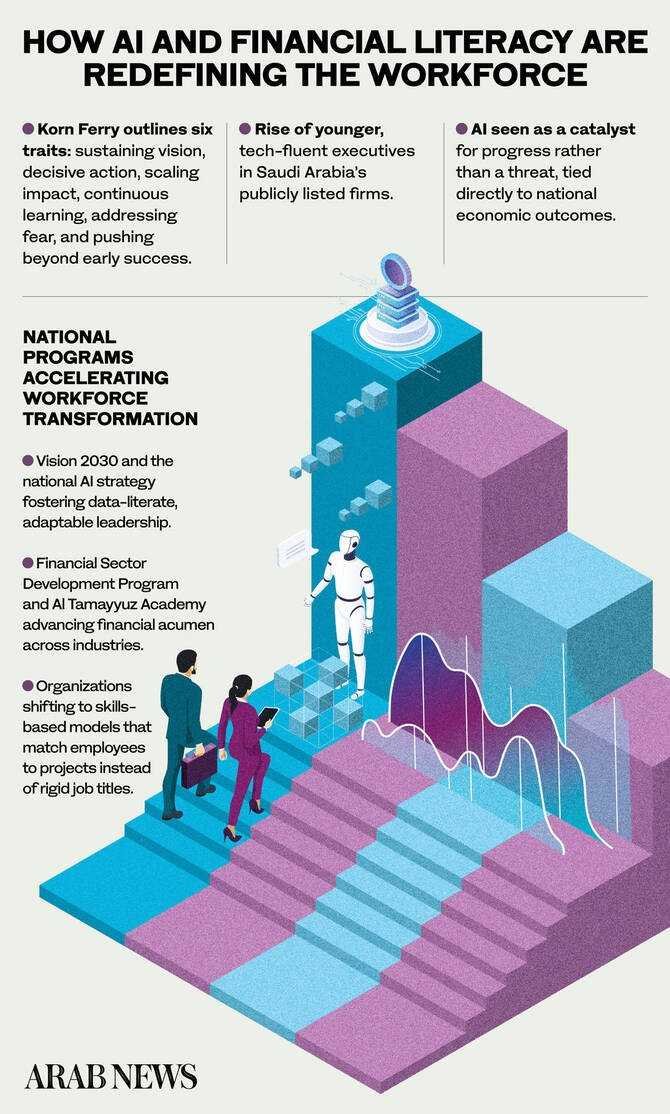
While AI is increasingly used to personalize learning and streamline processes, Tawfiq stresses that judgment, ethics, and financial reasoning remain human skills. She advocates using AI as a decision-support tool rather than a substitute for experience, aligning with national initiatives such as the Financial Sector Development Program and Al Tamayyuz Academy, which aim to raise financial acumen across industries.
From a leadership perspective, Jonathan Holmes, Managing Director at Korn Ferry Middle East, sees AI as a growth catalyst rather than a threat in Saudi Arabia. He notes that Vision 2030 and the national AI strategy are producing a younger, more agile, and data-literate generation of leaders. Korn Ferry’s research shows a rise in first-time CEO appointments, reflecting deliberate generational renewal in Saudi corporates.
Holmes emphasizes that successful AI leadership depends on human-centered skills, including vision, decisiveness, continuous learning, and the ability to manage uncertainty. As Saudi organizations adopt skills-based models that assign talent to projects rather than fixed roles, adaptability is becoming a core currency of success.
Together, the perspectives of Tawfiq and Holmes point to a workforce model where financial confidence, ethical judgment, and AI fluency reinforce one another. This blend of inclusion, innovation, and capability development positions Saudi Arabia to set a global benchmark for workforce transformation driven by both technology and human capital.