



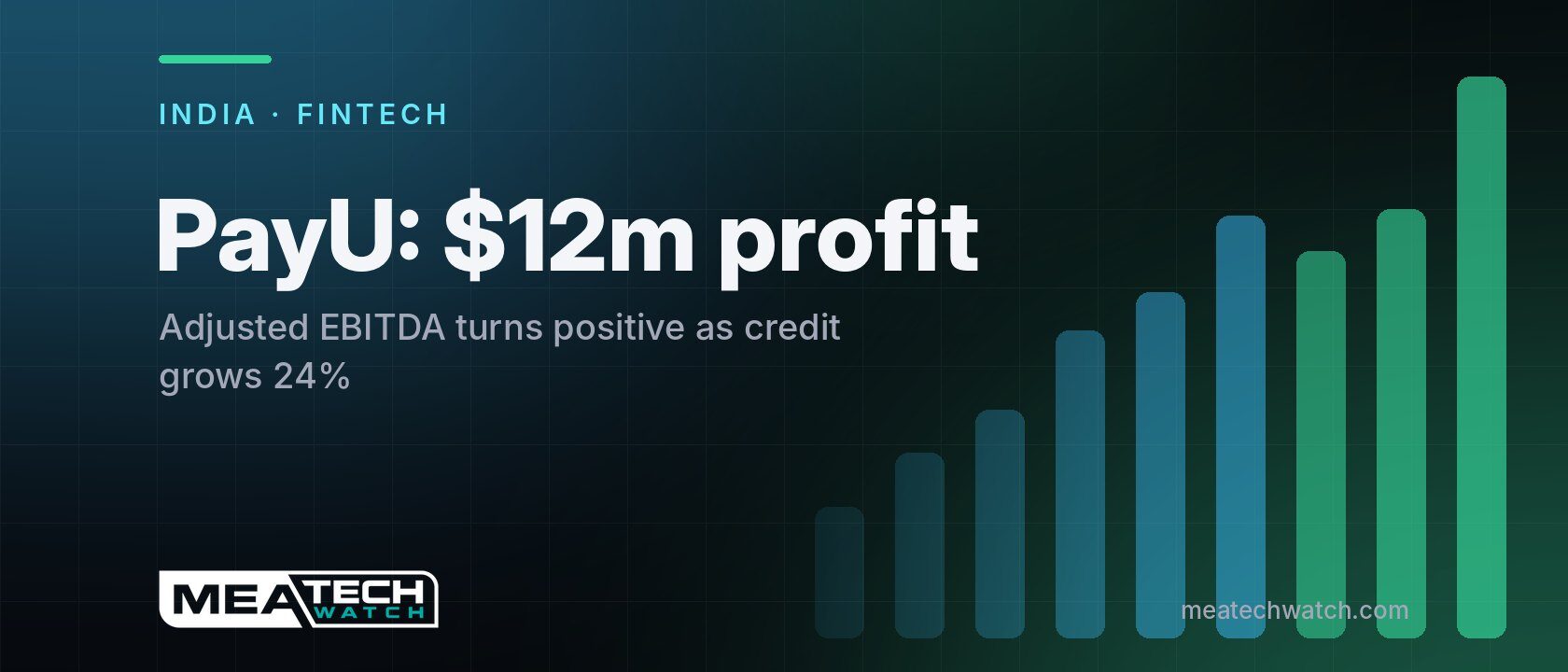
PayU, the Indian payments and lending company owned by Prosus, turned adjusted EBITDA positive at $12m in the six months to 30 September 2026 as revenue rose 6% to $384m, Prosus said.
PayU processes online payments and is expanding into loans for small firms and consumers. A profit at this level shows the business can earn money even as fees on India’s Unified Payments Interface (UPI) stay thin, and the split of its figures shows that lending, not payments, did most of the work.
How PayU’s results break down
PayU’s revenue grew 6% in local currency, excluding mergers and acquisitions, to $384m, according to Prosus’s half-year results statement. Prosus said growth came from total payment volume (TPV) and a 20% rise in credit assets under management.
The payments business shrank. Payments revenue fell 12% to $265m (down 4% in local currency, excluding M&A), which Prosus put down to the timing of Diwali and to merchants PayU chose to drop. Gross margin in payments rose from 23% to 25%, and adjusted EBITDA in payments stayed flat at $2m.
Lending grew. Credit revenue rose 24% to $119m (36% in local currency, excluding M&A), and credit adjusted EBITDA turned positive at $10m, the company said.
Prosus said that if the merchant accounts PayU cancelled on purpose are left out, revenue grew 13% and TPV rose 20% in local currency. It said profit came from moving into higher-margin services.
What Prosus said about its Indian businesses
Prosus said its Indian ecosystem, which includes PayU and holdings in Swiggy, Meesho, ixigo and Rapido, reached more than 500 million annual users and 450 million monthly orders. TPV processed by PayU across these businesses grew by more than 80% year on year, the company said.
The group said PayU’s systems are built into these companies as PayU expands from core payment processing into lending to small businesses and consumers.
“We said FY27 would be a year of execution, and we are delivering,” said Fabricio Bloisi, chief executive of Prosus, in the statement.
Context: UPI and the shift to lending
Business Standard, reporting the results, said PayU’s $12m adjusted EBITDA compares with a loss of $1m a year earlier, and that credit swung from a $3m loss to a $10m profit. It also reported that UPI’s share of PayU’s TPV rose to 42% from 32%, that credit originations rose 35% to $864m, and that credit now makes up 31% of PayU’s revenue. Prosus’s statement does not include those figures.
The same report said Prosus pointed to higher-margin and multi-year contracts as an offset to falling take rates on UPI payments. A rising UPI share with falling take rates helps explain why payments revenue fell while volumes grew.
Entrackr, covering the same results, reported the 500 million user and 450 million order figures for the Indian ecosystem and the 80% growth in volume PayU processed for it.
At group level, Prosus said ecosystem revenue rose 59% to $5.7bn and adjusted EBITDA reached $492m, against $530m a year earlier, including $344m of investment in its iFood and JET businesses. Adjusted earnings per share rose 12%.
What happens next
Prosus said it expects the group to return to adjusted EBITDA growth in the 2028 financial year. It gave no separate target for PayU.
Frequently asked questions
Is PayU profitable?
On an adjusted EBITDA basis, yes: $12m in the six months to 30 September 2026, according to Prosus.
Why did PayU’s payments revenue fall?
Payments revenue fell 12% to $265m, which Prosus attributed to the timing of Diwali and to merchants PayU chose to exit.