








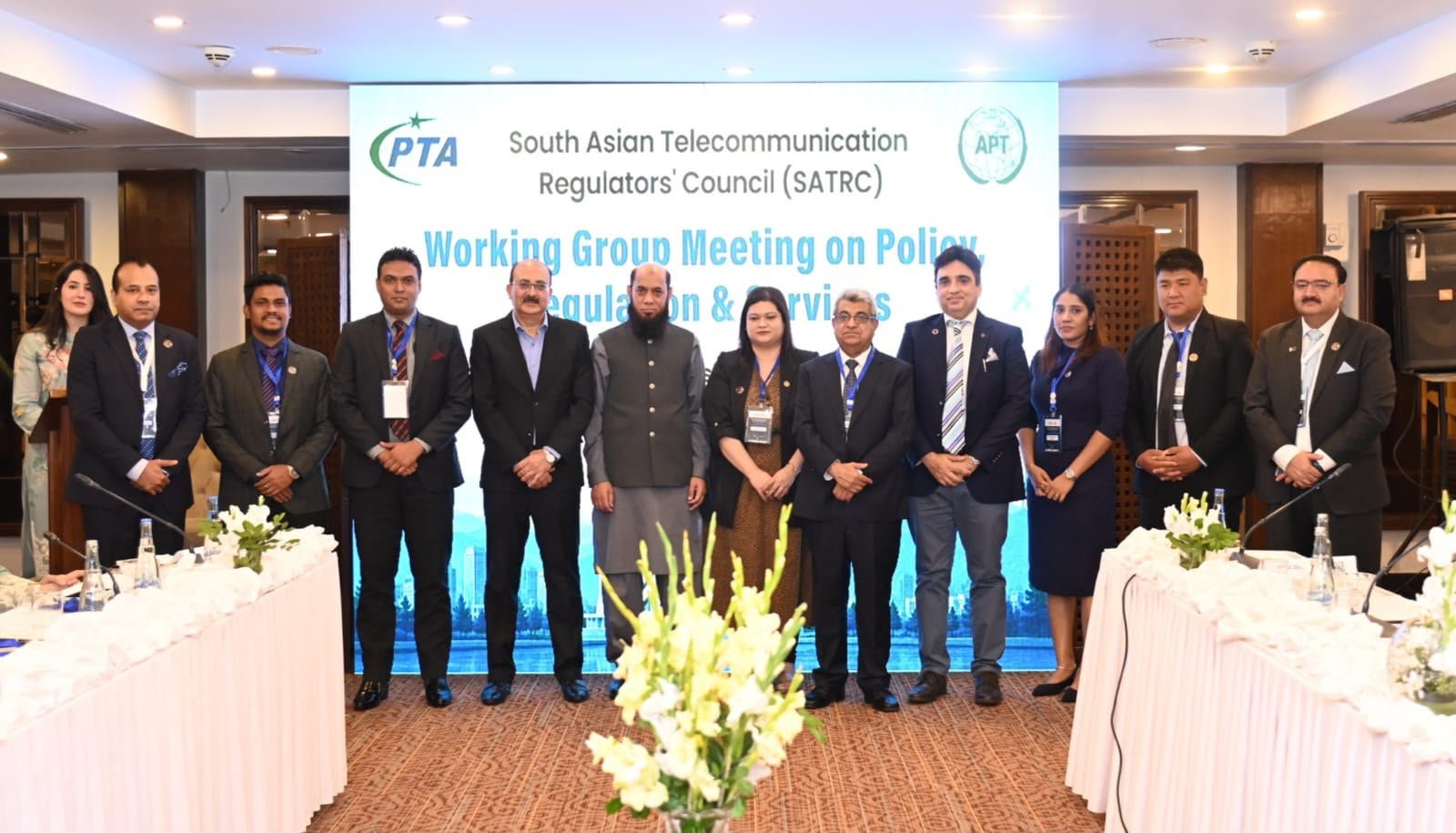
The Pakistan Telecommunication Authority (PTA) hosted the South Asian Telecommunication Regulators’ Council (SATRC) Working Group meeting, bringing together regional regulators and industry stakeholders to strengthen cooperation on telecommunications policy, regulatory frameworks and emerging digital services across South Asia.
The meeting provided a platform for participants to discuss evolving regulatory challenges, policy harmonization and best practices in telecommunications, with a focus on enabling innovation while ensuring resilient, inclusive and secure digital connectivity across the region.
The event underscores the growing importance of regional regulatory collaboration as countries prepare for the next generation of technologies, including 5G, artificial intelligence, digital public infrastructure and cross-border digital services.
Regional Cooperation Shapes Future Telecom Regulation
As digital technologies become increasingly interconnected, regulators are working more closely to address common policy challenges.
Forums such as SATRC enable telecommunications authorities to exchange knowledge on spectrum management, licensing frameworks, consumer protection, cybersecurity and digital inclusion.
Greater regulatory coordination also supports cross-border connectivity initiatives and creates a more predictable environment for telecom operators and technology investors operating across multiple markets.
Industry observers note that regional policy alignment is becoming increasingly important as digital economies become more integrated.
Regulation Evolves for the AI and 5G Era
Telecommunications regulators are expanding their focus beyond traditional licensing and spectrum management to address emerging technologies.
Artificial intelligence, cloud computing, satellite connectivity, Internet of Things (IoT) deployments and digital public services are introducing new regulatory considerations around data governance, security, interoperability and infrastructure investment.
Collaborative discussions help regulators develop forward-looking frameworks that encourage innovation while maintaining competition, consumer protection and network resilience.
Modern telecom regulation is increasingly viewed as an enabler of digital transformation rather than simply a compliance function.
Supporting Pakistan’s Digital Transformation
Hosting the SATRC Working Group reinforces Pakistan’s growing role in regional telecommunications policy discussions.
The country continues to advance initiatives around broadband expansion, digital government, AI adoption and the planned rollout of 5G, making regulatory modernization a key component of its digital agenda.
Engagement with regional counterparts enables Pakistan to incorporate international best practices while contributing to policy development across South Asia.
The meeting also strengthens collaboration on issues that require coordinated regional responses, including cybersecurity and digital infrastructure development.
Building a More Connected South Asia
Regional cooperation can help accelerate digital inclusion by encouraging harmonized approaches to telecommunications regulation and infrastructure development.
Shared policy frameworks support more efficient spectrum use, facilitate innovation and improve the investment climate for operators deploying next-generation networks.
As demand for digital services continues to grow, cooperation between regulators will become increasingly important in supporting resilient communications infrastructure and sustainable digital economic growth across South Asia.
Why This Matters
Regional regulatory collaboration helps countries address shared telecommunications challenges while preparing policy frameworks for emerging technologies such as 5G, AI and satellite communications. Harmonized approaches also improve the environment for digital investment and cross-border connectivity.
For Pakistan, hosting the SATRC Working Group meeting strengthens its role in shaping regional telecommunications policy and reinforces its commitment to modern, innovation-friendly regulation. For South Asia, the meeting supports greater cooperation in building secure, resilient and future-ready digital ecosystems.
Editor’s Note
As digital technologies transcend national borders, telecommunications regulation is becoming increasingly collaborative. Issues such as AI governance, cybersecurity, satellite connectivity and next-generation networks require coordinated approaches that extend beyond individual markets. PTA’s hosting of the SATRC Working Group reflects this shift, highlighting the growing role of regional cooperation in shaping the future of digital connectivity. For South Asia, stronger regulatory alignment will be essential to accelerating digital transformation, attracting investment and ensuring that emerging technologies can be deployed securely and efficiently across the region.