









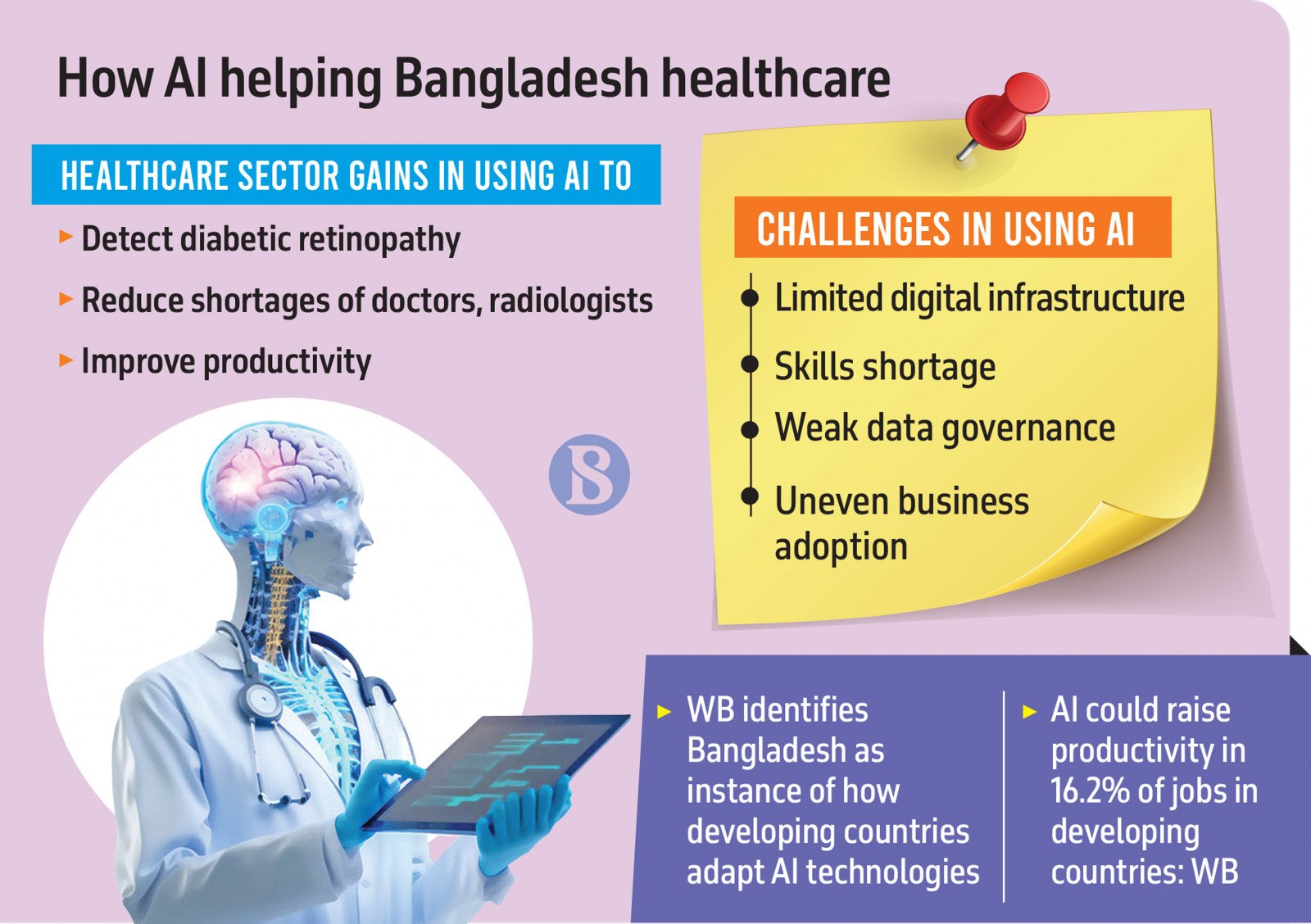
Bangladesh is making meaningful progress in applying artificial intelligence across healthcare and public services, but further investment in digital infrastructure, skills and governance will be essential to unlock AI’s full economic potential, according to the World Bank’s World Development Report 2026.
The report identifies Bangladesh as an example of how developing economies can generate significant value by adopting and adapting existing AI technologies rather than developing frontier AI models. It highlights successful deployments in healthcare while emphasizing that long-term success will depend on strengthening digital infrastructure, institutional capacity and responsible AI governance.
The findings come as Bangladesh prepares its National AI Policy 2026-2030 to promote inclusive, accountable and sustainable AI adoption across the economy.
AI is improving healthcare delivery
The World Bank cites Bangladesh’s healthcare sector as an example of AI’s practical impact in improving public services.
Clinics using AI-powered medical imaging to detect diabetic retinopathy have increased patient screening capacity by up to 40% per day, helping address shortages of specialist doctors and radiologists. Rather than replacing healthcare professionals, AI is supporting clinical decision-making and expanding access to essential medical services.
The report suggests that such applications demonstrate how AI can deliver measurable productivity gains in developing economies.
Governance will determine AI’s long-term success
While AI offers significant opportunities, the report warns that poor governance and weak data quality can undermine its effectiveness.
A study using mobile phone data to identify households eligible for social protection correctly identified only 32% of eligible families, leaving many vulnerable households excluded from welfare programmes. Public confidence was also limited, with only 45% of surveyed households viewing the AI-based targeting system as fair.
The findings highlight the importance of combining AI with robust governance, high-quality data and human oversight to ensure equitable outcomes.
Bangladesh is strengthening its AI policy framework
The country is developing a National AI Policy for 2026-2030 aimed at promoting responsible and inclusive adoption of artificial intelligence.
Proposals include establishing a National Data Governance Authority to oversee AI deployment and data regulation, alongside a multi-stakeholder advisory council comprising representatives from government, academia, industry and civil society. Bangladesh is also moving toward ratifying the Council of Europe Framework Convention on AI, the world’s first legally binding international AI treaty.
These initiatives are expected to strengthen the country’s regulatory framework as AI adoption accelerates.
Infrastructure and skills remain critical enablers
The World Bank identifies digital infrastructure, reliable electricity, broadband connectivity and workforce skills as essential foundations for expanding AI adoption.
The report notes that Bangladesh has opened its market to satellite broadband providers, including Starlink and OneWeb, to improve internet access in underserved regions. However, it also highlights the need for greater investment in local data infrastructure, computing capacity and digital skills to support wider AI deployment across industries.
Addressing these structural challenges will be key to enabling long-term AI-driven economic growth.
Why this matters
The World Bank’s assessment highlights Bangladesh’s growing progress in applying AI to real-world challenges while underscoring the need for stronger digital infrastructure, governance and skills development. Successfully balancing innovation with responsible implementation will be critical to ensuring AI delivers inclusive economic and social benefits.
Editor’s note
Developing economies increasingly have the opportunity to accelerate digital transformation by adapting existing AI technologies rather than building frontier models from scratch. The World Bank’s findings suggest that success will depend less on advanced algorithms and more on investments in connectivity, data quality, institutional capacity and workforce development. Bangladesh’s experience illustrates both the promise of AI-enabled public services and the importance of establishing governance frameworks that ensure innovation remains inclusive, transparent and trusted.