








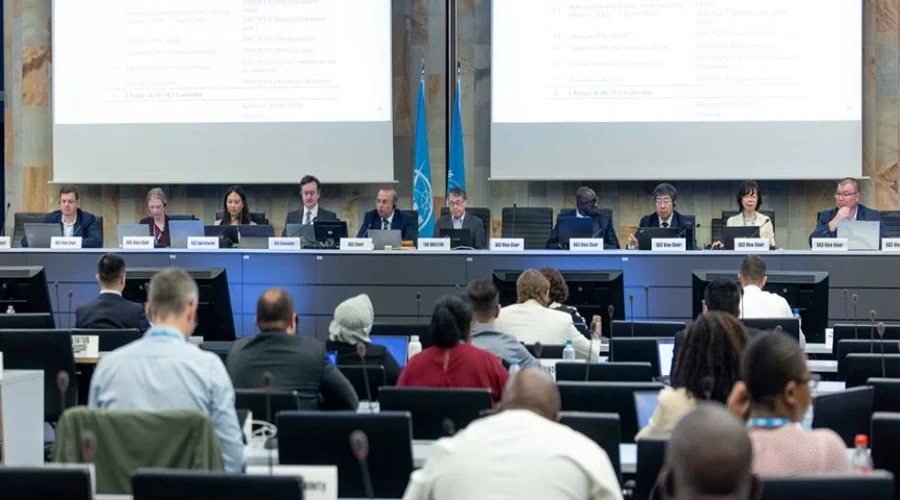
Egypt has chaired the latest meeting of the International Telecommunication Union’s Telecommunication Standardization Sector Study Group 3 (ITU-T SG3), where global representatives advanced work on the economic and regulatory implications of AI, satellite connectivity, IoT, eSIM, IPv6 and other technologies reshaping the digital economy.
Held in Geneva from July 28 to August 5, the meeting brought together representatives from ITU Member States and Sector Members to address tariff and accounting principles alongside wider economic, financial and policy issues affecting international telecommunications and ICT markets.
The meeting produced several technical deliverables and two new work items, including an Egypt-proposed study examining the economic and regulatory implications of IPv6 adoption.
AI and satellite connectivity enter telecom policy discussions
SG3’s agenda reflected the growing complexity of telecommunications policy as conventional networks converge with emerging digital technologies.
Participants examined satellite connectivity, over-the-top services, the Internet of Things, global internet connectivity and the economic implications of artificial intelligence.
These technologies are creating new considerations for regulators and operators as connectivity expands beyond traditional fixed and mobile network models.
AI introduces additional economic questions as computing and intelligent applications become more closely integrated with telecommunications infrastructure, while rapidly expanding satellite networks are creating alternative models for delivering broadband connectivity.
ITU advances work on affordable data services
The meeting also concluded the work of the Focus Group on Costing Models for Affordable Data Services.
Four technical reports were adopted following the group’s work, with the deliverables focused on promoting more equitable access to digital services globally.
Affordability remains a critical component of digital inclusion because network coverage alone does not ensure that individuals and businesses can meaningfully access online services.
Developing economic models that support affordable connectivity therefore remains an important part of efforts to narrow global digital divides.
Network slicing gets economic and policy framework
SG3 also agreed on technical reports addressing economic and policy frameworks associated with network slicing.
Network slicing allows multiple virtual networks to operate over common physical infrastructure, enabling operators to allocate network capabilities according to different service requirements.
The technology is particularly relevant to advanced mobile networks, where enterprises and other customers may require differentiated levels of performance, latency or reliability.
The ITU work indicates that attention is increasingly moving beyond the technical implementation of network slicing toward the commercial and regulatory frameworks required to support its wider use.
ITU to examine eSIM deployment for IoT
Members approved a new work item examining the economic and regulatory dimensions of eSIM deployment within IoT environments.
eSIM technology can simplify the provisioning and management of connected devices by reducing dependence on removable physical SIM cards.
This becomes increasingly relevant when organisations operate large numbers of connected devices across different locations and networks.
The new work will examine the economic and regulatory questions arising as eSIM becomes more deeply integrated into IoT deployments.
Egypt proposes new work on IPv6 economics and regulation
A second new work item, proposed by Egypt, will examine the economic and regulatory implications of IPv6 adoption.
IPv6 provides the vastly expanded internet address space required to accommodate continued growth in connected devices and digital services as the availability of conventional IPv4 addresses remains constrained.
While the technical case for IPv6 has been established for years, migration rates vary significantly between markets.
Examining economic and regulatory factors could help identify some of the barriers affecting adoption and the policy approaches that could support wider deployment.
Egypt strengthens role in international telecom governance
Chairing SG3 reinforces Egypt’s longstanding involvement with the ITU, where the country has participated for more than six decades.
According to the source, Egypt is currently the only ITU Member State chairing a study group across all three ITU sectors, while also holding leadership roles within the organisation’s General Secretariat.
These positions give Egypt an active role in discussions around telecommunications policy, international standards and the wider transformation of the digital economy.
Why this matters
The latest SG3 meeting demonstrates how telecommunications policymaking is expanding beyond traditional tariffs and connectivity issues. AI, satellite networks, IoT, eSIM, IPv6 and network slicing are introducing new economic and regulatory questions that increasingly require international coordination.
Egypt’s chairing role and its proposal for dedicated work on IPv6 also strengthen its participation in shaping discussions that could influence future telecom policy frameworks internationally.
Editor’s note
The significance of ITU-T SG3 is that many technologies move from technical possibility to commercial reality only after economic and regulatory questions are addressed. Network slicing needs viable commercial frameworks, IoT connectivity needs scalable identity models, and IPv6 migration involves incentives and implementation costs alongside technical readiness. As AI and satellite connectivity add further complexity, international telecom policy will increasingly need to evolve at the same pace as network technology.