


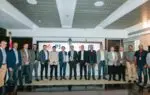



Nutanix has made Nutanix Cloud Clusters available on Google Cloud’s Dammam region in Saudi Arabia, giving organisations a new option for extending existing Nutanix environments into the public cloud while maintaining a consistent infrastructure and operating model.
The launch forms part of a broader collaboration between Nutanix and Google Cloud announced at LEAP Saudi Arabia and is aimed at organisations pursuing hybrid cloud strategies while addressing requirements around data residency, application portability and operational consistency.
Nutanix Cloud Clusters (NC2) on Google Cloud is available immediately in the Dammam region through Nutanix and its channel partners.
NC2 connects on-premises infrastructure with Google Cloud
NC2 allows organisations operating Nutanix infrastructure on-premises to extend those environments into Google Cloud without having to rearchitect existing applications.
Customers can move applications between their private infrastructure and Google Cloud while continuing to use familiar management tools, security policies and operating processes.
The architecture is intended to reduce some of the complexity associated with cloud migration, particularly for established enterprise applications that may otherwise require significant modification before being moved to a public cloud environment.
Organisations can use NC2 to address temporary or longer-term capacity requirements, migrate applications, establish disaster recovery environments and support workload modernisation.
Dammam deployment addresses Saudi data requirements
Making NC2 available within Google Cloud’s Dammam region adds a local deployment option for Saudi organisations considering hybrid cloud architectures.
Keeping workloads within the Kingdom can help organisations address data residency, regulatory and business requirements while placing applications and infrastructure closer to local users.
The companies are positioning these capabilities around growing Saudi demand for cloud infrastructure as public and private sector organisations advance digital transformation initiatives associated with Vision 2030.
“Bringing NC2 to Google Cloud’s Dammam region gives organisations in the kingdom and across the Middle East access to a consistent hybrid multicloud platform that simplifies operations while enabling faster innovation,” said Talal Alsaif, Regional Director for Saudi Arabia at Nutanix.
Disaster recovery and capacity expansion among use cases
One of the potential applications for NC2 is disaster recovery.
Organisations can extend their existing Nutanix environments into Google Cloud and establish cloud-based recovery capacity without maintaining an identical secondary physical infrastructure environment.
The platform can also provide additional computing capacity when organisations need to expand beyond their existing on-premises resources.
Because applications can be migrated with minimal architectural changes, Nutanix is targeting enterprises seeking cloud flexibility without immediately refactoring established workloads into cloud-native applications.
Khalid Alohali, Head of Customer Engineering at Google Cloud Saudi Arabia, said the deployment provides enterprises with a route to extend existing infrastructure into Google Cloud while maintaining low-latency access and operational consistency.
Google Cloud AI and analytics services become accessible
The collaboration also gives organisations running enterprise applications through NC2 a pathway to integrate those workloads with Google Cloud services.
These include artificial intelligence, machine learning, data analytics and cloud-native development technologies.
This creates a potential bridge between established enterprise applications and newer cloud services. Organisations could retain workloads within a familiar Nutanix environment while selectively using Google Cloud capabilities for AI, analytics and application development.
The model is designed to allow enterprises to modernise incrementally rather than requiring an immediate migration of their entire application estate to a different architecture.
Why this matters
Saudi Arabia’s cloud market is expanding alongside investment in AI, data centres and digital government, but enterprise cloud adoption is not simply a question of moving every application into a public cloud environment.
Large organisations often have established applications, security policies and infrastructure that cannot easily be refactored. At the same time, they increasingly require access to scalable cloud infrastructure and AI services while meeting local data and regulatory requirements.
Bringing NC2 to Google Cloud’s Dammam region addresses that middle ground. It allows organisations to maintain a common Nutanix operating model across on-premises and Google Cloud environments while accessing local public cloud capacity.
The ability to connect those workloads with Google Cloud’s AI, machine learning and analytics services could become particularly relevant as Saudi enterprises seek to introduce AI into existing business systems without rebuilding their underlying application environments.
Editor’s note
The Dammam launch reflects a broader shift in Saudi Arabia’s cloud market from debating public versus private cloud toward building architectures that can use both.
For established enterprises, application portability and operational consistency can be as important as raw cloud capacity. NC2’s proposition is therefore less about replacing existing infrastructure and more about creating a bridge between existing Nutanix estates and Google Cloud.
The next indicator will be customer adoption. Named Saudi deployments across regulated industries, disaster recovery, application migration and AI integration would provide a clearer measure of how strongly local enterprises are embracing this hybrid model and whether access to Google Cloud’s Dammam region materially accelerates workload migration.