








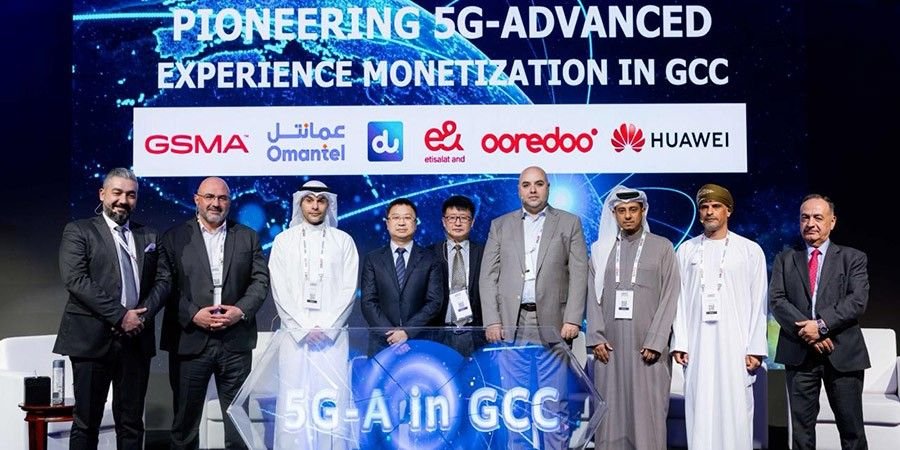
The 19th Telecom Review Leaders’ Summit (TRS 2025), held in Dubai under the theme “Tech Intelligence Beyond Mobility,” brought together senior telecom leaders to examine how 5G-Advanced (5G-A) is reshaping networks, business models, and customer experiences across the GCC. A central highlight was the panel titled “Pioneering 5G-Advanced Experience Monetization in GCC,” which focused on translating advanced connectivity into sustainable revenue growth.
Opening the discussion, Toni Eid, Founder of Telecom Review Group and CEO of Trace Media International, emphasized the GCC’s early and decisive investments in 5G-Advanced. He noted that the region’s proactive approach has laid the groundwork for AI-powered operations, smarter networks, and experience-based monetization models that go beyond traditional connectivity.
Moderated by Issam Eid, CMO of Telecom Review Group, the panel explored how AI, automation, and 5G-Advanced capabilities are converging to unlock the next phase of digital value creation.
Essa Haidar, CTO of Ooredoo Kuwait, highlighted that GCC countries consistently rank among global 5G leaders due to national strategies that position digital infrastructure as a driver of economic transformation. He explained that Ooredoo Kuwait’s early investments in 5G-Advanced are enabling low-latency, autonomous networks critical for emerging AI-as-a-Service use cases. According to Haidar, the fusion of AI and 5G-A is key to delivering premium, context-aware services such as enhanced gaming and personalized digital experiences.
Jawad Abbassi, Head of MENA at GSMA, reinforced the importance of competitive markets in sustaining innovation. He warned that artificial network limitations could hinder operators just as the region accelerates toward standalone 5G and 5G-Advanced deployments. Abbassi cited projections showing 90% 5G adoption across the GCC by 2030, initially driven by fixed wireless access, while acknowledging early monetization gaps. He pointed to GSMA’s Open Gateway initiative as a mechanism to unlock cross-border and cross-industry 5G services, noting China as a benchmark for large-scale 5G revenue generation.
From an operator perspective, Ayman Magdy Abousenna, Vice President of Mobile Data Core & Services at e& UAE, described 5G-Advanced as a milestone in network evolution. He referenced e&’s commercial 5.5G launch, which has enabled dynamic network slicing and high-performance connectivity for large-scale events such as Formula 1, as well as emerging use cases like drone services. Abousenna stressed that AI is not just about automation but about fundamentally transforming networks to deliver smarter, more trusted, and monetizable customer experiences.
Qadri Al Ahdal, Director of Core Network Planning at du, traced the operator’s journey from early 5G through standalone deployments to 5G-Advanced. As bandwidth demand rises due to autonomous and immersive applications, he said 5G-A introduces advanced capabilities to improve reliability and performance. He highlighted the role of 3GPP Releases 18 and 19 in enabling cross-domain intelligence and stronger security, with AI acting as the rapid-response layer that underpins both network resilience and differentiated service monetization.
Dr. Ali Al Hashmi, General Manager of Infrastructure Planning & Design at Omantel, framed connectivity as a fundamental human need, particularly in Oman’s remote and geographically challenging regions. He outlined Omantel’s progress toward a modernized 5G-Advanced landscape through new spectrum allocations and alignment with national digital ambitions. Dr. Al Hashmi emphasized that AI will be essential in managing future networks, enabling differentiated service levels, spectrum optimization by customer segment, and deeper understanding of customer experience. He also underlined the importance of aligning telecom strategies with government priorities and key sectors such as logistics and oil and gas.
From the vendor ecosystem, David Li, Chief Expert of Strategy Marketing at Huawei, highlighted the ecosystem-wide impact of 5G-Advanced, especially for home connectivity and high-bandwidth consumer applications. He stressed that AI integration is no longer optional, but essential for accuracy, efficiency, and innovation. Li emphasized close collaboration between vendors and operators, particularly through open OSS/BSS frameworks and Mobile AI, to build highly intelligent networks.
The panel concluded with a ceremonial launch symbolizing the GCC’s next leap into the 5G-Advanced era. The moment marked not only a technological milestone, but a regional commitment to experience-driven monetization, intelligent networks, and a digitally empowered future.