








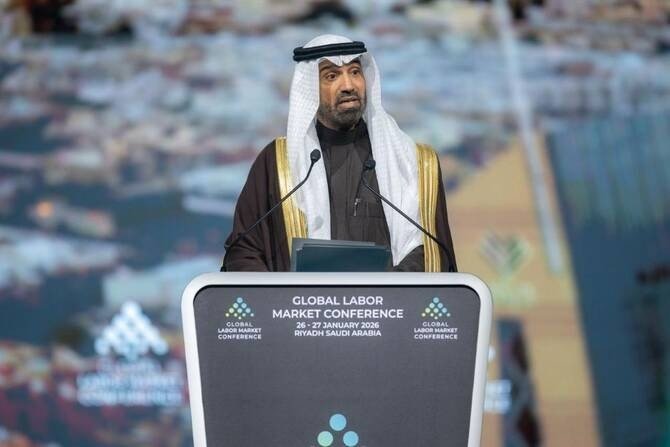
Saudi Arabia’s Minister of Human Resources and Social Development Ahmad Al-Rajhi said artificial intelligence, robotics, and automation are reshaping global labour markets by creating new opportunities while phasing out traditional roles.
Speaking at the opening of the third Global Labor Market Conference in Riyadh under the theme “Future in Progress,” Al-Rajhi said demand will surge for technology-driven roles such as AI specialists and data analysts, while positions like data entry and administrative assistants are likely to decline.
He added that the green transition is also transforming employment patterns, with rising demand for renewable energy engineers and environmental specialists as industries align with climate goals.
Al-Rajhi noted that rising living costs and slowing economic growth worldwide are changing the skills employers value most. Resilience, flexibility, and creative thinking will increasingly define employability in a volatile global environment.
He pointed to demographic shifts as another major force shaping labour markets, with ageing populations in some regions and expanding workforces in others. These trends are increasing demand for healthcare, training, and inclusive job creation.
Highlighting youth unemployment as a global challenge, Al-Rajhi said more than 262 million young people worldwide are not in employment, education, or training. Job creation, he warned, is not keeping pace with population growth in many regions, while others face the pressures of ageing workforces.
Rapid technological change is also outpacing education systems, making continuous upskilling essential across both developed and emerging economies. “These pressures differ by region, but they are too complex for countries to address in isolation,” he said.
Turning to Saudi Arabia’s domestic transformation, Al-Rajhi said more than 2.5 million Saudis have joined the private sector since 2020. He described young men and women as a growing national asset driving new skills and industries.
“These indicators show an economy in motion, with people investing in themselves, learning, competing, and shaping the future with confidence,” he said.
During the conference, Minister of Industry and Mineral Resources Bandar Al-Khorayef announced the launch of a new occupations and skills framework for the mining and industrial sectors. Covering more than 500 roles, the framework defines job titles, descriptions, and skills to help align training systems with industry needs.
Minister of Tourism Ahmed Al-Khateeb said global tourism is expected to generate 91 million jobs by 2035, despite a projected global shortfall of 43 million workers. In Saudi Arabia alone, he said, tourism is expected to create between 400,000 and 600,000 new jobs over the next five to six years as new destinations and cities are developed.
He added that tourism employment in the Kingdom has already grown from 750,000 in 2019 to more than one million, making it one of the most impactful sectors for reducing unemployment.
Muhammad Al-Jasser, chairman of the Islamic Development Bank Group, said infrastructure investment remains a powerful driver of growth and job creation, citing its strong multiplier effect. He warned that over the next decade, 1.2 billion people will enter the global labour market, while only 400 million jobs are expected to be created.
The two-day conference, running from January 26–27, focuses on trade shifts, informal economies, the evolving global skills landscape, the real impact of AI on jobs, building resilient labour markets, and improving job quality, with youth positioned at the centre of the future economy.