








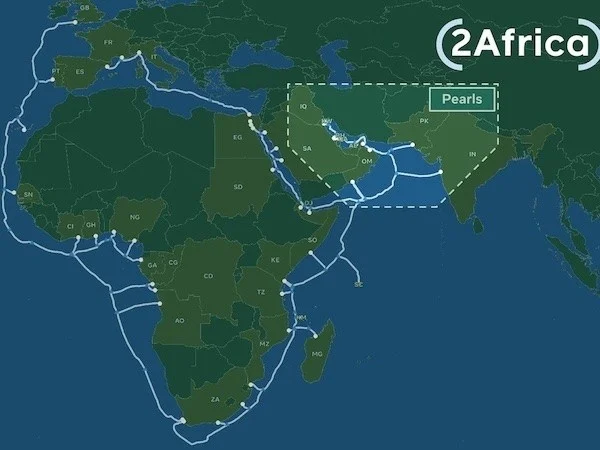
Deployment of the Middle Eastern segment of the 2Africa Pearls subsea cable system has reportedly been suspended after Alcatel Submarine Networks (ASN) issued force majeure notices, citing security risks linked to the ongoing conflict involving the US, Israel and Iran.
The 2Africa Pearls project, announced in 2021, is designed as an extension of the wider 2Africa subsea cable system and aims to strengthen connectivity between Oman, the UAE, Qatar, Bahrain, Kuwait, Iraq, Pakistan, India and Saudi Arabia.
The affected segment runs through the Persian Gulf via the Strait of Hormuz, a critical maritime corridor that has become a focal point in the escalating conflict. Iranian forces controlling the strait have reportedly targeted tankers and ships linked to the US and its allies, creating heightened security risks and impacting global oil markets.
According to Bloomberg, citing sources familiar with the situation, ASN informed customers that the security environment makes it unsafe to continue cable deployment operations. The company’s cable installation vessel operating in the Persian Gulf is currently stranded at the port of Dammam in Saudi Arabia.
While the core segment of the 2Africa system circling the African continent was completed earlier this year, the 2Africa Pearls extension remains partially unfinished. Much of the cable has already been deployed, but several landing stations have yet to be connected. The project had originally been scheduled to enter service later in 2026.
The 2Africa and 2Africa Pearls systems are backed by a consortium that includes China Mobile International, Meta, Bayobab, Orange, stc’s center3, Telecom Egypt, Vodafone and WIOCC.
TeleGeography analyst Alan Mauldin told Bloomberg that other subsea cable projects crossing the Persian Gulf—including the SEA-ME-WE 6 consortium cable and Ooredoo’s Fibre in Gulf (FIG) cable—have also reportedly paused deployment due to the conflict.
Meanwhile, subsea cable routes in the Red Sea have also faced increasing disruption. The corridor, widely used to link Europe, the Middle East, Africa, India and Southeast Asia, experienced several cable breaks and outages during 2025.