







By MEA Tech Watch Editorial
On the same day that industry leaders gathered at Atlantis, The Palm to discuss the future of intelligent networks, an Iranian drone was striking the administrative building of Thuraya Telecommunications in Sharjah. The juxtaposition was not ironic. It was instructive.
The SAMENA Leaders’ Summit 2026 opened under the theme “Intelligent Networks for Sovereign and Sustainable Futures.” It is a phrase that has lived comfortably in conference programmes for several years, a forward-looking aspiration that regulators and operators could nod at without urgency. This week, it stopped being aspirational. It became operational.
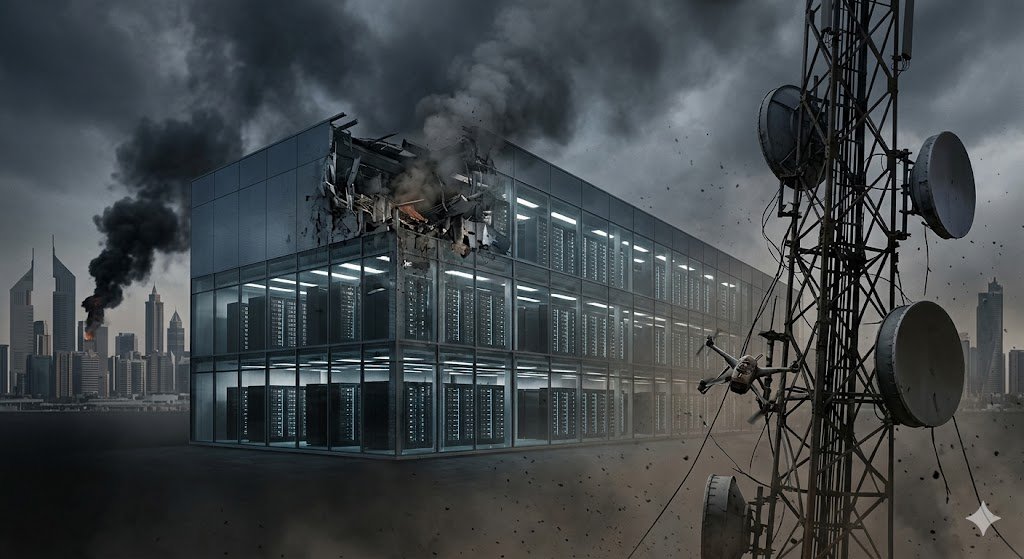
The events of the past five weeks have redrawn the map of what digital infrastructure risk actually means in this region. Iranian drone strikes damaged three Amazon Web Services data centre facilities across the UAE and Bahrain in early March, triggering extended outages across banking, payments and cloud services for millions of residents who could not pay for a taxi, access their accounts or reach their employers. A drone then struck Thuraya’s Sharjah headquarters — a geostationary satellite operator majority owned by a UAE sovereign entity, providing connectivity to maritime, government and humanitarian operations across three continents. Meanwhile, Iran’s own internet has been reduced to approximately one per cent of normal levels for more than 750 consecutive hours, with its government operating a deliberate kill-switch against its own population.
These are not edge cases. They are the new baseline.
At the summit, H.E. Sheikh Nahyan bin Mubarak Al Nahyan put it plainly: “In times of conflict, the digital domain becomes part of the battlefield, potentially targeted to create disruption, fear, and economic instability.” He then outlined four principles — resilience, trust, partnership and wisdom — that he said must underpin the region’s digital future. The UAE Cybersecurity Council disclosed that the country is absorbing 600 to 700 cyberattacks per day, a figure rising and being amplified by AI-enabled attack tools. ITU Secretary-General Doreen Bogdan Martin reminded the room that 2.2 billion people remain offline globally, and that decisions made now about 6G will determine whether the next generation of networks extends or repeats the exclusions of every previous technology cycle.
Taken together, these are not separate conversations. They are the same conversation.
The Gulf AI infrastructure buildout — Microsoft, Google Cloud, AWS, Oracle, the USD 2.7 billion Hexagon data centre in King Abdullah Economic City, G42’s 5GW Abu Dhabi campus — is real, consequential and still moving forward. But it is now moving forward under conditions that have permanently altered what resilience means. Cheap energy and geographic positioning at the intersection of three continents remain genuine advantages. The assumption of physical security for concrete infrastructure housing AI workloads does not.
The operators and regulators attending SAMENA this week are not retreating from their digital ambitions. The evidence suggests the opposite: Saudi Arabia has designated 2026 the Year of Artificial Intelligence, LEAP has been rescheduled rather than cancelled, du posted record profits and a record dividend, Zain’s brand value hit USD 4 billion, and the SAMENA summit itself ran a full programme including the world’s first commercial U6GHz deployment announcement. Across Africa, the Algiers Declaration committed 54 nations to a continental digital sovereignty agenda. Nigeria launched Project 774 to extend satellite connectivity to every local government area. Morocco ran a national AI hackathon through Ramadan and opens GITEX Africa in Marrakech next week.
The momentum is intact. What has changed is the honest acknowledgement of what it costs to sustain it.
Digital sovereignty, for years a somewhat abstract policy concept invoked to justify data localisation rules and national cloud preferences, now has a concrete operational meaning. It means the ability to keep systems running when missiles are in the air. It means the capacity to maintain communications when an adversary decides to use your infrastructure as a political signal. It means designing networks and data architectures not only for efficiency and scale but for the ability to absorb, reroute and recover under conditions that no commercial SLA has ever been written to address.
The industry has known this theoretically. The region is now living it in practice.
Sheikh Nahyan concluded his address at SAMENA with a line that deserves to travel beyond the room where it was delivered: “Technology must serve people and protect dignity, stability, prosperity, and peace.” That is not a platitude when it is spoken in a city where air defence systems are actively engaging missiles and drones. It is a statement of intent from a government that has chosen, deliberately and publicly, to continue building rather than to retreat.
That choice — to convene, to invest, to publish, to deploy, to connect — is itself an act of the resilience that every speaker at SAMENA this week said the region must demonstrate.
MEA Tech Watch will be watching whether the infrastructure, the institutions and the policies can match the intention.