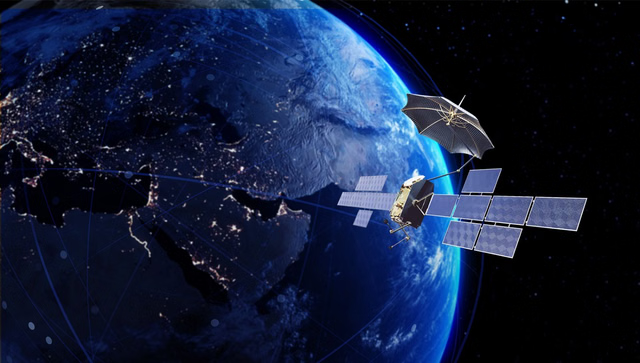




The Saudi Space Agency (SSA), in partnership with Aramco Digital, has launched the second edition of the “SARI 2” initiative, expanding efforts to build local capabilities and strengthen Saudi Arabia’s emerging space ecosystem.
The program is designed to engage undergraduate students from universities across the Kingdom in the development and launch of small satellites, providing hands-on exposure to satellite engineering, space communications, and advanced technology applications.
Through SARI 2, student teams will work on projects involving satellite design and space-based solutions that support multiple technology sectors. The initiative aims to strengthen scientific research, encourage innovation, and develop technical and engineering expertise aligned with the growing demands of the space industry.
The Saudi Space Agency and Aramco Digital are also providing an integrated support framework that includes mentorship from industry experts, technical workshops, and intensive training programs. Participants will gain access to educational resources and engineering guidance intended to improve project quality and execution readiness.
Saudi Arabia has been accelerating investment in its space sector as part of broader national efforts to diversify the economy and expand high-tech capabilities under Vision 2030. Talent development initiatives are increasingly being positioned as a foundational element of long-term space ambitions.
By focusing on university-level participation, the initiative aims to create an early-stage pipeline of engineers, researchers, and innovators capable of contributing to the Kingdom’s future space programs and advanced technology sectors.
Applications for the program are being reviewed through a competitive selection process led by a specialized committee.
Editor’s Note
This is not just a student competition. It reflects long-term space capability building.
The real story is talent pipeline creation. Countries entering the space economy must develop engineers and researchers years before large-scale programs mature.
The opportunity is early ecosystem formation. Programs like SARI 2 help create practical exposure to advanced aerospace and satellite technologies at university level.
The advantage is hands-on learning. Real project development produces stronger technical capability than theoretical education alone.
The challenge is continuity. Student initiatives must connect into sustained research, startup, and employment pathways.
The risk is symbolic participation. Without long-term ecosystem integration, projects can remain educational exercises rather than innovation drivers.
What to watch next is downstream impact. The real signal will be whether participants transition into startups, research programs, or national space initiatives over time.