








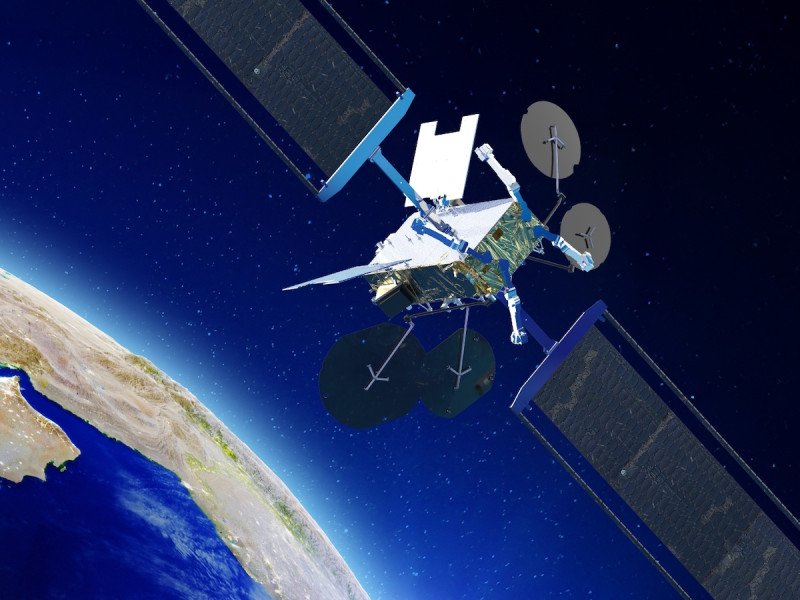
Qatar Satellite Company (Es’hailSat) has selected Thales Alenia Space to supply a next-generation software-defined communications satellite, strengthening the country’s satellite infrastructure and enhancing its ability to deliver flexible, high-capacity connectivity across the Middle East, Africa and beyond.
The new satellite will incorporate software-defined payload technology, enabling Es’hailSat to dynamically reconfigure coverage areas, bandwidth allocation and service capabilities throughout the satellite’s operational lifetime. The project represents a significant step in Qatar’s strategy to modernize its space communications infrastructure and support the growing demand for broadband, broadcasting and government communications services.
The agreement reflects the broader transformation underway in the satellite industry, where software-defined architectures are replacing traditional fixed-capacity satellite systems.
Software-Defined Satellites Redefine Space Connectivity
Unlike conventional satellites with fixed coverage and capacity, software-defined satellites can adapt to changing market requirements after launch.
Operators can reallocate bandwidth, reshape coverage beams and optimize capacity in response to customer demand without requiring new hardware in orbit.
This flexibility enables satellite providers to respond more quickly to evolving requirements from telecommunications operators, broadcasters, governments and enterprise customers.
Industry analysts increasingly view software-defined satellites as the future of commercial satellite communications.
Supporting the Growth of AI and Digital Infrastructure
Demand for satellite connectivity continues to grow as cloud computing, artificial intelligence and digital services expand into remote and underserved regions.
Modern satellite infrastructure complements terrestrial fiber and mobile networks by providing resilient connectivity for aviation, maritime services, energy operations, disaster recovery and rural broadband.
Software-defined capabilities also enable more efficient management of network resources, supporting increasingly dynamic digital workloads.
As digital economies become more interconnected, hybrid terrestrial-satellite networks are expected to play an increasingly important role.
Strengthening Qatar’s Space Economy
The project reinforces Qatar’s long-term investment in space infrastructure as part of its broader digital transformation strategy.
Es’hailSat has steadily expanded its satellite capabilities to support broadcasting, telecommunications, government communications and secure connectivity across regional and international markets.
Deploying next-generation satellite technology strengthens Qatar’s position within the rapidly evolving global space economy while enhancing national digital resilience.
The investment also supports the country’s ambition to become a leading regional provider of advanced satellite services.
Satellite Technology Evolves into Intelligent Infrastructure
The satellite communications industry is undergoing a major technological shift driven by software-defined payloads, artificial intelligence, cloud integration and digital network management.
Future satellite platforms will increasingly operate as intelligent, programmable infrastructure capable of integrating seamlessly with terrestrial 5G, cloud platforms and enterprise networks.
For operators, this flexibility improves operational efficiency while extending the commercial lifespan and value of satellite assets.
Industry observers expect software-defined architectures to become the standard for future satellite deployments.
Why This Matters
Software-defined satellites provide greater flexibility, efficiency and resilience than traditional satellite platforms, enabling operators to adapt capacity and coverage as market demands evolve. These capabilities are becoming increasingly important as cloud services, AI applications and global connectivity requirements continue to expand.
For Es’hailSat, the agreement with Thales Alenia Space strengthens its next-generation satellite infrastructure and enhances its ability to deliver advanced communications services across the region. For Qatar, the investment reinforces the country’s growing role in the global space economy while supporting long-term ambitions in digital infrastructure, secure communications and technology innovation.
Editor’s Note
The satellite industry is moving from static infrastructure to programmable digital platforms. Software-defined satellites represent one of the most significant technological advances in space communications, allowing operators to adapt networks in real time rather than being constrained by design decisions made years before launch. Es’hailSat’s investment reflects this evolution, positioning Qatar to benefit from more agile and resilient satellite capabilities. As AI, cloud computing and ubiquitous connectivity reshape global communications, software-defined satellite infrastructure will become an increasingly important pillar of the world’s digital ecosystem.