








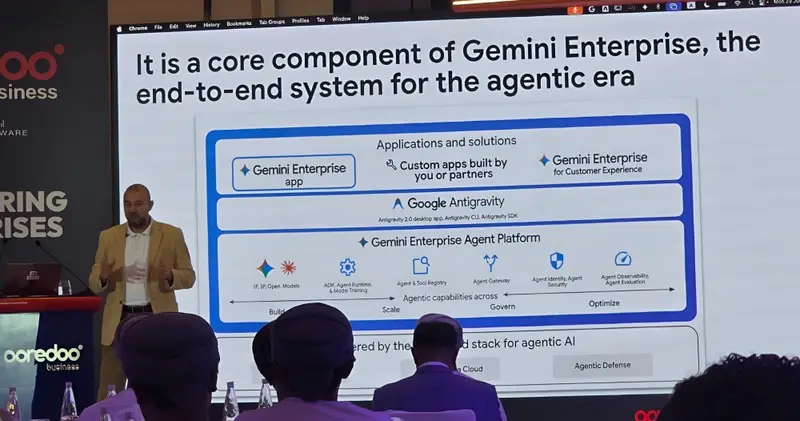
Ooredoo Business and Google Cloud have launched a joint initiative to accelerate the adoption of sovereign, enterprise-grade artificial intelligence (AI) in Oman, addressing growing demand for secure, locally compliant AI infrastructure that aligns with Gulf data sovereignty regulations.
Announced during a cloud forum in Muscat, the partnership focuses on enabling organizations to deploy advanced AI capabilities without compromising regulatory compliance. By combining Google Cloud’s AI technologies with Ooredoo’s local infrastructure, the initiative provides enterprises with a secure path to adopt generative AI while ensuring sensitive data remains within national regulatory boundaries.
The move reflects a broader trend across the GCC, where governments and enterprises are prioritizing sovereign AI infrastructure to support digital transformation while meeting increasingly stringent data residency and cybersecurity requirements.
Sovereign AI Becomes an Enterprise Priority
As organizations adopt generative AI and large language models, data sovereignty has become one of the biggest barriers to enterprise deployment.
Highly regulated sectors such as banking, healthcare and government are often prohibited from transferring sensitive information outside national borders, limiting the use of public AI platforms hosted in international cloud environments.
The solution presented by Ooredoo Business and Google Cloud addresses these concerns by providing enterprise AI capabilities within a secure cloud environment where corporate data remains isolated and is not used to train public AI models.
This approach enables organizations to benefit from advanced AI while maintaining compliance with local regulations and internal security policies.
Secure Infrastructure Powers Enterprise AI
The partnership places significant emphasis on secure AI architecture designed for mission-critical business environments.
The enterprise platform includes dedicated cloud “landing zones” that isolate customer data, preventing exposure to public foundation model training while maintaining end-to-end encryption and enterprise access controls.
The architecture also supports direct integration with existing enterprise platforms such as SAP, Oracle and Salesforce through retrieval-augmented generation (RAG), allowing AI systems to access live business information without duplicating sensitive databases.
By grounding AI responses in real-time enterprise data, organizations can reduce hallucinations while improving the reliability of AI-generated outputs.
AI Agents Move Beyond Chatbots
The forum highlighted the evolution of enterprise AI from conversational assistants toward autonomous AI agents capable of executing complex business workflows.
Rather than simply answering questions, these AI systems can automate multi-step operational processes, retrieve business information across multiple systems and support decision-making with contextual intelligence.
This shift represents the next phase of enterprise AI adoption, where organizations increasingly focus on workflow automation, operational efficiency and intelligent business orchestration.
Industry analysts expect agentic AI to become a major driver of enterprise productivity over the coming years.
Supporting Oman Vision 2040
The initiative aligns closely with Oman Vision 2040, which identifies artificial intelligence, cloud computing and digital transformation as key pillars of economic diversification.
By providing locally hosted AI infrastructure, Ooredoo Business strengthens Oman’s digital ecosystem while enabling organizations to modernize operations without compromising regulatory compliance.
The partnership also reinforces the growing role of telecommunications operators as providers of sovereign digital infrastructure, extending beyond connectivity into cloud, cybersecurity and AI services.
As enterprise AI adoption accelerates across the Gulf, locally compliant cloud infrastructure is expected to become an increasingly important competitive advantage.
Why This Matters
Enterprise AI adoption is increasingly constrained not by model capability but by regulatory compliance, data governance and infrastructure readiness. Sovereign AI platforms help organizations deploy advanced AI securely while meeting local data residency and cybersecurity requirements.
For Oman, the collaboration between Ooredoo Business and Google Cloud strengthens the country’s AI infrastructure and supports national digital transformation objectives under Vision 2040. For enterprises, it provides a compliant pathway to adopt generative AI, autonomous AI agents and intelligent automation while maintaining control over sensitive corporate data.
Editor’s Note
The enterprise AI conversation is rapidly shifting from which model to use to where and how that model is deployed. Across the GCC, data sovereignty has become a defining requirement for AI adoption, particularly in highly regulated sectors. Ooredoo Business and Google Cloud’s collaboration illustrates how telecom operators are evolving into sovereign AI infrastructure providers, combining hyperscale cloud capabilities with locally hosted, regulation-compliant environments. As organizations move toward agentic AI and enterprise-wide automation, trusted digital infrastructure will become as critical to AI success as the intelligence of the models themselves.