






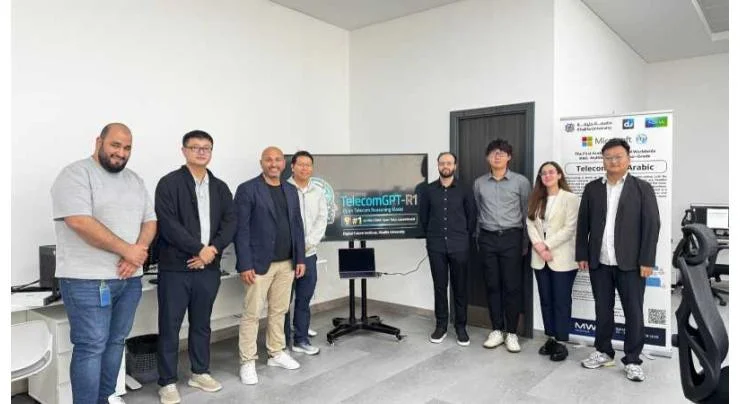
Khalifa University has announced that its TelecomGPT R1 large language model has achieved the highest ranking on the GSMA Open-Telco LLM Benchmark, positioning the UAE at the forefront of artificial intelligence innovation for the global telecommunications industry.
The achievement highlights the growing shift toward domain-specific AI models tailored for telecommunications, where operators are increasingly deploying artificial intelligence to automate network operations, enhance customer service and accelerate digital transformation.
Rather than relying on general-purpose AI systems, telecom-focused large language models are being developed to understand the industry’s technical standards, operational workflows and network environments.
AI Models Become Specialized for Telecommunications
As AI adoption matures, industries are moving beyond generic foundation models toward domain-specific AI designed to solve sector-specific challenges.
Telecommunications operators require AI systems capable of interpreting network protocols, supporting fault diagnosis, optimizing infrastructure and assisting engineers with complex operational tasks.
TelecomGPT R1 has been developed specifically for these requirements, demonstrating how specialized AI can outperform broader-purpose models in industry-focused benchmarks.
This trend reflects the growing importance of vertical AI models that combine deep industry knowledge with advanced language understanding.
Benchmark Recognition Strengthens UAE’s AI Credentials
Leading the GSMA Open-Telco LLM Benchmark provides international recognition of the UAE’s growing capabilities in applied artificial intelligence research.
The achievement aligns with the country’s broader investments in AI, advanced computing, cloud infrastructure and digital innovation, reinforcing ambitions to become a global center for AI development.
Universities are playing an increasingly important role in this ecosystem by translating academic research into technologies with practical commercial and industrial applications.
The collaboration between academia and industry is becoming a key driver of AI innovation across sectors.
AI Is Reshaping Telecom Operations
Artificial intelligence is rapidly becoming embedded across telecommunications networks.
Operators are deploying AI to automate network management, improve customer support, predict equipment failures, optimize energy consumption and strengthen cybersecurity.
Telecom-specific language models have the potential to further enhance these capabilities by providing engineers and operators with intelligent assistants capable of understanding highly technical telecommunications environments.
Industry analysts expect AI-native networks to become a defining characteristic of next-generation telecom infrastructure.
Supporting the Future of Intelligent Networks
The rise of AI-driven telecommunications coincides with the industry’s evolution toward 5G-Advanced and future 6G networks.
These increasingly complex environments will require intelligent automation to manage network performance, optimize spectrum utilization and support emerging applications such as autonomous systems, IoT and immersive digital services.
Specialized AI models such as TelecomGPT R1 are expected to become foundational tools for enabling these intelligent network capabilities.
The achievement also demonstrates the growing strategic importance of sovereign AI research and locally developed models.
Why This Matters
Domain-specific AI models are becoming increasingly valuable as industries seek solutions tailored to their unique operational requirements. In telecommunications, specialized AI can improve network management, customer experience and operational efficiency while supporting the transition toward AI-native networks.
For the UAE, Khalifa University’s achievement reinforces the country’s leadership in applied AI research and telecommunications innovation. For the global telecom industry, it signals the growing importance of sector-specific large language models in shaping the next generation of intelligent communications infrastructure.
Editor’s Note
The next phase of artificial intelligence will not be defined solely by larger foundation models, but by specialized AI systems built for individual industries. Telecommunications is among the sectors where domain expertise is critical, requiring AI that understands network architectures, engineering standards and operational complexity. Khalifa University’s success with TelecomGPT R1 illustrates how focused innovation can deliver measurable performance gains over general-purpose models. As operators worldwide move toward AI-native networks, specialized telecom language models are likely to become as important to future communications infrastructure as spectrum, fiber and cloud computing.