

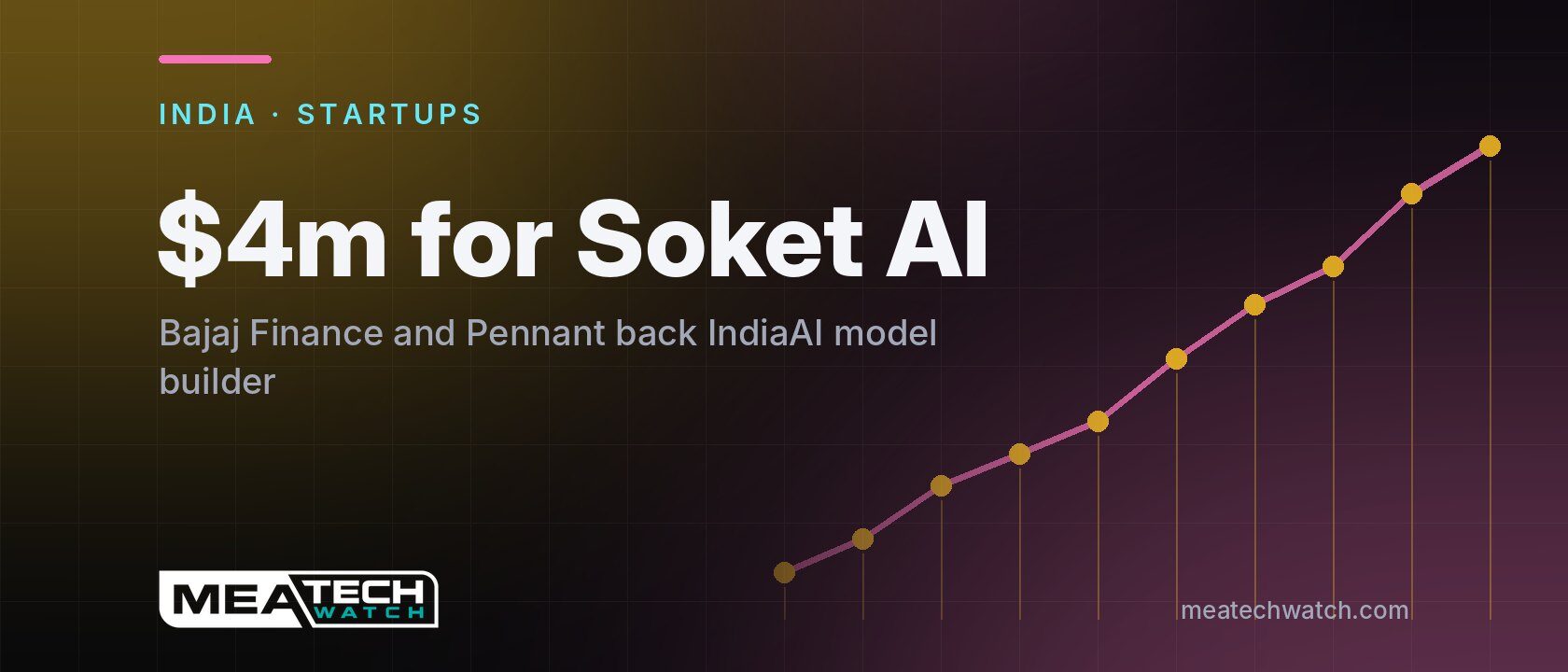
Bajaj Finance and lending software firm Pennant Technologies have each put $2m into Soket AI, a Bengaluru company building Indian large language models under the government’s IndiaAI Mission, bringing the round to $4m.
The deal puts money from a large Indian lender, and from a supplier of software to banks, behind a model builder that also draws on state-subsidised computing. Both investors say they want models that banks and lenders can run on their own servers, which is a live issue for regulated firms that handle customer data.
How the Soket AI investment is structured
Bajaj Finserv’s group research arm, Finserv Intelligence, invested about $2m through Bajaj Finance, according to the Bajaj Finserv statement issued on 19 November in Mumbai and Bengaluru. The statement describes Bajaj Finance as India‘s largest private sector non-bank.
Pennant Technologies, a Hyderabad company that sells lending software to banks and financial institutions, announced its own $2m investment in a release dated 18 November. Pennant said Bajaj Finance was co-investing as a strategic investor, taking the combined amount to $4m. Bajaj Finance is itself an investor in Pennant: it agreed in October 2023 to take a stake of up to 26% for Rs267.50 crore, as Indian Startup News reported.
Neither company disclosed Soket AI’s valuation. Business Standard described the total as nearly $4m.
What Soket AI builds
Soket AI was founded in 2019 and was selected under the IndiaAI Mission to build a sovereign foundation model, Pennant’s release said. Its main project, Project EKA, focuses on mathematics, code and reasoning.
The first model from that project, EKA-1, was launched by the government in early November alongside two models from another developer, ZenteiQ, News On AIR reported on 4 November. The public broadcaster said EKA-1 has 26.3 billion parameters, was trained on about 7.5 trillion tokens and covers all 22 scheduled Indian languages plus English.
The company says it plans much larger models later, in the range of hundreds of billions to a trillion parameters, and that Project EKA is designed to support more than 100 languages. It has also released Loop, an open-source tool for running long AI tasks.
Pennant said the two companies will test Soket’s models inside its banking software, including AI agents, document processing and collections tools. They also plan banking-specific models and agents for know-your-customer (KYC) checks, onboarding, collections, compliance and fraud detection. The models are designed to run on a customer’s own premises and in air-gapped systems that are cut off from the internet.
What the investors said
Rajeev Jain, vice chairman and managing director of Bajaj Finance, said in the statement: “At Bajaj Finance, FinAI is reshaping how we build, operate and scale our business.”
He also said: “The next phase of AI will be defined by outcomes delivered at sustainable cost.” According to the statement, he added that Soket’s models can be deployed within Bajaj Finance’s own infrastructure.
Context: how IndiaAI funds model builders
The IndiaAI Mission has an outlay of Rs10,372 crore. In March, Jitin Prasada, minister of state for electronics and IT, told the Lok Sabha that 38,231 GPUs had been made available through a shared compute facility at subsidised rates and that 12 organisations and consortia were being supported to build Indian foundation models, NewKerala reported.
Most of the mission’s compute money has gone to that small group. An analysis by ThePrint of the IndiaAI compute portal, published on 20 October, found Rs1,275 crore committed for subsidised computing, of which foundation model builders received Rs1,058 crore, or about 83%. It listed an approval worth Rs163.04 crore in the name of Soket’s founder, Abhishek Upperwal, behind Sarvam AI at Rs246.72 crore and an approval of Rs177.27 crore linked to Gnani.ai.
Set against that, the $4m round is small. Its weight lies in who is paying: a lender that would use the models, and a software supplier that would sell them to other banks.
Other governments in the region are also backing local language models. In Egypt, the Applied Innovation Centre’s Karnak model has passed 300,000 downloads and powers legal, education and dental-screening apps, the communications ministry said at Cairo ICT in early November, Daily News Egypt reported.