Govt publishes white paper on telecom sector
The government has released a white paper on Bangladesh’s telecommunications sector, documenting widespread corruption, administrative failures, and structural weaknesses that have accumulated over the past 15 years. The report was prepared by a task force formed in April last year with the approval of the chief adviser, tasked with reviewing allegations of corruption and misconduct within the Posts and Telecommunications Division.
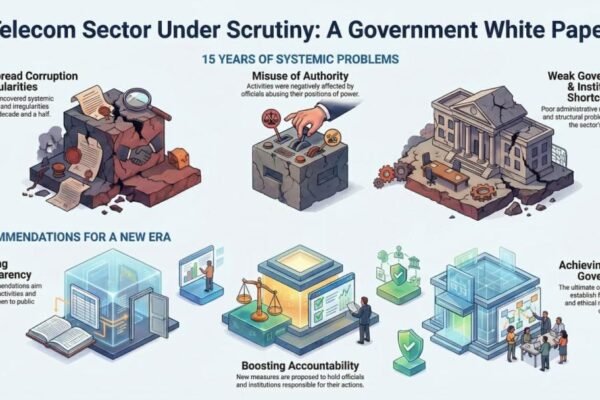
After months of investigation and analysis, the task force submitted its final report, which the government published today. According to the official statement, the white paper finds that the sector has been undermined by systemic irregularities, misuse of authority, weak governance frameworks, and persistent institutional shortcomings.
The document provides a forensic review of 10 key entities under the Posts and Telecommunications Division, concluding that governance failures have distorted markets, eroded regulatory credibility, and resulted in the misuse of public resources. It identifies entrenched corruption, favoritism, politicised appointments, and procurement manipulation as recurring patterns that have weakened the sector’s ability to deliver affordable and reliable connectivity.
Prepared by a seven-member committee led by Professor Kamrul Hasan of Bangladesh University of Engineering and Technology, the white paper describes the sector as structurally misaligned and operationally compromised. It warns that these deficiencies pose systemic risks to meritocracy, institutional trust, service delivery, and long-term reform.
A central focus of the report is the Bangladesh Telecommunication Regulatory Commission (BTRC), which it describes as a key source of irregularities rather than an effective regulator. The commission is accused of non-competitive recruitment practices, excessive age relaxations, improper absorption of project-funded staff, re-employment of retirees, and conflicted commissioner appointments. The report says these practices blurred the line between regulator and employer, undermining institutional integrity and oversight.
The findings also extend to state-owned enterprises such as Bangladesh Telecommunications Company Limited and Teletalk, where boards are described as instruments of governance capture, with politicised decision-making at the board level contributing to inefficiency and financial losses.
The white paper includes a set of recommendations aimed at restoring transparency, accountability, and good governance. The government said it hopes the report will serve as a guideline for institutional reform, strengthen anti-corruption measures, and support the delivery of more efficient and citizen-friendly telecom services in the future.