
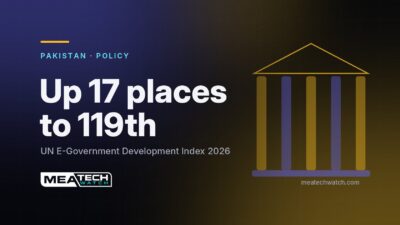


Pakistan has climbed 17 places to 119th of 194 countries in the United Nations E-Government Development Index (EGDI) 2026, moving from the index’s “Middle” group into its “High” group.
The UN survey, published every two years, compares how well governments deliver services and connect citizens online. Pakistan’s gain is one of the largest in Southern Asia, but its overall score is still below the global average, and Bangladesh remains well ahead.
Pakistan’s scores in the UN e-government index
Pakistan’s EGDI score rose from 0.5096 in 2024 to 0.6264 in 2026, an increase of 23%, the Ministry of Information Technology and Telecommunication said, as reported by the state news agency APP. The country ranked 150th in 2022 and 136th in 2024, so it has gained 31 places across two editions.
The ministry gave three sub-scores. The online services index rose 20% to 0.8422, the second highest in Southern Asia. The telecommunication infrastructure index rose 39% to 0.6590, after a 52% rise in the previous edition. Pakistan’s online participation score of 0.9655 was the highest in Southern Asia, the ministry said.
The ministry linked the gain to the Digital Nation Pakistan Act, 2025, which created the Pakistan Digital Authority, and said the UN named Pakistan among the largest gainers in Southern Asia, according to APP and Dawn.
Shaza Fatima Khawaja, federal minister for information technology and telecommunication, said: “Pakistan has risen 31 places in two editions of the UN’s benchmark for digital government.”
What the UN E-Government Survey 2026 measures
The 2026 survey is the 14th edition and marks 25 years of the assessment, according to the UN Department of Economic and Social Affairs (UN DESA). It covers the 193 UN member states and, for the first time, the State of Palestine.
The UN says 151 of the 194 countries now have high or very high EGDI values. About 1.95 billion people, or 24.3% of the world’s population, live in countries with scores below the global average. This edition also looks at the move towards AI-enabled and potentially agentic public administration, UN DESA said.
Pakistan’s ministry published scores for online services, telecom infrastructure and online participation, but not for the other parts of the index.
Context: how Pakistan compares with Bangladesh and the world
Bangladesh ranked 97th, up three places from 100th in 2024, with an EGDI score of 0.6893, its highest yet, according to a Ministry of Posts, Telecommunications and Information Technology release carried by BSS. Its online services score was 0.81 and its telecommunication infrastructure score 0.69.
The global average EGDI rose to 0.6675 in 2026 from 0.6382 in 2024, according to the same BSS report. Pakistan’s 0.6264 is therefore still below the world average, while Bangladesh is above it. The Republic of Korea topped the 2026 ranking, BSS reported.
Pakistan’s online services score of 0.8422 is higher than Bangladesh’s 0.81, on the two governments’ figures. The gap between the two countries in the overall index comes from the other parts of the score.
Frequently asked questions
Where does Pakistan rank in the UN e-government index 2026?
Pakistan ranks 119th of 194 countries, up 17 places from 136th in 2024, with an EGDI score of 0.6264, according to its IT ministry.
How does Bangladesh compare?
Bangladesh ranks 97th with an EGDI score of 0.6893, up from 100th in 2024, according to its telecom ministry.
Is Pakistan above the global average?
No. The global average EGDI in 2026 is 0.6675, according to the BSS report, against Pakistan’s 0.6264.