









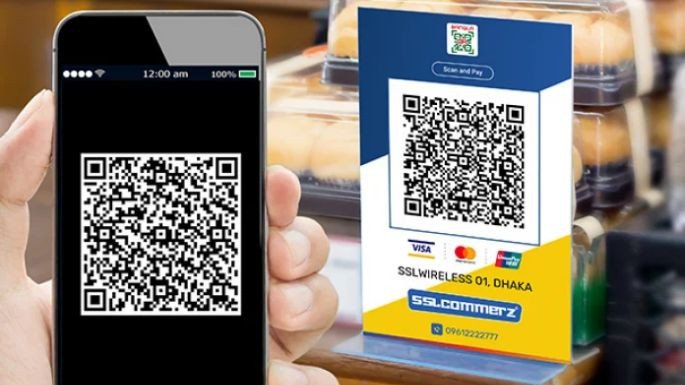
Bangladesh Bank has issued a mandatory directive requiring all banks, mobile financial service providers, payment service providers and payment system operators to replace proprietary QR codes at merchant points with its interoperable Bangla QR platform by 30 June 2026, threatening fines of up to Tk 30 lakh, imprisonment of up to three years, or both for institutions that fail to comply.
The circular, issued under Section 37(5) of the Payment and Settlement Services Act 2024, marks a decisive regulatory shift from promotion to enforcement. Bangla QR, launched by Bangladesh Bank in 2023, allows customers of any participating bank or mobile financial service to pay at merchant points using a single universal QR code, eliminating the fragmented proprietary systems operated by individual providers including bKash and Nagad.
Under the directive, all merchant points must visibly display Bangla QR, and institutions must ensure uninterrupted interoperability and regular monitoring of merchant compliance. Any merchant found using Bangla QR for cash-out rather than payment transactions must have the facility immediately cancelled. Institutions have also been instructed to intensify merchant and consumer awareness campaigns.
The mandate sits within Bangladesh’s broader Cashless Bangladesh initiative, under which Bangla QR integration has already been made a compulsory condition for issuing and renewing trade licences for retail businesses and merchants. Separately, all banks and mobile financial service providers were required to establish dedicated cashless transaction units by 31 March, staffed at deputy managing director level in banks, with annual reporting to Bangladesh Bank.
Bangladesh Bank Governor Md Mostaqur Rahman framed the Bangla QR rollout as central to national revenue enhancement and financial transparency in remarks on 1 April, describing cashless transaction expansion as a priority for the central bank.
Editor’s Note: The June 30 deadline backed by criminal sanctions is a significant escalation. Bangladesh is following a well-worn emerging market playbook — interoperable QR standard, adoption incentives, then mandatory enforcement — but the speed of the enforcement phase is notable. The trade licence linkage is particularly powerful as a compliance mechanism, since it puts merchant livelihoods directly at stake. Watch for the implementation gap between the directive and city corporation rollout, which The Business Standard has already flagged as a friction point.