






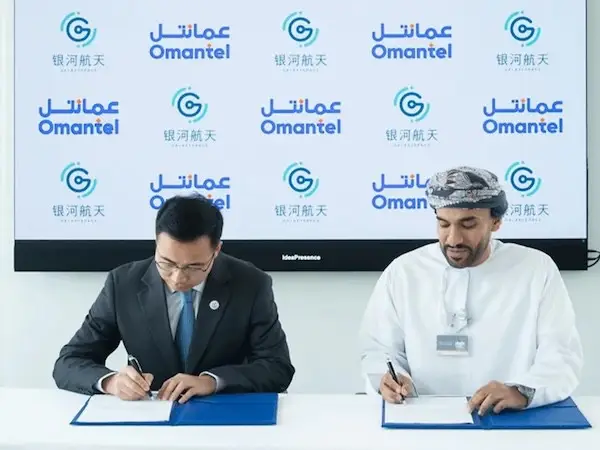
Omantel has signed a framework agreement with Chinese low Earth orbit satellite company GalaxySpace to evaluate next-generation satellite connectivity in Oman, including the potential use of direct-to-device technologies alongside terrestrial networks.
The collaboration will focus on proof-of-concept activities, technical assessments and possible service scenarios to determine the feasibility, performance and commercial relevance of future satellite-enabled services in the Sultanate.
The agreement also covers knowledge transfer, technical capability development and joint learning.
D2D and LEO broadband among technologies under evaluation
Omantel and GalaxySpace will assess how LEO satellite connectivity could complement Oman’s existing telecom infrastructure.
Potential areas include resilient broadband, coverage continuity in remote or difficult locations, enterprise and industrial applications, maritime connectivity, logistics and IoT services.
Direct-to-device technology is also part of the evaluation framework.
D2D systems are designed to allow compatible mobile devices to communicate directly with satellites, potentially extending connectivity beyond the reach of terrestrial mobile towers.
The agreement does not yet represent a commercial service launch.
Proof-of-concept work will test technical and commercial viability
The partnership is structured around exploratory work rather than immediate deployment.
Both companies will examine proof-of-concept projects and technical evaluations to understand where satellite connectivity could provide practical value.
This could include assessing coverage, capacity, performance and how satellite services can integrate with Omantel’s terrestrial network.
Commercial relevance will also be considered before any wider rollout decision is made.
Remote, maritime and logistics use cases highlighted
Oman’s geography makes satellite connectivity particularly relevant for areas where terrestrial network expansion is difficult or uneconomic.
The companies identified remote locations, maritime environments and logistics operations among the potential use cases.
Satellite connectivity could also provide an additional layer of resilience where terrestrial networks are unavailable or disrupted.
For industrial and IoT deployments, LEO connectivity could support assets operating beyond conventional fixed or mobile network coverage.
Omantel links partnership to Oman Vision 2040
Omantel CEO Aladdin Baitfadhil said the collaboration is intended to deepen the operator’s understanding of emerging connectivity technologies and their potential role in Oman’s digital transformation.
“As connectivity technologies continue to evolve, satellite capabilities are becoming an increasingly important complement to terrestrial networks in enabling the next phase of digital transformation,” he said.
Baitfadhil added that the partnership supports Omantel’s efforts to strengthen the resilience, reach and future readiness of Oman’s connectivity ecosystem.
The initiative also aligns with Oman Vision 2040 and wider national digital priorities.
GalaxySpace brings more than 40 LEO satellites
GalaxySpace designs and manufactures its own LEO satellites and currently has more than 40 spacecraft in orbit.
The company has also developed the Mini-Spider LEO broadband test constellation in China to validate satellite internet technologies and applications.
Peter Huang Heping, general manager for international business development at GalaxySpace, said the Omantel collaboration would allow the companies to assess how LEO broadband and direct-to-cell technologies could support the development of local satellite capabilities in Oman.
He also pointed to potential opportunities beyond Oman in the wider region.
GalaxySpace expands international telecom partnerships
The Omantel agreement adds to GalaxySpace’s growing list of international telecom collaborations.
The company signed a similar cooperation agreement with Thailand’s True Corp in February 2025.
It also signed a memorandum of understanding with Nigeria’s National Space Research and Development Agency in June 2025 to explore integration of its LEO constellation with Nigeria’s telecom infrastructure for potential direct-to-device services.
These partnerships suggest GalaxySpace is seeking to build international commercial and technical relationships as competition in the LEO satellite market intensifies.
Why this matters
The agreement shows that Gulf telecom operators are increasingly treating satellite connectivity as a complementary layer rather than a separate market.
For Omantel, LEO and D2D technologies could extend coverage, improve resilience and open new enterprise and maritime use cases without relying solely on terrestrial infrastructure.
The most important point is that the partnership remains exploratory. Proof-of-concept work and technical validation will determine whether these technologies progress toward commercial deployment.
Editor’s note
Oman is a strong test market for hybrid terrestrial and satellite connectivity because of its remote terrain, maritime economy and logistics corridors.
The strategic value of the Omantel-GalaxySpace agreement lies in integration.
If LEO broadband and direct-to-device services can be combined effectively with existing mobile networks, satellite connectivity could become part of the mainstream telecom architecture rather than a standalone service for isolated use cases.