







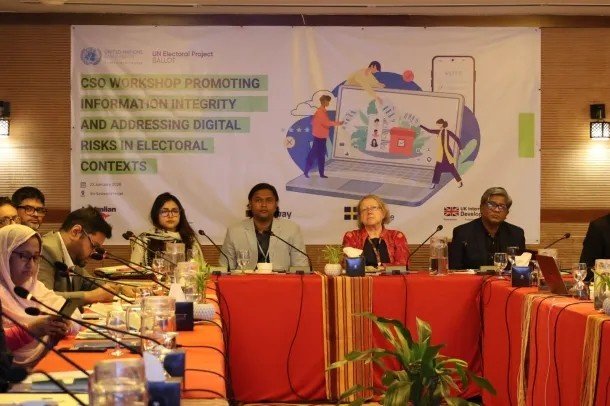
As Bangladesh prepares for its national elections in February 2026, UNESCO Dhaka has convened digital platforms, civil society organisations, and media and fact-checking bodies to address growing risks to electoral information integrity.
The day-long in-person workshop, organised with Digitally Right under the UN Electoral Project (BALLOT), brought together more than 30 participants from over 20 civil society organisations. The objective was to examine emerging online threats to electoral discourse and explore collaborative, rights-based responses in support of the Bangladesh Election Commission (BEC).
META and TikTok joined virtually to provide insights into community standards, reporting tools, enforcement policies, escalation pathways, and challenges related to AI-generated content and deepfakes, strictly from an informational perspective.
Participants, including senior CSO representatives, media development and fact-checking organisations, development partners, and information integrity experts, discussed the rising impact of misinformation, disinformation, hateful content, and AI-driven deepfakes. These trends were examined in the context of their potential to erode public trust, voter confidence, and social cohesion during elections.
Throughout the sessions, participants stressed that traditional media-centric responses are no longer sufficient. They highlighted the need for multi-stakeholder engagement, stronger digital literacy, and deeper understanding of platform governance and content moderation mechanisms.
Recent consultations under the BALLOT Project, alongside a CSO-level dialogue hosted by Digitally Right in November 2025, have already pointed to the growing vulnerability of Bangladesh’s information ecosystem. The prevalence of mis- and disinformation continues to pose a threat to public confidence in electoral processes.
Using “UNESCO’s Guidelines for the Governance of Digital Platforms” as a foundation, the workshop aimed to foster neutral and inclusive dialogue on electoral information integrity while strengthening practical awareness among CSOs and media organisations on identifying, reporting, and escalating harmful or misleading online content. It also introduced relevant digital and human rights frameworks to support multi-stakeholder approaches to platform governance and online participation.
The workshop opened with remarks from Dr Susan Vize, Head of Office and UNESCO Representative to Bangladesh, followed by a presentation on electoral information integrity and digital risks by UNESCO Senior Project Officer Mehdi Benchelah.
Additional sessions were led by FactWatch on election-period fact-checking and by Digitally Right on digital safety tools, offering practical guidance for journalists, CSOs, and other stakeholders working on election-related information integrity.
Through shared experiences and collective discussion, participants identified follow-up priorities under the BALLOT Project, particularly to strengthen online safety and information integrity for journalists and vulnerable groups during electoral periods. The outcomes are expected to enhance situational awareness among electoral stakeholders, including the BEC, and inform future initiatives to support credible, transparent, and peaceful elections in Bangladesh.