







ISLAMABAD: Pakistan and Türkiye have reaffirmed their commitment to strengthening bilateral cooperation in science, technology, innovation and applied research, with a renewed focus on industrial modernization and knowledge-based economic growth.
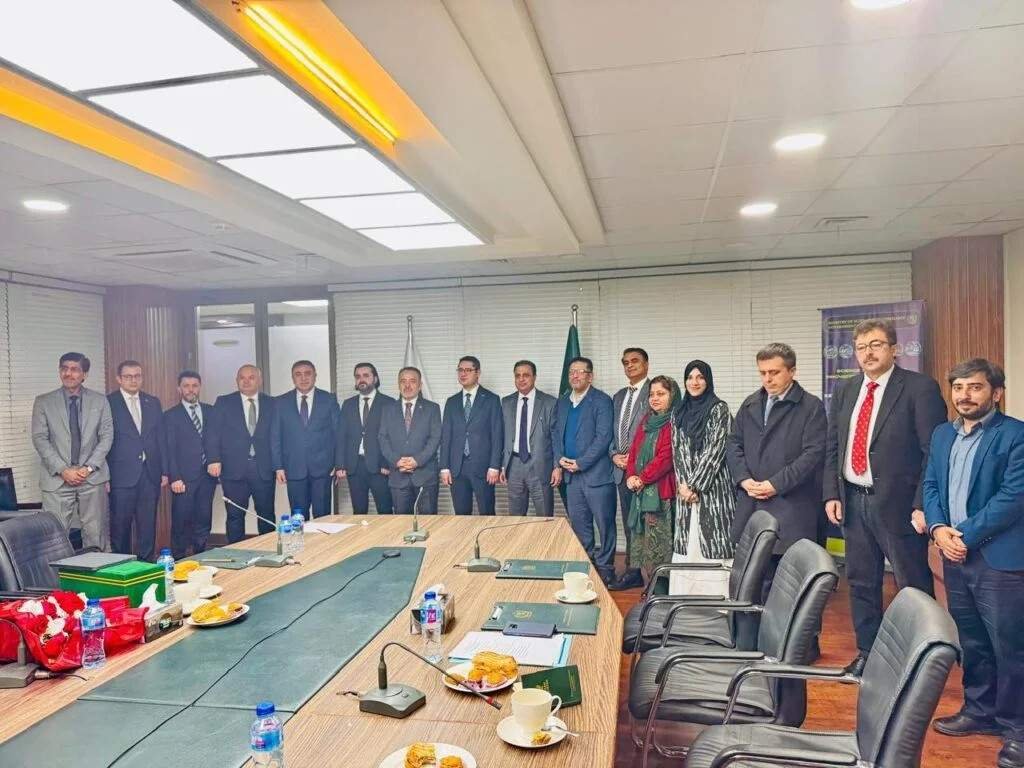
The discussions took place during a meeting between a Turkish delegation, led by Deputy Minister of Industry and Technology Muhammet Kasım Gönüllü, and Pakistan’s Federal Secretary of the Ministry of Science and Technology, Shahid Iqbal Baloch. The engagement was held under the agenda of advancing scientific and technological cooperation between the two countries.
Both sides emphasized expanding institutional linkages and accelerating joint initiatives aligned with innovation-driven development and industrial competitiveness. The collaboration is being pursued in line with broader national priorities to promote sustainable industrial growth and strengthen technology-led economic development.
Key areas of cooperation include halal certification through collaboration between the Pakistan Halal Authority (PHA) and Türkiye’s Halal Accreditation Agency (HAK), aimed at enhancing Pakistan’s participation in the global halal trade market. Cooperation is also underway in legal and scientific metrology to strengthen Pakistan’s quality and measurement infrastructure, while coordination between the Pakistan Standards and Quality Control Authority (PSQCA) and the Turkish Standards Institution (TSE) is supporting standards harmonization to improve international market access.
Joint research initiatives between the Pakistan Science Foundation (PSF) and Türkiye’s Scientific and Technological Research Council (TÜBİTAK) remain a central pillar of the partnership. Since signing a memorandum of understanding in 2013, both institutions have launched four joint calls for research proposals, receiving 270 submissions and funding 33 collaborative projects across priority sectors including energy, biotechnology, biomedical technologies, advanced materials, artificial intelligence, Internet of Things, electric vehicles, food technologies and oceanography.
Officials noted that these projects have contributed to strengthening Pakistan’s research capabilities, supporting human resource development and enabling knowledge transfer between academic and research institutions in both countries.
Secretary Shahid Iqbal Baloch stated that the Ministry of Science and Technology remains focused on building international partnerships that deliver measurable outcomes aligned with national development priorities, adding that Pakistan continues to position itself as a reliable partner in global scientific collaboration.
Both countries agreed to expand cooperation further in advanced research, innovation ecosystems, technology commercialization and science-based entrepreneurship as part of efforts to deepen long-term economic and industrial collaboration.