







Morocco and India are exploring deeper cooperation across digital transformation, artificial intelligence, digital public infrastructure and digital skills, with both countries agreeing to establish a joint commission to advance practical collaboration.
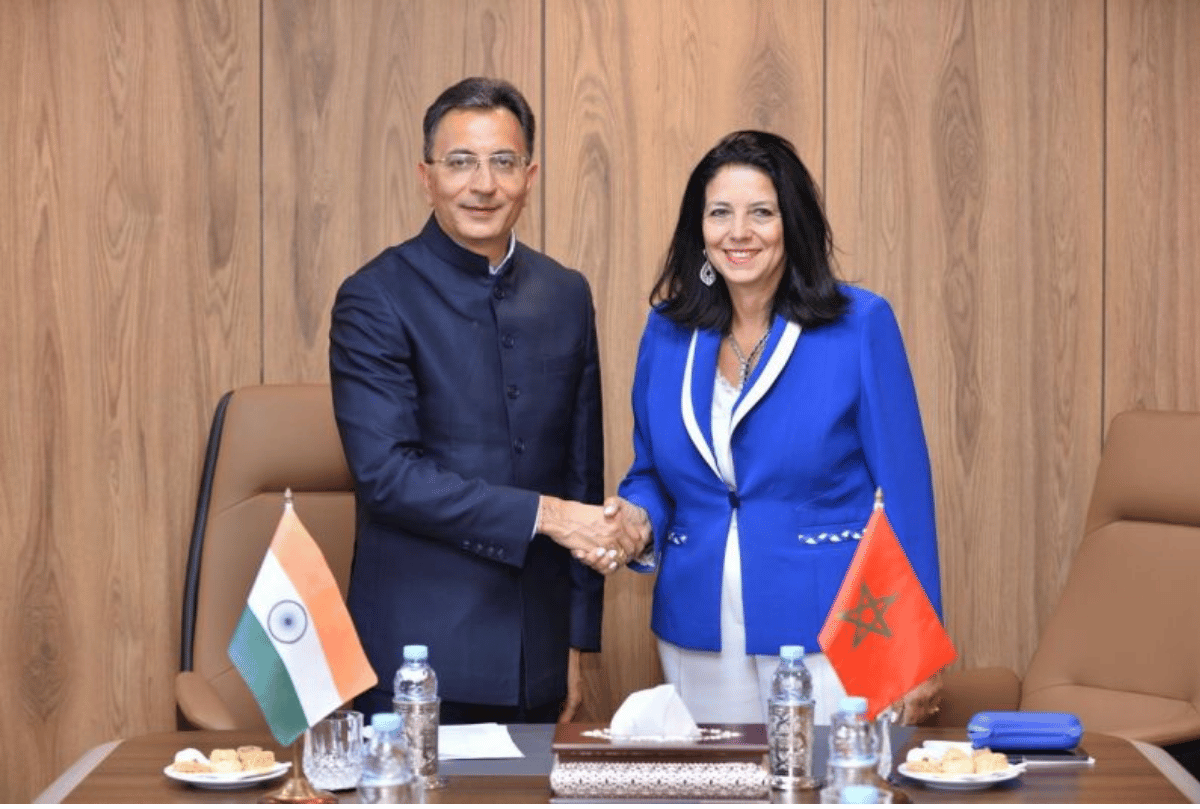
The discussions took place in Rabat on August 24, 2026, between Morocco’s Minister Delegate for Digital Transition and Administration Reform Amal El Fallah Seghrouchni and India’s Minister of State for Trade and Industry and Electronics and Information Technology Jitin Prasada.
Joint commission to focus first on language technologies
A key outcome of the meeting was an agreement to establish a joint commission, with an initial focus on language technologies.
The proposed cooperation will explore solutions capable of supporting multiple languages, language variants and dialects.
The objective is to improve how citizens interact with public administrations and make digital government services more accessible across linguistically diverse communities.
This gives the planned partnership a practical public-service dimension beyond broader discussions around AI and digital transformation.
AI and digital public infrastructure form wider cooperation agenda
The two sides also discussed opportunities to expand cooperation in artificial intelligence and digital public infrastructure.
These areas are becoming increasingly important as governments seek to modernise public services, improve interoperability and build more scalable digital platforms.
The discussions suggest Morocco and India are looking at cooperation that could span both underlying digital infrastructure and the AI systems that operate on top of it.
JAZARI Institutes included in talks
Officials also discussed potential collaboration involving Morocco’s JAZARI Institutes and their work in artificial intelligence.
The source does not provide details on specific projects, funding commitments or implementation timelines linked to the institutes.
However, their inclusion points to a possible research, skills and institutional dimension to the wider bilateral partnership.
Talks build on February meeting in New Delhi
The Rabat meeting follows earlier discussions between Seghrouchni and Prasada in New Delhi in February 2026.
That meeting took place on the sidelines of the AI Impact Summit.
The latest engagement indicates that both sides are attempting to move from initial dialogue towards a more structured cooperation framework.
The establishment of a joint commission is an important step in that process because it creates a mechanism through which individual projects can be identified and developed.
Digital talent development also on agenda
Digital skills and talent development form another part of the proposed cooperation.
For Morocco, building a stronger pool of AI and digital professionals is central to supporting wider public and private-sector transformation.
India, meanwhile, brings significant experience in large-scale digital systems, technology services and digital skills development.
Closer cooperation could therefore support knowledge exchange, training and institutional collaboration, although no specific programmes have yet been announced.
Why this matters
The Morocco-India discussions are significant because they combine three areas that are increasingly being developed together: AI, digital public infrastructure and digital skills.
Language technologies are particularly relevant for public-sector digitalisation because government platforms are more useful when citizens can interact with them in the languages and dialects they actually use.
For Morocco, cooperation with India could also provide access to expertise in large-scale digital systems and public digital infrastructure while supporting its own ambitions in AI and digital government.
Editor’s note
The most important development is the move towards a formal joint commission rather than another broad statement of intent.
The initial focus on language technologies is also strategically interesting because it targets a concrete barrier to digital inclusion: the gap between government platforms and the linguistic diversity of the populations they serve.
The next test will be whether the commission produces specific pilots, technical partnerships or institutional programmes around AI, digital public infrastructure and the JAZARI Institutes. That will determine whether the cooperation evolves into a substantive bilateral technology partnership.