









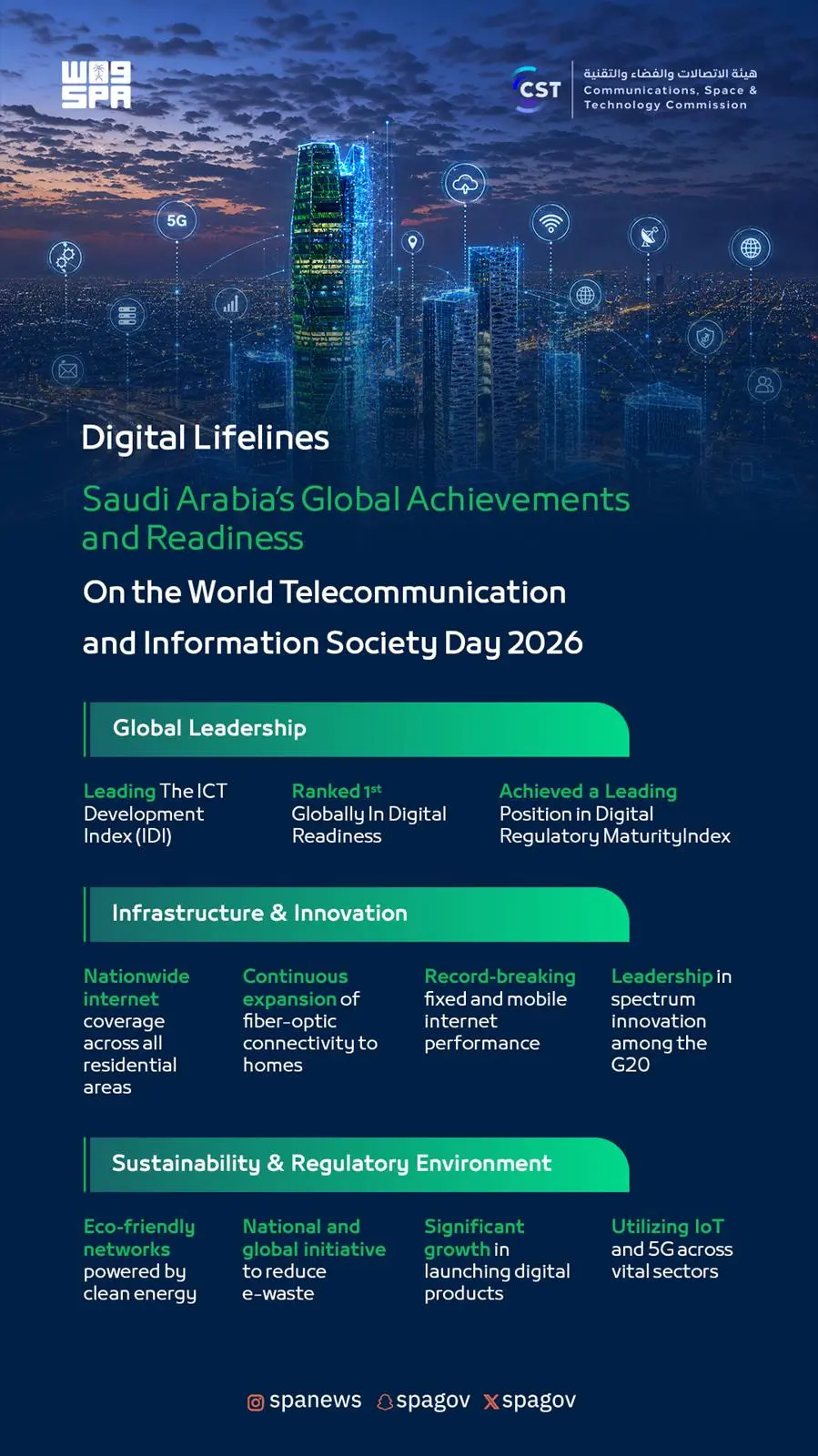
Saudi Arabia marked World Telecommunication and Information Society Day 2026 by highlighting major advancements across its ICT sector, reinforcing the Kingdom’s position as one of the region’s leading digital economies and a rising global technology player.
The achievements underscore Saudi Arabia’s accelerating progress in digital infrastructure, telecommunications, spectrum management, space technologies, and regulatory modernization under the Kingdom’s broader Vision 2030 transformation agenda.
According to the Saudi Press Agency (SPA), the Kingdom’s ICT sector continues to play an increasingly important role in national economic diversification, innovation development, and digital society enablement.
Digital Economy Becomes a Core Driver of National Growth
Saudi Arabia stated that the ICT sector has become a major contributor to GDP growth, supported by what it describes as the region’s largest and fastest-growing telecommunications and technology market.
The Kingdom has significantly expanded digital infrastructure capabilities in recent years through nationwide connectivity investments, fiber optic network deployment, cloud ecosystem development, and advanced wireless technologies.
Internet coverage now extends across all residential areas, while fixed and mobile broadband speeds continue reaching record levels through ongoing infrastructure modernization efforts.
Saudi Arabia also maintained its leadership position among G20 countries in total mobile communications frequency spectrum allocation, reinforcing its aggressive spectrum strategy aimed at accelerating next-generation wireless services and innovation ecosystems.
Space and Direct-to-Device Connectivity Gain Strategic Momentum
The Kingdom also highlighted progress in space and satellite-related technologies, including becoming the first country globally to successfully test seamless direct-to-device (D2D) connectivity capabilities.
The development reflects growing regional focus on non-terrestrial networks (NTN), satellite communications integration, and next-generation connectivity models designed to support broader digital inclusion and resilient communications infrastructure.
Saudi Arabia’s Communications, Space and Technology Commission (CST) also launched the country’s first national Earth Observation (EO) data marketplace, enabling sectors to utilize AI-powered satellite image analytics and geospatial intelligence capabilities.
The initiative aligns with increasing government interest in combining AI, satellite technologies, and data platforms to support economic planning, environmental monitoring, smart infrastructure, and national resilience strategies.
Regulatory Leadership Strengthens Saudi Arabia’s Global Position
Saudi Arabia emphasized its strong international rankings across multiple digital development indicators, including the Digital Readiness Index, ICT Development Index (IDI), and the Digital Regulatory Maturity Index.
The Kingdom ranked second globally in digital regulatory maturity, reflecting continued efforts to modernize telecommunications regulation, digital governance frameworks, and technology policy environments.
Regulatory modernization has become a key pillar of Saudi Arabia’s digital transformation strategy as the country seeks to attract investment, accelerate innovation, and position itself as a regional technology and connectivity hub.
Expanding Vision for a Digitally Enabled Future
Saudi Arabia’s rapid digital progress reflects broader ambitions to become a leading global player in advanced technologies including AI, cloud computing, smart infrastructure, space technologies, and digital public services.
The Kingdom continues investing heavily in infrastructure, innovation ecosystems, startup development, and next-generation connectivity as it accelerates transition toward a knowledge-based economy.
Editor’s Note
Saudi Arabia’s digital transformation strategy is increasingly moving beyond traditional telecom modernization into a broader national technology positioning effort. The Kingdom’s growing focus on AI, satellite connectivity, spectrum leadership, and regulatory maturity reflects an ambition to become a globally competitive digital infrastructure and innovation hub capable of shaping future regional technology ecosystems.