






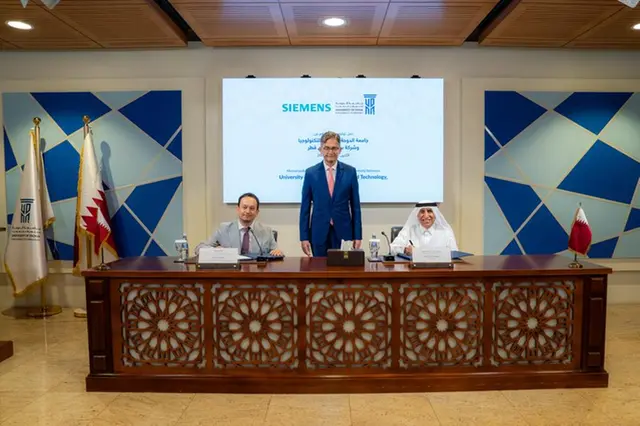
The University of Doha for Science and Technology (UDST) has signed a memorandum of understanding (MoU) with Siemens to establish a Smart Grid Living Lab, creating a collaborative platform for research, innovation and workforce development in next-generation energy technologies.
The initiative will provide students, researchers and industry partners with a real-world environment to develop, test and validate smart grid technologies, supporting Qatar’s efforts to modernize its energy infrastructure while preparing the workforce for the digital energy transition.
The partnership reflects the growing convergence of digital technologies, artificial intelligence and power systems as utilities worldwide move toward more intelligent, efficient and sustainable electricity networks.
Smart Grids Power the Future of Energy
Electricity networks are evolving from traditional one-way distribution systems into intelligent, digitally connected infrastructures capable of responding to real-time changes in supply and demand.
Smart grids integrate advanced sensors, Internet of Things (IoT) devices, artificial intelligence and data analytics to improve grid reliability, optimize energy distribution and support renewable energy integration.
Living labs provide an environment where these technologies can be tested under realistic operating conditions before wider commercial deployment.
Industry analysts view smart grids as a critical foundation for future digital economies and sustainable energy systems.
Bridging Academia and Industry
The Smart Grid Living Lab strengthens collaboration between higher education and industry by connecting academic research with practical engineering applications.
Students gain hands-on experience with advanced energy technologies, while researchers and industry partners can jointly develop innovative solutions to address emerging challenges in power generation, transmission and distribution.
Such partnerships help accelerate technology commercialization while ensuring graduates develop the skills required for an increasingly digital energy sector.
Industry collaboration has become an essential component of modern engineering and technology education.
Supporting Qatar’s Digital and Energy Transformation
The initiative aligns with Qatar’s broader strategy to diversify its economy through innovation, advanced technologies and sustainable infrastructure.
As the country expands investments in smart cities, renewable energy, artificial intelligence and digital infrastructure, intelligent energy systems are becoming increasingly important to ensuring reliable and efficient power delivery.
The collaboration with Siemens supports these objectives by fostering local expertise while encouraging innovation in digital energy technologies.
The project also contributes to Qatar’s ambition to strengthen research and development capabilities in strategic sectors.
Building the Workforce for Intelligent Utilities
The energy sector is undergoing rapid digital transformation driven by automation, AI, cybersecurity and connected infrastructure.
Developing skilled engineers and technology professionals capable of designing and managing intelligent utility systems will be critical to supporting future energy networks.
Living labs enable experiential learning that bridges theoretical knowledge with operational expertise, helping prepare graduates for careers in smart infrastructure, industrial automation and digital energy management.
As utilities become increasingly data-driven, workforce development will remain central to successful energy transition strategies.
Why This Matters
Smart grid technologies are reshaping electricity infrastructure by improving efficiency, reliability and sustainability through digital innovation. University-industry partnerships play a crucial role in developing both the technologies and the skilled workforce needed to support this transition.
For UDST, the partnership with Siemens strengthens its role as a center for applied research and advanced engineering education. For Qatar, the Smart Grid Living Lab supports national ambitions to build a digitally enabled, sustainable energy ecosystem while preparing the next generation of talent for the future of intelligent infrastructure.
Editor’s Note
The energy transition is no longer driven solely by renewable generation; it is increasingly powered by digital intelligence. Smart grids combine AI, automation, IoT and advanced analytics to create electricity networks that are more resilient, efficient and responsive. Establishing living labs such as the one at UDST provides an important bridge between research and real-world deployment, enabling innovation to move more quickly from the classroom to critical infrastructure. As countries invest in smarter, cleaner energy systems, partnerships between academia and technology leaders will be essential to building both the solutions and the skilled workforce needed for the digital energy economy.