





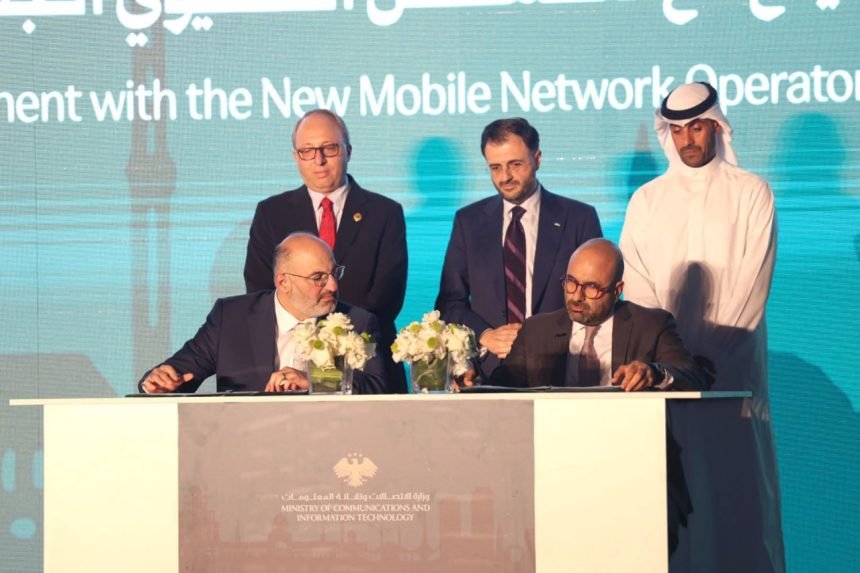
Zain Group will launch mobile telecommunications services in Syria within six months of receiving its operating licence, with commercial operations expected to begin in early 2027, marking one of the country’s largest telecommunications investments and a major step in rebuilding its digital infrastructure.
According to Syria’s Telecommunications and Post Regulatory Authority (TPRA), Zain has been awarded a renewable 20-year licence valued at $747 million, alongside $10 million in first-year optional spectrum fees. The regulator estimates the project will generate approximately $800 million in direct and indirect investment over the next seven years, bringing the total value of the initiative to more than $1.5 billion.
The investment is expected to expand mobile coverage, improve service quality and introduce next-generation mobile technologies as Syria accelerates efforts to modernize its telecommunications sector.
New Operator to Expand Competition and 5G Deployment
The new mobile operator will be majority owned by Zain Group (75%), while Syria’s sovereign wealth fund will hold the remaining 25% stake.
According to the regulator, the operator will play a key role in expanding nationwide mobile coverage, improving network quality and introducing 5G services, while creating new employment opportunities and increasing competition within Syria’s telecommunications market.
Greater competition is expected to encourage further investment in network infrastructure and improve digital services for consumers and businesses.
Syria Pursues Comprehensive Network Modernization
The launch forms part of a broader national telecommunications strategy focused on upgrading digital infrastructure.
The regulator said Syria plans to deploy standalone 5G networks while simultaneously modernizing existing 4G infrastructure, alongside the gradual retirement of legacy 2G and 3G networks.
This dual-track approach is intended to improve network performance while preparing the country’s telecommunications sector for future digital applications, including cloud services, AI and enterprise connectivity.
Modern mobile infrastructure is increasingly viewed as foundational to national digital transformation strategies.
Fiber and International Connectivity Projects Complement Mobile Expansion
Beyond mobile services, Syria is advancing several large-scale connectivity initiatives designed to strengthen fixed broadband and international internet capacity.
Among them is the Silk Link project, being developed in cooperation with Saudi Arabia’s stc, with planned investments approaching $1 billion.
The complementary Barq Net initiative will deploy a 4,500-kilometre fiber-optic backbone delivering fiber-to-the-premises (FTTP) connectivity for homes and businesses while linking the network to an international submarine cable.
Together, these projects aim to improve internet performance, support reconstruction efforts and attract international investment in digital infrastructure.
Positioning Syria as a Regional Digital Gateway
The telecommunications modernization programme is also intended to improve Syria’s investment environment and attract global technology companies.
Authorities envision expanded partnerships in areas including data centres, cloud services and digital infrastructure, with the long-term objective of positioning Syria as a regional digital connectivity corridor linking the Middle East, Asia and Europe.
The strategy reflects a broader regional trend in which countries are investing simultaneously in mobile networks, fiber infrastructure and AI-ready digital ecosystems.
Why This Matters
Telecommunications infrastructure is becoming a critical foundation for economic recovery, digital transformation and foreign investment. Large-scale investments in mobile networks, fiber connectivity and 5G create the capacity needed to support cloud computing, AI, digital government and enterprise innovation.
For Syria, Zain’s entry into the market represents a significant step toward modernizing the country’s telecommunications sector while attracting more than $1.5 billion in associated investment. For the Middle East’s telecom industry, the project highlights the continued importance of infrastructure investment, market competition and next-generation connectivity in enabling long-term digital development.
Editor’s Note
Syria’s telecommunications strategy reflects a broader regional shift from rebuilding connectivity to building future-ready digital infrastructure. Rather than focusing solely on expanding mobile coverage, the country is combining investments in 5G, fiber-optic networks, international connectivity and data infrastructure to create a more resilient digital ecosystem. If successfully implemented, these projects could improve Syria’s digital competitiveness while creating new opportunities for technology investment, cloud services and AI-enabled applications. As countries across the Middle East race to strengthen digital infrastructure, integrated investments across mobile, fiber and data infrastructure are becoming the defining blueprint for long-term digital transformation.