






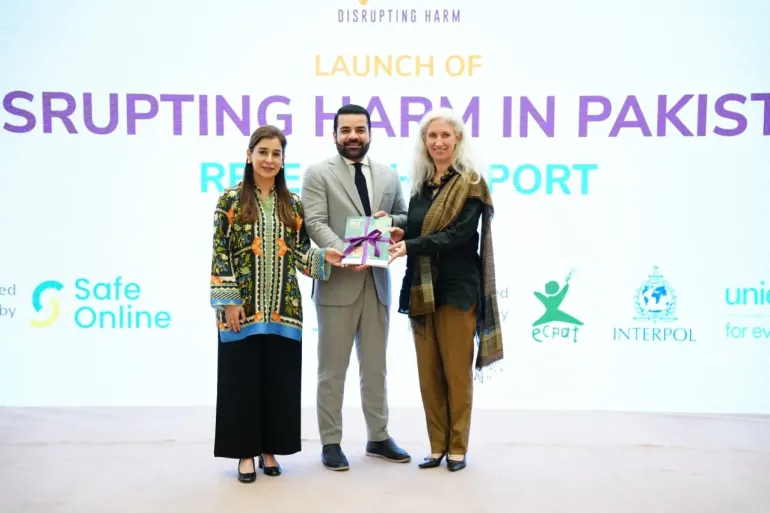
Nearly one in 16 internet-using children aged 12 to 17 in Pakistan experienced at least one form of technology-facilitated sexual exploitation and abuse within a single year, equivalent to around 1.5 million children, according to new research from UNICEF Innocenti, ECPAT International and INTERPOL.
The findings are published in the report Disrupting Harm in Pakistan: Evidence on Technology-Facilitated Child Sexual Exploitation and Abuse, funded by Safe Online.
The research draws on a nationally representative household survey of children aged 12 to 17 and their parents and caregivers, alongside interviews with frontline and justice professionals and an assessment of Pakistan’s legal and policy framework.
Abuse includes blackmail, image sharing and AI-generated content
The report documents several forms of technology-facilitated abuse.
These include unwanted sexual images or conversations, requests for children to share images of private parts, the distribution of children’s images without consent, and threats or blackmail involving sexual images or activity.
It also identifies the use of artificial intelligence to create fake sexual images or videos involving children as an emerging risk.
The findings highlight how the rapid evolution of digital tools is creating new forms of abuse while also complicating detection, reporting and enforcement.
More than half of affected children told no one
One of the most significant findings is the extent to which abuse remains hidden.
More than half of children who experienced technology-facilitated sexual exploitation and abuse did not tell anyone what had happened.
None of the children surveyed reported their experience through formal channels such as helplines, social workers or police.
The report links this underreporting to stigma, victim-blaming and lack of trust in law enforcement and formal support systems.
This points to a major gap between the existence of legal protections and children’s ability or willingness to use them.
Most perpetrators were known to the child
The research also challenges the common perception that online sexual abuse is mainly a threat from strangers.
In 85% of incidents cited by children, the perpetrator was someone the child already knew.
That finding suggests that prevention strategies focused only on anonymous online threats may miss a large part of the risk environment.
Social media platforms accounted for 44% of reported instances of abuse, making them the most commonly cited digital environment in the study.
Boys and girls affected at similar rates
The report found that girls and boys in Pakistan experienced technology-facilitated sexual exploitation and abuse at similar rates.
However, their experiences and barriers to disclosure can differ.
ECPAT International said boys may be particularly overlooked because stigma and expectations around masculinity can discourage them from identifying themselves as victims or seeking help.
The report therefore calls for child protection systems to account for gender-specific barriers rather than assuming one uniform experience of abuse.
UNICEF calls for stronger system-wide protection
UNICEF said responsibility for online safety should not rest on children alone.
The organisation called for stronger laws suited to the digital environment, greater accountability for online platforms, safety-by-design measures and child-centred justice systems.
It also stressed the need for confidential and accessible reporting channels, stronger institutional capacity and better support for children and families.
UNICEF Representative in Pakistan Pernille Ironside said the focus should move from simply telling children to avoid risk toward building stronger systems that prevent abuse and hold perpetrators and platforms accountable.
Legal framework exists but implementation remains challenge
The report says Pakistan has an existing legal foundation for protecting children from online exploitation and abuse.
However, implementation remains a major issue.
National Commission on the Rights of the Child Chairperson Ayesha Raza Farooq said the priority is ensuring children and families can access justice and that institutions have the capacity and resources to respond effectively and sensitively.
The findings point to gaps in reporting, law enforcement, victim support and criminal justice responses, despite the presence of formal legal protections.
Why this matters
The scale of the findings makes technology-facilitated child sexual abuse a major digital safety and public policy issue in Pakistan.
The estimate of around 1.5 million affected children shows that the problem is not confined to isolated cases, while the extremely low level of formal reporting suggests that official statistics may capture only a small fraction of actual abuse.
The finding that most perpetrators were known to the child is also important because it shifts the focus away from simple “stranger danger” messaging toward broader prevention, education and safeguarding measures.
Editor’s note
The most concerning element of the report is not only the prevalence of abuse, but the gap between exposure and formal help-seeking.
A protection system cannot be judged only by whether laws exist. It must also be judged by whether children trust it, can access it safely and receive meaningful support when they do.
The rise of sexual extortion, AI-generated abuse material and platform-based exploitation also means Pakistan’s response will need to evolve alongside technology. The key indicators will be stronger reporting pathways, better investigative capacity, greater platform accountability and whether child protection mechanisms become accessible enough for victims to actually use them.